Needful Things
By Stephen King
Copyright 1991
In the novel, Needful Things, Stephen King brings the saga of the town of Castle Rock, Maine to a head. Castle Rock has always been an uneasy little town. A local celebrity psychic helped catch a serial killing cop. Joe Camber’s big Saint Bernard went bad and killed a kid, celebrity writer Thad Beaumont lost his home and eventually his wife and child in a strange series of events, and local institution, Pop Merrill, went up in a ball of flames with his Emporium Galorium. Castle Rock is an uneasy place with a lot of tension building up.
King opens his final Castle Rock novel by telling us, we’ve been here before. He takes us on a tour of the town and introduces us to the principle players. The big story in Castle Rock at the moment is the building feud between the Catholics and the Baptists over the Catholic church’s intention to hold a casino night fundraiser. For Baptists, the devil and dice are one and the same.
Meanwhile, Sheriff Alan Pangborn is in the final stages of grieving for his lost family. As he battled Thad Beaumont’s unholy twin, his wife was fighting her own battle. She was suffering from nearly crippling headaches. But Alan was too engaged in the Beaumont business to notice. Later, when she crashed the car, killing herself and their only child, Alan was left with painful 20/20 hindsight.
He has found love once again with Polly Chalmers, owner of a local dress making shop. Polly suffers from exceptionally painful and debilitating arthritis in her hands. She also suffers from guilt from a very dark secret she harbors involving the death of a child she bore out of wedlock in the 1970s.
Like all parochial small towns, Castle Rock is rife with petty grudges and sleights. There is corruption and jealousy, all waiting to be exploited.
The plot gets moving much as it did in ‘Salem’s Lot with the announcement that a new store is coming to town. The locals are all sure it is another antique store that will sell second rate merchandise to rook tourists. But, with news and gossip being at a premium in a small town, its arrival generates interest and excitement.
The first to enter Neeful Things is 11 year old Brian Rusk. He meets Leland Gaunt, an elderly and stately gentleman from Akron who is setting up his merchandise, who is the store’s proprietor. Brian is immediately drawn to Gaunt’s collection of sports cards. Brian is looking for one card in particular – a 1956 Topps Sandy Koufax. To Brian, it is the holy grail of cards.
It just so happens that Gaunt has that particular card, autographed by Koufax. Serendipitously, it is signed, “To Brian.”
Brian is excited by his incredible find, then immediately crestfallen by his knowledge that he couldn’t possibly come up with the funds for such a purchase. But Leland Gaunt offers him a special deal. He takes Brian Rusk’s pocket change and a “favor,” to be called it at a later time
Over the next several days, many of Castle Rock’s citizens, from its esteemed (and corrupt) head selectmen to the town mouse who is out on parole after murdering her husband in self defense. Each finds the improbable desire of their dreams. Each dream is for sale at a reasonable price, and a “favor,” to be called in later.
Leland Gaunt has set in motion a series of events that will stoke the Catholics and the Baptists, the petty grievances of Castle Rock residents, and bring the underlying anger of the town to a boil.
Gaunt has arranged for each person to play what would seem to them, mean, but harmless pranks on people they hardly know. At the scene of each prank is left a clue to point the victim in the wrong direction – in the direction of the person with whom they are angry or hold a grudge.
Polly Chalmers is among those who have visited Leland Gaunt’s Neeful Things. To Polly, Mr. Gaunt provides an ancient charm on a chain from the Middle East. It is a talisman to ward of the pain that has left Polly crying in bed for days at a time. She pays $40.00 and promises to play a trick on the town’s former resident bad boy who is on his way back home.
Events get underway when mousy Nettie Cobb, who has just arrived home to find her precious dog stabbed to death, ostensibly by a bitchy neighbor, meets that Wilma Jerczyk, who is sure it is Nettie who has thrown mud on her drying sheets. The two meet in the street armed with knives and cleavers. There, they die at each other’s hand, not knowing that it was the town maintenance man who stabbed Nettie’s dog as his payment to Gaunt, and Brian Rusk who tossed the mud in exchange for the Koufax card.
Nettie worked for Polly at her sewing shop and she is devastated by her death. She and Alan discuss grief and loss and find themselves brought closer than ever by their mutual suffering and the therapy of the other’s comfort. Polly comes close to telling Alan what happened with her son when she lived in San Francisco, but decides not to, out of shame.
Tensions between the Catholics and the Baptists builds as pranks our pulled and threats levied. The Catholics promise swift and harsh retribution should the Baptists interfere with their fundraiser. The Baptists promise to shut down the gambling den by all means necessary.
With all of his wares now in circulation and his markers coming in, Leland Gaunt puts out the help wanted sign because he’s expanded his inventory to meet the new demand – demand for instruments of retribution. The man who excepts Gaunt’s help wanted solicitation is none other than Ace Merrill, who long ago tormented Gordie Lachance and his buddies as they searched for the body of a kid along the railroad tracks. Ace is back in town, on the run from coke dealers whom he owes a lot of money. He’s just completed a four year sentence at Shawshank Prison where Sheriff Alan Pangborn has put him.
Ace’s first mission is to travel to Boston to pick up a load of pistols, automatic weapons, and ammunition. This is Gaunt’s new inventory to be sold out the back door of the shop.
Other tensions are simmering in town as well. The head selectman, Dan Keeton, has helped himself to a sizeable chunk of the town treasury to play the ponies in Lewiston. The state auditors are on his tale and his doom is at hand. But Leland Gaunt has offered him the means of financial salvation and promise of aid in his battle against those who are persecuting him.
Alan puzzles over Nettie Cobb’s death. The solution seems obvious, but the clues don’t quite add up right. He knows there was a “witness” because a neighbor told Alan she saw Brian Rusk leaving the scene on his bike. Alan approaches Brian, who is now so guilt stricken and paranoid that he’s barely coherent. Alan tries to talk to Brian who seems almost desperate to reveal what he knows. But at the last minute, Brian rides off on his bicycle. He goes home and shoots himself in the head with his dad’s shotgun while his little brother looks on.
Sure that Brian Rusk was the key to the mystery of the death of Nettie Cobb and Wilma Jerczyk, Alan travels to the hospital in Lewiston to interview Brian’s brother who is in a state of shock. Meanwhile, somebody has played a trick on Polly. She arrives home to find a letter from the California child welfare agency to Alan and cc’d to her telling Alan that his inquiries into the death of Polly Chalmer’s child are improper and illegal. She goes to see Leland Gaunt who encourages her to break it off with the prying sheriff. She calls Alan and tells him off.
While Alan is away, the tension in Castle Rock explodes as people set forth from their homes, seeking vengeance against those who they believed have wronged them with a hurtful or destructive prank. They all stop in to see Leland Gaunt on their way. Gaunt is more than happy to sell them what they think they need. The slaughter starts.
There are shootings and stabbings all over town. The Baptists and Catholics, each attacked in their respective churches with stink bombs, meet on the field of battle in the town park. The state police who try to break it up are caught up in the melee.
After delivering the weapons, Ace Merrill goes treasure hunting, looking for where is uncle Pop Merrill buried his reputably large stash. He uses a map provided by Mr. Gaunt. Eventually, that map leads him to the old Camber farm where Cujo terrorized Donna and Tad Trenton over those two hot summer days in 1983. There, he digs until he finds a can. In that can is a note from Sheriff Pangborn informing Ace that he has beat him to the treasure. Ace is hell bent on revenge against the sheriff.
Ace Merrill, town thug, hooks up with Dan Keeton, leading citizen, to lay waste to Castle Rock once and for all. Keeton opens the town storage building and they grab all the dynamite they can carry and proceed to set time bombs all over town.
Alan is finally able to talk to Brian’s brother who tells him of Brian’s final warning. Brian told his little brother to avoid Needful Things, to avoid Leland Gaunt. What Gaunt sold was poison and he wasn’t human. Alan heads back to Castle Rock, certain that Gaunt is behind what is happening.
Meanwhile, Polly has an epiphany. She watches events unfold in town and knows that Gaunt is behind it. She knows that she has played a role in it and knows that if she keeps the charm around her neck, it will cost her her soul. She removes the charm and embraces her pain. The creature that dwells within the charm escapes and she kills it in the bathtub. She realizes she must find Alan and put things right with him.
Alan arrives in Castle Rock just as the bombs are detonating. Building after building goes up in a ball of flames. He heads straight for Needful Things and finds it abandoned and covered with dust, as if it had been years since anyone had been in. On the counter, he finds a television and VCR with an envelope attached.
In the envelope is a letter from Leland Gaunt who tells him that the tape in the VCR shows the final moments of his wife and son’s life and will close the door on the mystery of what happened in that car when it inexplicably ran off the road, killing Alan’s family.
Polly arrives and tries to convince Alan not to watch. He does and sees Ace Merrill run his wife off the road and into a tree where they are killed. Alan now wants nothing more than to kill Ace. Polly pleads with Alan, telling him it’s all false, like her cure. Alan pauses for a second and carefully goes over what he saw. He finds the inconsistency in what he knows happened and what’s on the tape
He and Polly leave Neeful Things. As they walk out, Ace Merrill grabs Polly and puts a gun to her head. He demands that Alan turn over the money he stole. As they face off, Ace is gunned down by one of Alan’s deputies.
As this is happening, Leland Gaunt tries to slip out of town, carrying with him an ancient valise. Alan confronts him and, using the white magic of an amateur magician, uses sleight of hand to snag the valise. It squirms and shakes with the souls Gaunt has gathered over the centuries of selling people needful things in exchange for those souls. Alan demonstrates to Gaunt that his white magic is more powerful than his and Gaunt flees in his Tucker Talisman. As he flees, the car morphs into an ancient, horse drawn carriage manned by a hunchback dwarf.
As he leaves, those Catholics and Baptists still standing stop their fighting. The anger has dissipated. Fires rage all over town as it slowly burns to the ground. The Castle Rock we once knew exists no more.
The story ends with the announcement of a new shop opening in a small town in rural Iowa. The residents are gossiping about what the new proprietor might be selling.
So ends the story of Castle Rock – the setting of some of King’s best early work. King has stated that he felt like he was visiting that strange little town too frequently. He feared his writing would stagnate if he stuck with it, so he decided to do away with it and do away with it in style.
Needful Things is never mentioned when people discuss King’s great works and I think it gets short shrift. It is an incredibly complex plot with an astounding number of fully developed characters. It’s set in a town well known and loved by fans of King’s work. Its villain is superb. It’s a weighty tome of almost 700 pages, but there’s nary a wasted word.
We see in King's story the nature of a small town where everybody knows everybody else's business and secrets (like that held by Polly Chalmers) are a premium. King reveals the power of coveting what we want and sometimes sacrificing what we need to get it. Finally, we see the power of white magic practiced by a law man over the black magic practiced by an ancient swindler and con man.
As with 'Salem's Lot, Castle Rock is more than a setting in this story. The town itself, the gestalt of its people, their hatreds and prejudices, its dark history, and its moral compass moves and acts as a character.
As King chugged along toward the end of the Dark Tower series, I was certain that Leland Gaunt was going to turn up somewhere. He had all the makings of a tower minion. Alas, he never appeared. The worlds of Castle Rock and the Dark Tower did not meet.
The book was made into a movie in 1993 that starred Ed Harris and Max Von Sydow. It wasn’t a box office smash and tepidly reviewed, but is a fun movie that is a little more “preachy” than the book.
The publication of Needful Things marked a distinct turning point in King’s writing. He quit writing pure horror stories and tried to be more socially relevant and mature. There would be no more monsters. His work went more mainstream. He went through a horrible feminist phase with his next few books and for the first time, he was writing bad books. It wasn’t until 1996 when The Green Mile was published that King would again turn out a worthwhile novel.
Saturday, December 24, 2011
Sunday, December 11, 2011
Book to Radio: The Martian Chronicles

Book to Radio: The Martian Chronicles
By Ray Bradbury
Dimension X radio broadcast
Radio play by Ernest Kinoy
Broadcast Date: August 18, 1950
This episode of Dimension X opens with Rocket Summer as a child watches in fascination as the first rocket takes off for Mars.
Ylla begins to have her dreams of men from the third planet coming to visit her. She begins to sing a song that she doesn’t know without knowing how or why. Ylla’s husband becomes increasingly disturbed with her prescience regarding the coming of the earthmen. He takes a weapon and waits for the earthmen. He deals with them. . .
The story then jumps to the fourth Martian expedition where astronaut Spender finds that Martians have all been dead about a week – dead of chicken pox. Spender eloquently quotes poem So, we’ll Go No More A-Roving as he predicts that men will defile Mars as they have defiled Earth with liquor and boorish behavior.
The men of Earth came to Mars for work, for adventure, for a fresh start – and they came in masses. We then revisit There Will Come Soft Rains. It is nearly identical to the earlier broadcast in the opening, but we get to meet the family. In this version, with atomic war inevitable, they decide to jump into their rocket and head for Mars. The house continues its duties in isolation. But instead of the family being dead in the war, they have evacuated to Mars.
The story then jumps to the Off Season as Sam Parker operates the only hot dog stand on Mars. Parker is looking forward to the new settlers filling their pockets when they observe the earth melt in a ball of atomic fire.
The people of Mars rush the Luggage Store and then head home, deserting the red planet. Shortly after they leave, our family who has evacuated their automated home arrive. They travel down the canal and arrive in a deserted Martian town. They proclaim themselves Martians.
In just 24 minutes, writer Ernest Kinoy introduced the masses to Ray Bradbury’s seminal work. It hardly scratches the surface and omits its most famous chapter – the doomed third voyage to Mars. Nonetheless, Kinoy uses his paltry 24 minutes to do a decent job in telling Bradbury’s story of the rise and fall of man’s civilization on Mars.
Book to Movie: Cry for the Strangers (1982)
Directed by Peter Medak
Teleplay by J.D. Feigelsen based on the book, Cry for the Strangers by John Saul
In 1982, John Saul’s best seller was made into a made for television movie starring Patrick Duffy. To date, it’s the only movie ever based on his work. One could only hope that Hollywood has not ignored John Saul based on this movie, because it’s not his fault it’s as bad as it is.
From beginning to end, this movie is just terrible. It sticks with the basic premise of the Saul story, but there is zero character development (and I mean absolutely NO character development) and we are given no clues as to what is going on. It's just a bunch of stuff that happened.
Admittedly, Saul introduced some premises that he left on the table, such as biorhythms and Indian curses. But this movie just leaves them all on the table. The final scene is Patrick Duffy, who played Brad Russell, explaining the whole thing to his wife – and to the audience.
It’s almost as if J.D. Feigelsen wrote his teleplay, went back to proofread it, and saw he had major plot holes. So, instead of developing some action or sequences to explain why all of these strangers are dying, he just has Patrick Duffy do a little narrative in the end.
Feigelsen also manages to eliminate the central conflict in the story which is the conflict between Sheriff Whalen and the Russells and Palmers. Whalen – played by Brian Keith – is just a bit player who comes off as dispassionate and unconcerned about everything going on around him. He has no malice toward strangers. He doesn’t carry out any malicious acts against strangers. He just tells everybody he doesn’t know what’s going on. This movie really need an antagonist to carry it and it doesn't have one.
This movie had no character development, a broken, linear plot, and no conflict. It made for a boring, bad movie that no one should watch.
The only compliment that can be given to this horrid movie is it is well shot. The village looks cold and foreboding in every shot. But even that gets screwed up by Feigelsen and director Peter Medak. In the book, both the cabin and the house were without utilities. The house, while structurally sound, was as primitive as the cabin. In their version of the story, the cabin is cozy and the house is luxurious.
At every turn, Feigelsen and Medak took Saul’s pretty decent story and screwed it up. John Saul should be angry and embarrassed.
Hollywood should take another look at Saul’s body of work and take two or three of his stories that would make for good teleplays or even motion pictures. Certainly Punish the Sinners would transfer well to visual. The Blackstone Chronicles has mini-series written all over it. In the right hands, these stories could work on film. Feigesen and Medak are not the right set of hands.
Directed by Peter Medak
Teleplay by J.D. Feigelsen based on the book, Cry for the Strangers by John Saul
In 1982, John Saul’s best seller was made into a made for television movie starring Patrick Duffy. To date, it’s the only movie ever based on his work. One could only hope that Hollywood has not ignored John Saul based on this movie, because it’s not his fault it’s as bad as it is.
From beginning to end, this movie is just terrible. It sticks with the basic premise of the Saul story, but there is zero character development (and I mean absolutely NO character development) and we are given no clues as to what is going on. It's just a bunch of stuff that happened.
Admittedly, Saul introduced some premises that he left on the table, such as biorhythms and Indian curses. But this movie just leaves them all on the table. The final scene is Patrick Duffy, who played Brad Russell, explaining the whole thing to his wife – and to the audience.
It’s almost as if J.D. Feigelsen wrote his teleplay, went back to proofread it, and saw he had major plot holes. So, instead of developing some action or sequences to explain why all of these strangers are dying, he just has Patrick Duffy do a little narrative in the end.
Feigelsen also manages to eliminate the central conflict in the story which is the conflict between Sheriff Whalen and the Russells and Palmers. Whalen – played by Brian Keith – is just a bit player who comes off as dispassionate and unconcerned about everything going on around him. He has no malice toward strangers. He doesn’t carry out any malicious acts against strangers. He just tells everybody he doesn’t know what’s going on. This movie really need an antagonist to carry it and it doesn't have one.
This movie had no character development, a broken, linear plot, and no conflict. It made for a boring, bad movie that no one should watch.
The only compliment that can be given to this horrid movie is it is well shot. The village looks cold and foreboding in every shot. But even that gets screwed up by Feigelsen and director Peter Medak. In the book, both the cabin and the house were without utilities. The house, while structurally sound, was as primitive as the cabin. In their version of the story, the cabin is cozy and the house is luxurious.
At every turn, Feigelsen and Medak took Saul’s pretty decent story and screwed it up. John Saul should be angry and embarrassed.
Hollywood should take another look at Saul’s body of work and take two or three of his stories that would make for good teleplays or even motion pictures. Certainly Punish the Sinners would transfer well to visual. The Blackstone Chronicles has mini-series written all over it. In the right hands, these stories could work on film. Feigesen and Medak are not the right set of hands.
Monday, December 5, 2011
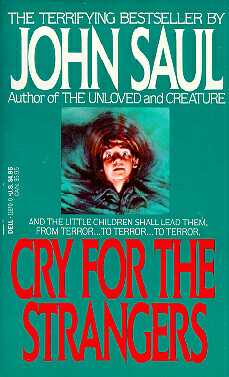
Cry for the Strangers by John Saul

Cry for the Strangers
By John Saul
Copyright 1979
Starting with his first book, Suffer the Children, John Saul almost relies on a template for constructing his stories. He opens with a prologue that describes some evil deed years prior. Then, he moves to present day and that evil is revisited upon his characters. Such is the formula in Cry for the Strangers.
The prologue is set on a stormy Washington beach. An older couple is buried up to their necks in the sand. The surf is pounding away at the shore as a storm builds. Each wave brings the tide closer to the helpless victims. Dark figures dance a ritualistic dance around them. A little boy watches from the seclusion of nearby woods.
The boy awakens the next morning to find his grandparents, with whom he lives, aren’t home. He runs to the beach to find them dead, drowned in the surf. A voice whispers, “Cry. . .Cry for them. . .and for me!”
We then flash forward to current time. Psychiatrist Brad Randall and his wife, Elaine, are looking for a quiet town where they can live for one year while Brad writes his book on biorhythms. They arrive in Clarks Harbor – a seemingly idyllic little town on Washington’s coast. It seems perfect.
While they are having lunch at the local inn, Brad is surprised to see the father of a former patient. Brad treated Glen and Rebecca’s son, Robby, for a mental disorder that made him incredibly hyperactive and destructive. Brad is surprised and pleased to learn that, since they moved to Clarks Harbor, Robby’s troubling malady has disappeared.
The Palmers love what Clarks Harbor has done for Robby, but it has not been good to them. People in Clarks Harbor despise outsiders. Glen is an artist trying to get an art studio up and running in the small fishing village, but has encountered passive resistance from residents who deliberately overcharge for services and deliver goods late. Were it not for Robby’s incredible cure, Glen tells Brad, they would not be in Clarks Harbor.
The only rental property available in the village is adjacent to the cabin being rented by the Palmers. Like the Palmers' cabin, it has no electricity or gas, but is habitable and has direct access to the beach. It is owned by the town sheriff, Harney Whalen who hates outsiders more than most residents of Clarks Harbor.
Whalen is being harassed by the wife of a fisherman who recently drowned, trapped in his own nets. The wife is certain that her husband’s death was not an accident. But Pete and Miriam Shelling are not natives to the town, having lived there but 15 years, so Whalen is not inclined to investigate too thoroughly.
A few days later, after warning Greg Palmer that bad things are in store for him and his family, Miriam Shelling hangs herself from a tree on the beach.
The Palmer children react differently to Clarks Harbor. Robby loves it. He loves the beach and he especially loves the storms when they blow him. They fill him full of energy and excitement and he enjoys venturing forth from the house to take them in.
The storms bring dark, disturbing images of ghosts dancing on the beach to his sister Missy, who hates Clarks Harbor and only accompanies her brother on his forays into the storms to avoid being left alone.
Whalen is troubled by the Palmers moving into a cabin down by the beach and he resolves that he won’t rent the house to the Randalls. Whenever strangers come to Clark’s Harbor, bad things happen to them. Whalen wishes strangers no ill will. He, and almost everybody else in town just want them to stay away.
Whalen meets the Randalls at the house and tells them how difficult life will be for them in the primitive home and in the village that hates strangers. He then rents the house to them, not remembering later that he did so. Harney Whalen has been subject to blackouts lately. He loses hours when he has no idea what he’s been doing or where he’s been. The Randalls return to Seattle for their belongings to relocate for a year.
Meanwhile, life for the Palmers gets a little easier. Robby and Missy endure the taunts and torments of their schoolmates who don’t like strangers any more than their parents. But Glen develops a friendship with Whalen’s only deputy, Chip and Chip helps him complete the remodeling of his art studio.
One evening a giant storm builds to the west and the fishermen of Clarks Harbor know to pull up anchor and head in. A pair of brothers who have ventured south get caught in the storm and head for Clarks Harbor. They make it in just before the storm. They check into the inn before the older brother returns to the harbor to secure the boat for the storm.
While he works to secure the boat, it is set free from its moorings. He tries to start the motor to bring it back into the harbor, but finds it was vandalized in the short time he was gone. He is helpless against the tide that soon smashes his boat against the rocks where it finally explodes, killing him.
Whalen investigates and his first inclination is to blame Glen Palmer for no other reason than he is not a native of the town. He finally concludes it was an accident. The younger brother wants a more thorough investigation, telling the sheriff that his brother was an experienced seaman and would not have been so careless. But Harney Whalen puts forth little effort in investigating the deaths of outsiders.
Whalen is also not happy that his deputy Chip – who is also his nephew – is getting friendly with Glen Palmer. One day, as Chip looks on, Whalen takes the please cruiser and uses it to splash mud onto the artwork Glen has displayed outside. He dares Glen to complain, which he does not.
Meanwhile, the Randalls move into their home down the beach. Shortly after their arrival, Jeff, the dead fisherman’s brother is found in the woods with his neck broken. The body is found on the Palmer’s property and again Whalen is inclined to blame Glen. But with no evidence, he can’t hold him.
Chip becomes concerned about his uncle. He can tell that Whalen is not himself and that there is definitely something unhealthy about his attitude toward strangers. One evening, he sits down with his grandfather who tells him the whole story about Harney Whalen.
Whalen’s grandparents owned a large chunk of the land that is Clarks Harbor, Chip’s uncle tells him. Harney’s grandparents leased the timber and mineral rights for some of the land to a company out of Seattle. When the lease came up for renewal, Whalen’s grandparents would not renew. Later, they were found dead on the beach, buried up to their necks in sand. Most people concluded the owner of the company carried out the murderous deed. But, as Chip’s uncle points out, the Indians that inhabited the area believed that man took from the sea and the sea demanded something in return – souls. Harney Whalen, Chip’s grandfather points out, is part Indian.
That night, a monster storm hits Clarks Harbor and Robby Palmer is driven to go outside and take in the sights and sounds of the storm that so enliven him. Missy tells her mother who ventures out into the storm with Missy in tow to find Robby before whatever got Jeff, got him. As they are searching, Missy feels a presence creeping up on them. She tries to warn her mother. Before she can, Rebecca is seized from behind. Missy flees into the storm and the mysterious entity breaks Rebecca’s neck.
Once again, a body has been found on the Palmer land. This time, it is Rebecca Palmer. Harney brings Glen in for questioning again. His mind is made up. Harney postulates that Glen caught Rebecca and Jeff making love on the beach and killed them. He has no evidence, circumstantial or otherwise, to back up the charge, but tries to force Glen to confess.
Brad and Elaine invite Glen and his children to stay with them at their house so they don’t have to be alone. That night, another storm moves in. Robby and Missy are distraught over the death of their mother and Robby suggests that they head back down the beach to their own home where they will be more comfortable.
They venture out into the storm and start through the woods adjacent to the beach. Once again, Missy senses the presence of evil around her. She looks around and sees ghostly figures dancing on the beach. Meanwhile, Harney Whalen is there, waiting, with the spirit of his dead grandmother exhorting him to avenge her death on the strangers. Harney attacks Robby.
Glen and the Randalls notice the kids missing. Elaine heads for town for help. Glen and Brad search the beach and the woods. After Elaine finds him, Chip heads for the beach and finds his uncle attacking Robby. He launches himself at his larger uncle and is able to wrest him away from Robby. After a brief struggle, Harney overpowers Chip. He gets up and walks into the ocean, never to be seen again.
This was a good book. That’s all I can say about it. What I like most about John Saul is consistency. He always writes a good book. He never writes bad ones, nor has he written a truly great one. There is no magnum opus or capstone work in John Saul’s library of 36 published titles. With a few exceptions, all rely on the standard Saul construct for a novel with different characters, settings and circumstances.
I’ve said in earlier reviews that Saul doesn’t flesh out his characters any more than is necessary to tell his story and none of the characters in this story are particularly deep. With the exception of Chip, none are introspective. We are left with the motivations and emotions at hand with no backstory.
A stylistic critique I’d level at this Saul work is how he writes from so many points of view. None of the main characters are a mystery to the reader and despite a few red herrings about Indian legends, it’s painfully obvious who the villain is. But being in Harney Whalen’s head was useless text. We were in his head when he was rational. He knew he was having blackouts and was concerned about it. Saul could have shown us that. If Saul needed to be an omniscient narrator, he should have taken us into Harney’s head when he was maniacal.
Saul does do a good job of creating the setting of the remote, unfriendly fishing village on the coast of Washington; constantly beset by storms and cold weather. Perhaps it’s because Saul grew up in Washington that he is able to set the scene so well.
Saul is fun and easy to read. I can breeze through his books in just a few sittings and the stories, while seldom enthralling, are well told and well written.
Cry for the Strangers was Saul’s third book. Like most authors, he improved over the years and wrote many books superior to Cry for the Strangers. Nonetheless, the book made for light, easy reading and I enjoyed it a great deal.
There was a made for television movie based on this story. To my knowledge, it is the only adaptation of a Saul story for any screen. I have not seen it, but it was apparently not well received by viewers and IMDB.com reviewers.
Labels:
Clarks Harbor,
Cry for the Strangers,
John Saul
Subscribe to:
Posts (Atom)