Comes the Blind Fury
By John Saul
Copyright 1980
A century ago, a young, blind girl walks along a path near her home. Familiar with the path, she is comfortable and happy making her way near a sheer bluff. But soon come the other kids to tease and taunt her because she is blind. She panics and stumbles over the bluff to her death. In her plummet to the beach below, she swears revenge.
One hundred years later, Michelle Pendleton moves to Paradise Point from Boston. Eager to enjoy small town life and make new friends, Amanda welcomes the move. Her father, Dr. Cal Pendleton, is there to take over the practice of the aging town doctor.
While moving in, Michelle finds an old china doll in a closet. She names the doll Amanda. She soon learns from her new friends that a little girl named Amanda once lived in her house and died after falling from the bluff. Amanda’s grave is quite well known in the town as his her mother’s whose stone has quite the cryptic inscription.
Michelle’s mother soon gives birth to Michelle’s new sister and events turn for Michelle. She is adopted and becomes painfully aware that her parents now have a biological daughter of their own. One day, she is at a picnic on the beach with several friends when a girl starts teasing her about being adopted. Michelle runs away, but trips on the bluff and falls. She is badly injured.
After a while, her physical injuries heal, but she maintains that she needs a cane to walk. She starts dressing in all black. Soon, she is an outcast and the kids routinely make fun of her. She seems not to care. After all, she has a new friend in Amanda who comes to show her things.
Soon, kids around Paradise Cove begin dying. Those who torment Michelle seem to die in unfortunate accidents or are outright murdered. The only person present when these deaths occur is Michelle. Soon, the past and the present converge, brought about by a vengeful spirit and a vengeful human bent on visiting his family curse upon a man he feels wronged him.
This is John Saul’s fourth novel and he employs what became his standard format for many of his books. Child wronged a hundred years ago seeks revenge by employing a child of today. The characters and circumstances are different, but, with a few exceptions, the same trope applies. Nonetheless, Saul has a way of telling a good story employing this framework again and again.
The story is much tighter than Saul’s earlier works. The evil is defined. The reason the past is important is part of the mystery that is brought nicely to fruition. The main character is two parts sympathetic, one part slacker. Saul did leave us with a taste of ambiguity that worked for the story. Did Michelle kill because she wanted to? Or did Amanda’s lust for revenge drive her to it.
All the usual Saul tropes are here. The weak, indecisive father. The ancient evil bent on revenge. The wife who has no idea what is going on around her. The small town cop who is friends with the family around which all the evil is transpiring. One could complain that Saul tells the same tale over and over again. Perhaps, but many great books are retellings of older books. Saul uses the same devices over and over again to tell decent stories. This is never going to earn him a spot in the pantheon of great horror writers who weave a different tale every time. But that does not make him any less fun to read and sometimes, it’s good to have fun while reading.
Showing posts with label John Saul. Show all posts
Saturday, June 10, 2017
Sunday, May 14, 2017
Suffer the Children By John Saul
Suffer the Children
By John Saul
Copyright 1977
A hundred years ago, in Port Arbello, Maine, an ugly and unspeakable crime happens. A little girl is raped and murdered by her father. Her body is never found. After committing the ghastly deed, the father promptly commits suicide. This is the curse of the Congers.
One hundred years later, the Congers still reside in the same home in Port Arbello, with nearby woods and a cliff falling to the ocean below. The old family fortune is dried up and Jack Conger publishes the town newspaper while his wife, Rose, sells real estate.
Jack Conger has committed his own crime. He does not remember the details, but the results are apparent. One day, a year before, he came out of the woods carrying the unconscious body of his younger daughter, Sarah. Since that day he attacked – but did not rape – Sarah, she has not spoken. She lives in her own world that only she understands.
The Conger’s older daughter, Elizabeth, is a well-adjusted 13 year old who is well behaved, does well in school, and takes very good care of her impaired sister.
There is tension in the Conger marriage as Jack’s crime has rendered him impotent – at least when it comes to his wife. Between their dysfunctional daughter – rendered so by Jack – and their marital problems, the Congers are always on edge with each other.
One night, a classmate of Elizabeth’s stumbles back into town, also unable or unwilling to speak. The local constabulary can find no evidence of an abduction or any other crime even though her father keeps pressing for a full investigation. Later, a second girl goes missing, lured to a remote cave by Elizabeth who is answering to another entity that has entered her head.
Elizabeth has been visiting a cave that is believed to only be legend. The cave is located along the cliff and is very hard to get to. There, she has found the skeleton of a young girl murdered 100 years before. The spirit of that girl speaks to Elizabeth through a Ouija board and takes control of her mind and body at night. She goes to the cave and stages tea parties with her captive, a dead cat, and the dead girl.
A third child, an eight year old boy, goes missing a few days later and the residents of Port Arbello are quite worried. The boy, like the girl, was lured to the cave by Elizabeth and forced to participate in the macabre ritual.
Meanwhile, young Sarah – who has been witness to many of Elizabeth’s crimes – is growing more agitated and acting out. Elizabeth’s activities go unnoticed as the Congers deal with their daughter, her school, and the school psychologist. Sarah becomes a suspect in the disappearances even though the police concede she is too small to have overpowered a teenage girl.
Events come to a head when a third kid goes missing. This time, it is the teenage son of the Congers’ new neighbors. Elizabeth eventually kills all of the kids she has imprisoned in the remote cave and manages to frame Sarah for the crimes when Sarah returns from the cave carrying a dismembered arm. Sarah is sent to a sanitarium while Elizabeth and her parents try to resume a somewhat normal life. The bodies of the missing kids are not found for many years until construction of apartments leads the sheriff to the remote cavern and the skeletal remains of four children.
Suffer the Children was John Saul’s first novel and sold more than a million copies. In the wake of the success of The Exorcist, books featuring young girls possessed or driven to evil took off in popularity. Witness the success of Audrey Rose and other titles like it. Saul’s manuscript was timely in its submission.
It also set a pattern for plotting that Saul would use over and over again throughout his career which has now apparently ended. He starts with a prologue taking place 100 years before where a child is either the victim of a crime or is the doer of a crime. Then that spirit is awakened and haunts or helps a child or children in the present. Not all his books are like this. But most follow this same format.
Suffer the Children succeeds on several levels. First and foremost, it is atmospheric. The remote, hidden cave and the ghastly scenes Elizabeth plays out are brilliantly written and absolutely creepy. The candle-lit macabre tea parties with Elizabeth’s rantings succeed in creeping out the reader.
The tension in the novel is well-developed. Saul usually develops his characters only to the point of making them interesting enough to the reader for the plot to work. There are no extensive backstories – al a Stephen King. But Saul goes above and beyond in developing his characters in Suffer the Children with Jack and Rose Conger. The tension in their marriage, their growing anxiety over Sarah’s increasingly bizarre behavior, their worry about the Conger curse, Jack’s affair with his secretary and their feelings of inadequacy as parents all serve to keep the tension high in Suffer the Children.
Saul falls short in what I believe to be an essential element of great horror: What was the nature of the evil? Although parts of the story are told from Elizabeth’s point of view, we are never really in her head. What drove her to do what she did? Was there an evil spirit, Beth, who contacted her through the Ouija board? Did finding the cave and the body of the dead girl lead to the possession? Or, was she just acting out the Conger curse because she had to be the perfect daughter in a home riddled with tension? Saul never lets us know exactly.
The actions and reactions of some of the characters are rather unbelievable. Why would Rose stay with and continue to love a man who inexplicably beat his daughter so badly that she was traumatized to the point of not talking? Why would Elizabeth, aware of her father’s crimes against her sister, continue to love and cherish a father who did that? Why would a chief of police continue a close friendship with that sort of person? None of that really makes sense, but is essential for Saul’s plot to work. A plot relying on implausible behavior is going to be weak.
Along that same point, nobody even has a private moral objection to Jack’s crime. Nobody privately thinks he is a drunken lout devoid of morality. Worse, people like his secretary and the chief of police tell him what he did wasn’t so bad because he didn’t rape her! If I knew someone like this, if I was force by business or decorum to be polite, I would. But my private feelings would be of loathing.
Why was Jack not arrested for his crime against his daughter? One might reason it was a different decade with different values, but I don’t buy it. Child abuse was child abuse in the 1970s. He got drunk and beat his daughter badly. He obviously did some serious harm to her psyche. It is clear that she was rape tested. Yet he is allowed to go on with his life like he was the perfect father. It just doesn’t work in real life or in fiction. It’s too implausible.
These shortcomings can all be explained by the fact that Saul was a young writer and this was his first novel. He got much better over the next several books with more believable character actions and reactions and more clearly defined evil. While Suffer the Children is not great horror, it is good horror carried by some excellent writing. It was good enough to establish John Saul as one of the top authors of horror fiction for four decades and worth the time spent reading.
By John Saul
Copyright 1977
A hundred years ago, in Port Arbello, Maine, an ugly and unspeakable crime happens. A little girl is raped and murdered by her father. Her body is never found. After committing the ghastly deed, the father promptly commits suicide. This is the curse of the Congers.
One hundred years later, the Congers still reside in the same home in Port Arbello, with nearby woods and a cliff falling to the ocean below. The old family fortune is dried up and Jack Conger publishes the town newspaper while his wife, Rose, sells real estate.
Jack Conger has committed his own crime. He does not remember the details, but the results are apparent. One day, a year before, he came out of the woods carrying the unconscious body of his younger daughter, Sarah. Since that day he attacked – but did not rape – Sarah, she has not spoken. She lives in her own world that only she understands.
The Conger’s older daughter, Elizabeth, is a well-adjusted 13 year old who is well behaved, does well in school, and takes very good care of her impaired sister.
There is tension in the Conger marriage as Jack’s crime has rendered him impotent – at least when it comes to his wife. Between their dysfunctional daughter – rendered so by Jack – and their marital problems, the Congers are always on edge with each other.
One night, a classmate of Elizabeth’s stumbles back into town, also unable or unwilling to speak. The local constabulary can find no evidence of an abduction or any other crime even though her father keeps pressing for a full investigation. Later, a second girl goes missing, lured to a remote cave by Elizabeth who is answering to another entity that has entered her head.
Elizabeth has been visiting a cave that is believed to only be legend. The cave is located along the cliff and is very hard to get to. There, she has found the skeleton of a young girl murdered 100 years before. The spirit of that girl speaks to Elizabeth through a Ouija board and takes control of her mind and body at night. She goes to the cave and stages tea parties with her captive, a dead cat, and the dead girl.
A third child, an eight year old boy, goes missing a few days later and the residents of Port Arbello are quite worried. The boy, like the girl, was lured to the cave by Elizabeth and forced to participate in the macabre ritual.
Meanwhile, young Sarah – who has been witness to many of Elizabeth’s crimes – is growing more agitated and acting out. Elizabeth’s activities go unnoticed as the Congers deal with their daughter, her school, and the school psychologist. Sarah becomes a suspect in the disappearances even though the police concede she is too small to have overpowered a teenage girl.
Events come to a head when a third kid goes missing. This time, it is the teenage son of the Congers’ new neighbors. Elizabeth eventually kills all of the kids she has imprisoned in the remote cave and manages to frame Sarah for the crimes when Sarah returns from the cave carrying a dismembered arm. Sarah is sent to a sanitarium while Elizabeth and her parents try to resume a somewhat normal life. The bodies of the missing kids are not found for many years until construction of apartments leads the sheriff to the remote cavern and the skeletal remains of four children.
Suffer the Children was John Saul’s first novel and sold more than a million copies. In the wake of the success of The Exorcist, books featuring young girls possessed or driven to evil took off in popularity. Witness the success of Audrey Rose and other titles like it. Saul’s manuscript was timely in its submission.
It also set a pattern for plotting that Saul would use over and over again throughout his career which has now apparently ended. He starts with a prologue taking place 100 years before where a child is either the victim of a crime or is the doer of a crime. Then that spirit is awakened and haunts or helps a child or children in the present. Not all his books are like this. But most follow this same format.
Suffer the Children succeeds on several levels. First and foremost, it is atmospheric. The remote, hidden cave and the ghastly scenes Elizabeth plays out are brilliantly written and absolutely creepy. The candle-lit macabre tea parties with Elizabeth’s rantings succeed in creeping out the reader.
The tension in the novel is well-developed. Saul usually develops his characters only to the point of making them interesting enough to the reader for the plot to work. There are no extensive backstories – al a Stephen King. But Saul goes above and beyond in developing his characters in Suffer the Children with Jack and Rose Conger. The tension in their marriage, their growing anxiety over Sarah’s increasingly bizarre behavior, their worry about the Conger curse, Jack’s affair with his secretary and their feelings of inadequacy as parents all serve to keep the tension high in Suffer the Children.
Saul falls short in what I believe to be an essential element of great horror: What was the nature of the evil? Although parts of the story are told from Elizabeth’s point of view, we are never really in her head. What drove her to do what she did? Was there an evil spirit, Beth, who contacted her through the Ouija board? Did finding the cave and the body of the dead girl lead to the possession? Or, was she just acting out the Conger curse because she had to be the perfect daughter in a home riddled with tension? Saul never lets us know exactly.
The actions and reactions of some of the characters are rather unbelievable. Why would Rose stay with and continue to love a man who inexplicably beat his daughter so badly that she was traumatized to the point of not talking? Why would Elizabeth, aware of her father’s crimes against her sister, continue to love and cherish a father who did that? Why would a chief of police continue a close friendship with that sort of person? None of that really makes sense, but is essential for Saul’s plot to work. A plot relying on implausible behavior is going to be weak.
Along that same point, nobody even has a private moral objection to Jack’s crime. Nobody privately thinks he is a drunken lout devoid of morality. Worse, people like his secretary and the chief of police tell him what he did wasn’t so bad because he didn’t rape her! If I knew someone like this, if I was force by business or decorum to be polite, I would. But my private feelings would be of loathing.
Why was Jack not arrested for his crime against his daughter? One might reason it was a different decade with different values, but I don’t buy it. Child abuse was child abuse in the 1970s. He got drunk and beat his daughter badly. He obviously did some serious harm to her psyche. It is clear that she was rape tested. Yet he is allowed to go on with his life like he was the perfect father. It just doesn’t work in real life or in fiction. It’s too implausible.
These shortcomings can all be explained by the fact that Saul was a young writer and this was his first novel. He got much better over the next several books with more believable character actions and reactions and more clearly defined evil. While Suffer the Children is not great horror, it is good horror carried by some excellent writing. It was good enough to establish John Saul as one of the top authors of horror fiction for four decades and worth the time spent reading.
Saturday, October 1, 2016
Punish the Sinners By John Saul
Punish the Sinners
By John Saul
Copyright 1978
Like most John Saul novels, Punish the Sinners opens with a prologue that provides clues to the conflict to come. A young boy is playing in his parents’ room when he hears his parents coming. He hides in the closet. As his parents are making love, his sister enters the room and inexplicably murders them with an axe.
Flash forward more than 30 years and Peter Balsam, former aspirant to the priesthood, is invited to teach psychology at St. Francis Xavier High School in Neilsville, Washington. His old friend from seminary, Monsignor Peter Vernon, is principal and wants his old friend to join them.
As they talk during the school year, Balsam notices that his old friend has become rigid and judgmental over the years. He has an affinity for the saints who were Inquisitors – specifically, St. Peter Martyr. He has a group of priests who meet regularly in his office. They call themselves the Society of St. Peter Martyr.
Balsam settles into his teaching job and Neilsville. He meets a divorcee and starts a relationship with her, much to the consternation to the predominately Catholic populace of Neilsville. His classes are going well until one young student attempts suicide.
When more girls kill themselves or try to do so, parents and staff start to focus their blame and ire on Peter Balsam, suspecting that his psychology class is undermining Catholic theology taught in the church. Peter Vernon presses him to join the Society.
Finally, Balsam agrees. At the first meeting, the other priests question him aggressively about his belief in church doctrine, much like the inquisitors of old. At a subsequent meeting, he passes out and has no memory of what has transpired. At Margo’s urging, he wears a tape recorder to this meeting. Balsam and Margo listen to the tape and hear with horror sounds of sexual ecstasy from the priests and from Peter.
As Peter Balsam presses his investigation of the suicides, he becomes convinced that Peter Vernon and the Society of St. Peter Martyr are using mind control to push these girls – all part of the same clique – to commit suicide. The local psychologist dismisses Peter’s suspicions. He’s inclined to believe that Neilvsville is afflicted with a suicide contagion.
Peter Balsam’s stress level is out of control and he can no longer sleep or eat, believing that he is the only person who knows the truth behind the suicides. Meanwhile, Peter Vernon tells him that he is the reincarnation of St. Peter Martyr himself and that Balsam is the reincarnation of the saint who killed him. Their battle to the death is inevitable.
Peter resolves to get to the bottom of Peter Vernon’s obsession and the plot to kill the girls of St. Xavier. He sneaks into Vernon’s office one night and starts reading the contents of Vernon’s file cabinet. He finds newspaper clippings that describe the “modern-day Lizzie Borden” who slaughtered her parents whilst her little brother watched. Peter Vernon was that little boy.
Vernon bursts into the room and catches Balsam by surprise. He murders Balsam there in that study and makes it look like suicide. Peter Balsam is buried in unconsecrated ground in an unmarked grave. His grave is repeatedly desecrated and vandalized by townspeople who believe Balsam responsible for the suicides that afflicted Neilsville. Saul leaves us with the fact that, once a year, a young girl commits suicide on Balsam’s grave.
While not being exceptionally well written, Punish the Sinners stands apart in the John Saul canon.
Most John Saul novels are simply stories. They have no subtext or social commentary. Punish The Sinners examines the conflict between traditional Catholic Church doctrine versus a more contemporary view. This is the only novel where Saul examines any subject of any consequence.
Saul’s views are quite clear on the subject. The strong beliefs and unyielding passion of Peter Vernon were certainly cast in the role of evil. Balsam’s more humane and contemporary views were heroic. Saul is also clear on who he thought was winning. Evil triumphed good in Punish the Sinners. This is also unique in Saul’s canon when good always triumphs over evil.
What is more remarkable about this novel is its presience. This conflict would not come to the fore until a couple decades after Punish the Sinners was written. Also addressed on the periphery of the novel is sexual deviance which became the defining issue for Catholics in the 2000s.
Another issue in the book not typically discussed in decent company in the 1970s was teen suicide. Peter and the hospital psychologist debate the phenomenon of suicide contagion. The suicide contagion is the idea that when one teen commits suicide, other teens get caught up in the romantic notion of suicide and kill themselves. In a more modern era where teen suicide is addressed openly as a social affliction, suicide contagion and how it works is an issue of public discussion.
This social and religious debate and subtext is unique in Saul’s canon. Also unusual is the fact that Punish the Sinners is not a particularly well plotted or well written.
Saul’s books are all plot driven. He plots carefully and seldom leaves holes or gaps. He provides great twists that are believable and well conceived. Punish the Sinners has several gaping plot holes that detract from an otherwise dark and riveting novel.
We never learn just how it is that the Society of St. Peter Martyr and Peter Vernon are able to engage in such dominating mind control? It all takes place out of sight of the reader. What was the motivation? The reader learns in the twist that Peter Vernon was that little boy who witnessed his parents’ murder when Saul leads us to believe through most of the novel it was Balsam. But nothing in the text shows us how that hatred of young girls grows and festers. The hate is just there. More development of the malice would have improved this novel immensely.
I have read Saul’s entire library. I have enjoyed all his novels to varying degrees. However, I look at many Saul novels sitting on my bookshelf and have no recollection of the characters or the plot. They don’t stick with me. This book has stuck with me over the years because it is so dark and does provide that social commentary and subtext.
John Saul is regarded as a good horror writer among those who read horror. But he is never mentioned in the same voice as the greats of the genre. One wonders how his stature might have been different had he continued to provide subtext and social commentary in his novels.
By John Saul
Copyright 1978
Like most John Saul novels, Punish the Sinners opens with a prologue that provides clues to the conflict to come. A young boy is playing in his parents’ room when he hears his parents coming. He hides in the closet. As his parents are making love, his sister enters the room and inexplicably murders them with an axe.
Flash forward more than 30 years and Peter Balsam, former aspirant to the priesthood, is invited to teach psychology at St. Francis Xavier High School in Neilsville, Washington. His old friend from seminary, Monsignor Peter Vernon, is principal and wants his old friend to join them.
As they talk during the school year, Balsam notices that his old friend has become rigid and judgmental over the years. He has an affinity for the saints who were Inquisitors – specifically, St. Peter Martyr. He has a group of priests who meet regularly in his office. They call themselves the Society of St. Peter Martyr.
Balsam settles into his teaching job and Neilsville. He meets a divorcee and starts a relationship with her, much to the consternation to the predominately Catholic populace of Neilsville. His classes are going well until one young student attempts suicide.
When more girls kill themselves or try to do so, parents and staff start to focus their blame and ire on Peter Balsam, suspecting that his psychology class is undermining Catholic theology taught in the church. Peter Vernon presses him to join the Society.
Finally, Balsam agrees. At the first meeting, the other priests question him aggressively about his belief in church doctrine, much like the inquisitors of old. At a subsequent meeting, he passes out and has no memory of what has transpired. At Margo’s urging, he wears a tape recorder to this meeting. Balsam and Margo listen to the tape and hear with horror sounds of sexual ecstasy from the priests and from Peter.
As Peter Balsam presses his investigation of the suicides, he becomes convinced that Peter Vernon and the Society of St. Peter Martyr are using mind control to push these girls – all part of the same clique – to commit suicide. The local psychologist dismisses Peter’s suspicions. He’s inclined to believe that Neilvsville is afflicted with a suicide contagion.
Peter Balsam’s stress level is out of control and he can no longer sleep or eat, believing that he is the only person who knows the truth behind the suicides. Meanwhile, Peter Vernon tells him that he is the reincarnation of St. Peter Martyr himself and that Balsam is the reincarnation of the saint who killed him. Their battle to the death is inevitable.
Peter resolves to get to the bottom of Peter Vernon’s obsession and the plot to kill the girls of St. Xavier. He sneaks into Vernon’s office one night and starts reading the contents of Vernon’s file cabinet. He finds newspaper clippings that describe the “modern-day Lizzie Borden” who slaughtered her parents whilst her little brother watched. Peter Vernon was that little boy.
Vernon bursts into the room and catches Balsam by surprise. He murders Balsam there in that study and makes it look like suicide. Peter Balsam is buried in unconsecrated ground in an unmarked grave. His grave is repeatedly desecrated and vandalized by townspeople who believe Balsam responsible for the suicides that afflicted Neilsville. Saul leaves us with the fact that, once a year, a young girl commits suicide on Balsam’s grave.
While not being exceptionally well written, Punish the Sinners stands apart in the John Saul canon.
Most John Saul novels are simply stories. They have no subtext or social commentary. Punish The Sinners examines the conflict between traditional Catholic Church doctrine versus a more contemporary view. This is the only novel where Saul examines any subject of any consequence.
Saul’s views are quite clear on the subject. The strong beliefs and unyielding passion of Peter Vernon were certainly cast in the role of evil. Balsam’s more humane and contemporary views were heroic. Saul is also clear on who he thought was winning. Evil triumphed good in Punish the Sinners. This is also unique in Saul’s canon when good always triumphs over evil.
What is more remarkable about this novel is its presience. This conflict would not come to the fore until a couple decades after Punish the Sinners was written. Also addressed on the periphery of the novel is sexual deviance which became the defining issue for Catholics in the 2000s.
Another issue in the book not typically discussed in decent company in the 1970s was teen suicide. Peter and the hospital psychologist debate the phenomenon of suicide contagion. The suicide contagion is the idea that when one teen commits suicide, other teens get caught up in the romantic notion of suicide and kill themselves. In a more modern era where teen suicide is addressed openly as a social affliction, suicide contagion and how it works is an issue of public discussion.
This social and religious debate and subtext is unique in Saul’s canon. Also unusual is the fact that Punish the Sinners is not a particularly well plotted or well written.
Saul’s books are all plot driven. He plots carefully and seldom leaves holes or gaps. He provides great twists that are believable and well conceived. Punish the Sinners has several gaping plot holes that detract from an otherwise dark and riveting novel.
We never learn just how it is that the Society of St. Peter Martyr and Peter Vernon are able to engage in such dominating mind control? It all takes place out of sight of the reader. What was the motivation? The reader learns in the twist that Peter Vernon was that little boy who witnessed his parents’ murder when Saul leads us to believe through most of the novel it was Balsam. But nothing in the text shows us how that hatred of young girls grows and festers. The hate is just there. More development of the malice would have improved this novel immensely.
I have read Saul’s entire library. I have enjoyed all his novels to varying degrees. However, I look at many Saul novels sitting on my bookshelf and have no recollection of the characters or the plot. They don’t stick with me. This book has stuck with me over the years because it is so dark and does provide that social commentary and subtext.
John Saul is regarded as a good horror writer among those who read horror. But he is never mentioned in the same voice as the greats of the genre. One wonders how his stature might have been different had he continued to provide subtext and social commentary in his novels.
Sunday, December 11, 2011
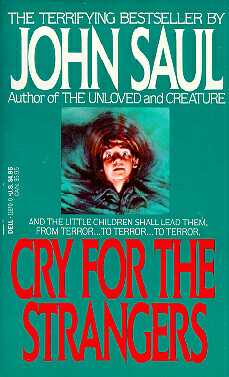
Book to Movie: Cry for the Strangers (1982)
Directed by Peter Medak
Teleplay by J.D. Feigelsen based on the book, Cry for the Strangers by John Saul
In 1982, John Saul’s best seller was made into a made for television movie starring Patrick Duffy. To date, it’s the only movie ever based on his work. One could only hope that Hollywood has not ignored John Saul based on this movie, because it’s not his fault it’s as bad as it is.
From beginning to end, this movie is just terrible. It sticks with the basic premise of the Saul story, but there is zero character development (and I mean absolutely NO character development) and we are given no clues as to what is going on. It's just a bunch of stuff that happened.
Admittedly, Saul introduced some premises that he left on the table, such as biorhythms and Indian curses. But this movie just leaves them all on the table. The final scene is Patrick Duffy, who played Brad Russell, explaining the whole thing to his wife – and to the audience.
It’s almost as if J.D. Feigelsen wrote his teleplay, went back to proofread it, and saw he had major plot holes. So, instead of developing some action or sequences to explain why all of these strangers are dying, he just has Patrick Duffy do a little narrative in the end.
Feigelsen also manages to eliminate the central conflict in the story which is the conflict between Sheriff Whalen and the Russells and Palmers. Whalen – played by Brian Keith – is just a bit player who comes off as dispassionate and unconcerned about everything going on around him. He has no malice toward strangers. He doesn’t carry out any malicious acts against strangers. He just tells everybody he doesn’t know what’s going on. This movie really need an antagonist to carry it and it doesn't have one.
This movie had no character development, a broken, linear plot, and no conflict. It made for a boring, bad movie that no one should watch.
The only compliment that can be given to this horrid movie is it is well shot. The village looks cold and foreboding in every shot. But even that gets screwed up by Feigelsen and director Peter Medak. In the book, both the cabin and the house were without utilities. The house, while structurally sound, was as primitive as the cabin. In their version of the story, the cabin is cozy and the house is luxurious.
At every turn, Feigelsen and Medak took Saul’s pretty decent story and screwed it up. John Saul should be angry and embarrassed.
Hollywood should take another look at Saul’s body of work and take two or three of his stories that would make for good teleplays or even motion pictures. Certainly Punish the Sinners would transfer well to visual. The Blackstone Chronicles has mini-series written all over it. In the right hands, these stories could work on film. Feigesen and Medak are not the right set of hands.
Directed by Peter Medak
Teleplay by J.D. Feigelsen based on the book, Cry for the Strangers by John Saul
In 1982, John Saul’s best seller was made into a made for television movie starring Patrick Duffy. To date, it’s the only movie ever based on his work. One could only hope that Hollywood has not ignored John Saul based on this movie, because it’s not his fault it’s as bad as it is.
From beginning to end, this movie is just terrible. It sticks with the basic premise of the Saul story, but there is zero character development (and I mean absolutely NO character development) and we are given no clues as to what is going on. It's just a bunch of stuff that happened.
Admittedly, Saul introduced some premises that he left on the table, such as biorhythms and Indian curses. But this movie just leaves them all on the table. The final scene is Patrick Duffy, who played Brad Russell, explaining the whole thing to his wife – and to the audience.
It’s almost as if J.D. Feigelsen wrote his teleplay, went back to proofread it, and saw he had major plot holes. So, instead of developing some action or sequences to explain why all of these strangers are dying, he just has Patrick Duffy do a little narrative in the end.
Feigelsen also manages to eliminate the central conflict in the story which is the conflict between Sheriff Whalen and the Russells and Palmers. Whalen – played by Brian Keith – is just a bit player who comes off as dispassionate and unconcerned about everything going on around him. He has no malice toward strangers. He doesn’t carry out any malicious acts against strangers. He just tells everybody he doesn’t know what’s going on. This movie really need an antagonist to carry it and it doesn't have one.
This movie had no character development, a broken, linear plot, and no conflict. It made for a boring, bad movie that no one should watch.
The only compliment that can be given to this horrid movie is it is well shot. The village looks cold and foreboding in every shot. But even that gets screwed up by Feigelsen and director Peter Medak. In the book, both the cabin and the house were without utilities. The house, while structurally sound, was as primitive as the cabin. In their version of the story, the cabin is cozy and the house is luxurious.
At every turn, Feigelsen and Medak took Saul’s pretty decent story and screwed it up. John Saul should be angry and embarrassed.
Hollywood should take another look at Saul’s body of work and take two or three of his stories that would make for good teleplays or even motion pictures. Certainly Punish the Sinners would transfer well to visual. The Blackstone Chronicles has mini-series written all over it. In the right hands, these stories could work on film. Feigesen and Medak are not the right set of hands.
Monday, December 5, 2011
Cry for the Strangers by John Saul

Cry for the Strangers
By John Saul
Copyright 1979
Starting with his first book, Suffer the Children, John Saul almost relies on a template for constructing his stories. He opens with a prologue that describes some evil deed years prior. Then, he moves to present day and that evil is revisited upon his characters. Such is the formula in Cry for the Strangers.
The prologue is set on a stormy Washington beach. An older couple is buried up to their necks in the sand. The surf is pounding away at the shore as a storm builds. Each wave brings the tide closer to the helpless victims. Dark figures dance a ritualistic dance around them. A little boy watches from the seclusion of nearby woods.
The boy awakens the next morning to find his grandparents, with whom he lives, aren’t home. He runs to the beach to find them dead, drowned in the surf. A voice whispers, “Cry. . .Cry for them. . .and for me!”
We then flash forward to current time. Psychiatrist Brad Randall and his wife, Elaine, are looking for a quiet town where they can live for one year while Brad writes his book on biorhythms. They arrive in Clarks Harbor – a seemingly idyllic little town on Washington’s coast. It seems perfect.
While they are having lunch at the local inn, Brad is surprised to see the father of a former patient. Brad treated Glen and Rebecca’s son, Robby, for a mental disorder that made him incredibly hyperactive and destructive. Brad is surprised and pleased to learn that, since they moved to Clarks Harbor, Robby’s troubling malady has disappeared.
The Palmers love what Clarks Harbor has done for Robby, but it has not been good to them. People in Clarks Harbor despise outsiders. Glen is an artist trying to get an art studio up and running in the small fishing village, but has encountered passive resistance from residents who deliberately overcharge for services and deliver goods late. Were it not for Robby’s incredible cure, Glen tells Brad, they would not be in Clarks Harbor.
The only rental property available in the village is adjacent to the cabin being rented by the Palmers. Like the Palmers' cabin, it has no electricity or gas, but is habitable and has direct access to the beach. It is owned by the town sheriff, Harney Whalen who hates outsiders more than most residents of Clarks Harbor.
Whalen is being harassed by the wife of a fisherman who recently drowned, trapped in his own nets. The wife is certain that her husband’s death was not an accident. But Pete and Miriam Shelling are not natives to the town, having lived there but 15 years, so Whalen is not inclined to investigate too thoroughly.
A few days later, after warning Greg Palmer that bad things are in store for him and his family, Miriam Shelling hangs herself from a tree on the beach.
The Palmer children react differently to Clarks Harbor. Robby loves it. He loves the beach and he especially loves the storms when they blow him. They fill him full of energy and excitement and he enjoys venturing forth from the house to take them in.
The storms bring dark, disturbing images of ghosts dancing on the beach to his sister Missy, who hates Clarks Harbor and only accompanies her brother on his forays into the storms to avoid being left alone.
Whalen is troubled by the Palmers moving into a cabin down by the beach and he resolves that he won’t rent the house to the Randalls. Whenever strangers come to Clark’s Harbor, bad things happen to them. Whalen wishes strangers no ill will. He, and almost everybody else in town just want them to stay away.
Whalen meets the Randalls at the house and tells them how difficult life will be for them in the primitive home and in the village that hates strangers. He then rents the house to them, not remembering later that he did so. Harney Whalen has been subject to blackouts lately. He loses hours when he has no idea what he’s been doing or where he’s been. The Randalls return to Seattle for their belongings to relocate for a year.
Meanwhile, life for the Palmers gets a little easier. Robby and Missy endure the taunts and torments of their schoolmates who don’t like strangers any more than their parents. But Glen develops a friendship with Whalen’s only deputy, Chip and Chip helps him complete the remodeling of his art studio.
One evening a giant storm builds to the west and the fishermen of Clarks Harbor know to pull up anchor and head in. A pair of brothers who have ventured south get caught in the storm and head for Clarks Harbor. They make it in just before the storm. They check into the inn before the older brother returns to the harbor to secure the boat for the storm.
While he works to secure the boat, it is set free from its moorings. He tries to start the motor to bring it back into the harbor, but finds it was vandalized in the short time he was gone. He is helpless against the tide that soon smashes his boat against the rocks where it finally explodes, killing him.
Whalen investigates and his first inclination is to blame Glen Palmer for no other reason than he is not a native of the town. He finally concludes it was an accident. The younger brother wants a more thorough investigation, telling the sheriff that his brother was an experienced seaman and would not have been so careless. But Harney Whalen puts forth little effort in investigating the deaths of outsiders.
Whalen is also not happy that his deputy Chip – who is also his nephew – is getting friendly with Glen Palmer. One day, as Chip looks on, Whalen takes the please cruiser and uses it to splash mud onto the artwork Glen has displayed outside. He dares Glen to complain, which he does not.
Meanwhile, the Randalls move into their home down the beach. Shortly after their arrival, Jeff, the dead fisherman’s brother is found in the woods with his neck broken. The body is found on the Palmer’s property and again Whalen is inclined to blame Glen. But with no evidence, he can’t hold him.
Chip becomes concerned about his uncle. He can tell that Whalen is not himself and that there is definitely something unhealthy about his attitude toward strangers. One evening, he sits down with his grandfather who tells him the whole story about Harney Whalen.
Whalen’s grandparents owned a large chunk of the land that is Clarks Harbor, Chip’s uncle tells him. Harney’s grandparents leased the timber and mineral rights for some of the land to a company out of Seattle. When the lease came up for renewal, Whalen’s grandparents would not renew. Later, they were found dead on the beach, buried up to their necks in sand. Most people concluded the owner of the company carried out the murderous deed. But, as Chip’s uncle points out, the Indians that inhabited the area believed that man took from the sea and the sea demanded something in return – souls. Harney Whalen, Chip’s grandfather points out, is part Indian.
That night, a monster storm hits Clarks Harbor and Robby Palmer is driven to go outside and take in the sights and sounds of the storm that so enliven him. Missy tells her mother who ventures out into the storm with Missy in tow to find Robby before whatever got Jeff, got him. As they are searching, Missy feels a presence creeping up on them. She tries to warn her mother. Before she can, Rebecca is seized from behind. Missy flees into the storm and the mysterious entity breaks Rebecca’s neck.
Once again, a body has been found on the Palmer land. This time, it is Rebecca Palmer. Harney brings Glen in for questioning again. His mind is made up. Harney postulates that Glen caught Rebecca and Jeff making love on the beach and killed them. He has no evidence, circumstantial or otherwise, to back up the charge, but tries to force Glen to confess.
Brad and Elaine invite Glen and his children to stay with them at their house so they don’t have to be alone. That night, another storm moves in. Robby and Missy are distraught over the death of their mother and Robby suggests that they head back down the beach to their own home where they will be more comfortable.
They venture out into the storm and start through the woods adjacent to the beach. Once again, Missy senses the presence of evil around her. She looks around and sees ghostly figures dancing on the beach. Meanwhile, Harney Whalen is there, waiting, with the spirit of his dead grandmother exhorting him to avenge her death on the strangers. Harney attacks Robby.
Glen and the Randalls notice the kids missing. Elaine heads for town for help. Glen and Brad search the beach and the woods. After Elaine finds him, Chip heads for the beach and finds his uncle attacking Robby. He launches himself at his larger uncle and is able to wrest him away from Robby. After a brief struggle, Harney overpowers Chip. He gets up and walks into the ocean, never to be seen again.
This was a good book. That’s all I can say about it. What I like most about John Saul is consistency. He always writes a good book. He never writes bad ones, nor has he written a truly great one. There is no magnum opus or capstone work in John Saul’s library of 36 published titles. With a few exceptions, all rely on the standard Saul construct for a novel with different characters, settings and circumstances.
I’ve said in earlier reviews that Saul doesn’t flesh out his characters any more than is necessary to tell his story and none of the characters in this story are particularly deep. With the exception of Chip, none are introspective. We are left with the motivations and emotions at hand with no backstory.
A stylistic critique I’d level at this Saul work is how he writes from so many points of view. None of the main characters are a mystery to the reader and despite a few red herrings about Indian legends, it’s painfully obvious who the villain is. But being in Harney Whalen’s head was useless text. We were in his head when he was rational. He knew he was having blackouts and was concerned about it. Saul could have shown us that. If Saul needed to be an omniscient narrator, he should have taken us into Harney’s head when he was maniacal.
Saul does do a good job of creating the setting of the remote, unfriendly fishing village on the coast of Washington; constantly beset by storms and cold weather. Perhaps it’s because Saul grew up in Washington that he is able to set the scene so well.
Saul is fun and easy to read. I can breeze through his books in just a few sittings and the stories, while seldom enthralling, are well told and well written.
Cry for the Strangers was Saul’s third book. Like most authors, he improved over the years and wrote many books superior to Cry for the Strangers. Nonetheless, the book made for light, easy reading and I enjoyed it a great deal.
There was a made for television movie based on this story. To my knowledge, it is the only adaptation of a Saul story for any screen. I have not seen it, but it was apparently not well received by viewers and IMDB.com reviewers.
Labels:
Clarks Harbor,
Cry for the Strangers,
John Saul
Saturday, December 18, 2010
House of Reckoning By John Saul

House of Reckoning
By John Saul
Copyright 2009
John Saul has published 31 novels over 32 years and has had several of his works appear on the New York Times Bestseller List. For all of his success, he is rarely mentioned in the company of better known, but less prolific writers.
I first read John Saul in the early 1990s when a friend lent me a copy of Second Child. Since then, I’ve read his entire body of work at least twice. Saul is a consistently good writer. Some of his books are not so good, but none of them are so bad that they are unreadable. Dean Koontz can’t make that claim. And while he’s published no magnum opus or great work that will define him like Robert McCammon did with Swan Song, he published many good and a few great books.
Saul relies on just a couple simple plot devices to tell his stories. They almost always have adolescents as their central characters. Those adolescents are usually social outcasts. Sometimes they are unloved and tormented at home as well. And there is always some malevolent force present to exploit those children’s alienation.
Such as it is in Saul’s latest book, House of Reckoning. Fifteen year old Sarah Crane is left to tend to her father’s farm after her mother dies because her father has fallen into an alcohol lubricated pit of despair and self pity after the death of his wife. One night as she walks to the neighborhood bar to find her father, she is struck a pickup truck on a country road – a pickup truck driven by her drunken father. Her father is on his way home having accidentally killed a man in a bar fight.
Dad ends up going to prison and Sarah is moved to a new town to live with a foster family whose father is a guard at the prison where Sarah’s dad is incarcerated. They welcome Sarah’s arrival in their home because she is a source of revenue from the county and a source of cheap labor as they immediately make her into a house servant.
Her status as the new kid and her pronounced limp permanently inflicted upon her by her accident, make her the subject of derision and scorn at the local high school. The only person who is nice to her is her art teacher who is also scorned in this conservative religious community for being a witch. Teacher Bettina Phillips inhabits an ancient mansion that is her ancestral home and served as the living quarters for her great grandparents several generations back who served as wardens of that prison for the criminally insane. Local residents socially shun her and her slowly decaying mansion.
Elsewhere in this small Vermont town there is a fifteen year old boy who hears voices in his head almost constantly. His strange behavior makes him the object of the school bullies who verbally torment him which they know makes the voices in his head yell louder, driving him to the brink of insanity. A chance encounter with Sarah reveals that her presence silences the voices. As outcasts, they are drawn together emotionally.
Sarah’s talent as an artist begins to manifest itself in ghastly ways. Without conscious thought, she paints scenes of murder and death, all taking place within the confines of her art teacher’s home. As Sarah paints, Eric lives out the horror that Sarah conveys to her canvass. It becomes apparent that the two children have a mystical link to each other and to the mansion known as Shutters.
Bettina, while exploring the ancient files left from the prison by her great, great, great grandfather, she finds a manuscript of short stories that describe acts that would make Poe cringe. When Sarah’s paintings begin to depict these unspeakable acts set within the confines of Shutters, Bettina suspects that these are not works of fiction, but rather documentation of actual events.
These suspicions grow as Sarah and Nick inadvertently act out some of these macabre tails. After having painted a picture of a man disemboweling a dog, the two are attacked by a dog set upon them by a school bully who is also the son of the sheriff. As the dog leaps to attack, Nick cuts it from chest to anus, neatly and cleanly. The dog falls dead, disemboweled. This, despite the fact that Nick had no weapon his hand.
Later, after Sarah has painted a picture of people burning alive, the sheriff’s son and the daughter of Sarah’s foster parents try to run them down on a country road. Nick, without thinking, sets the car afire and careening off the roadway. The sheriff’s son dies and only the wicked foster sister is left to tell an insane tale of witchcraft.
Sarah’s association with the art teacher has earned her the scorn and anger of her foster parents who lock her in an attic at night. Nick becomes increasingly concerned that his father is going to send him back to a mental hospital where he might never leave.
Both flee to the Shutter and Bettina Phillips to put an end to the madness. They delve deep into the endless catacombs of the ancient home. The sheriff, Nick’s father, and Sarah’s foster parents all arrive at the house and are drawn by a irresistible force to another time when the catacombs served as a private playground for a sadistic warden. To that time and that hell, each are consigned.
While this unfolds, Sarah learns that she has deep ties to the Phillips family and to Shutters and the grounds of the old asylum. She also finds she has blood ties to Nick. With the evil foster parents gone, the social worker places Sarah to live with Bettina Phillips and they all live happily ever after. . .
I would rank this as one of Saul’s average works. As I stated, this is a plot device that Saul has employed often and one has to think that this book was written on autopilot or with software assistance. Saul has been successful reusing formulas in the past because he makes each setting different and creates distinctive, if not well developed characters. These characters are atypical of Saul’s work for their lack of distinction in their development.
Saul develops adolescent characters well and has honed his talent for it over the years. He makes his pitiful heroes incredibly sympathetic and their tormentors purely hateful. It is not through introspection that Saul develops these characters, but through actions. He doesn’t achieve that effect in this story.
We have absolutely no backstory to provide motivation for the chief antagonist, the sheriff’s son. We learn nothing of his personality, his upbringing, some prior grudge he might hold. Nothing seems to motivate him. The foster parents get slightly better treatment and are well developed as greedy, uneducated, lower middle class with a wide narcissistic streak. Their frequent conflicts with Sarah are the only effective character development in the book. Eric is developed through minimal introspection. In the narrative, we experience Nick’s frustration and torment with the voices that bedevil him, but we could have felt more sympathy for him had his torment been given more development through a little more backstory.
The chief failing of the book is the underdevelopment of Shutters. Saul tells wonderful haunted house stories and frequently uses a prologue to the story to develop whatever malevolent force inhabits the dwelling. With Shutters, there is no prologue to give us a hint of the evil. Having Bettina read to us from the uncovered manuscripts might have done a great deal to make the house more terrifying. Other than the recollections of what Bettina was told as a child, we are told scant little about the horrific events that played out in the home’s cellar that lead to the downfall of Sarah and Nick’s tormenters.
Finally, for a reason that is never explained, Saul lifts a few pages from Robert Marasco’s Burnt Offerings as Shutters seems to repair itself a little with each event that transpires. The source of this rejuvenation is never revealed. It’s purpose never explained.
When Saul fails, it is usually because he leaves a lot of story on the table. There were so many subplots that could have been developed in this book. Nick doing battle with the voices, motivation for the sheriff’s son’s hatred of Nick, the evil history of the house. Saul touched none of it.
Saul has no lengthy tomes to his credit. His books average around 300 pages each. If he would free himself of this page constraint, there’s no telling how terrifying tale he could tell.
Monday, April 5, 2010
The Blackstone Chronicles by John Saul

The Blackstone Chronicles
by John Saul
Copyright 1997
Six Volumes - serialized
Recalling the age of Dickens, when novels were published in serialized booklets, Stephen King published a serialized novel in 1996 called The Green Mile. Following King’s success, John Saul published his own serialized novel called The Blackstone Chronicles. While King is the superior writer and his story is better, Saul makes better use of the serialization process to tell his story.
Saul's story centers on an abandoned asylum in the town of Blackstone. Unspeakable horrors were committed there in its 100 year history. Unfortunately for the mentally ill of the last century, many of Saul's fictional tortures are based in fact.
The first five installments are named for relics from the asylum, delivered to carefully selected Blackstone residents by an unknown and unseen presence that lurks in the abandoned building. Those relics visit upon their recipients the mental illness that afflicted their original owners.
The central character in the story is Oliver Metcalf, publisher of the town newspaper and a direct descendant of the asylum's owner and operator. Each installment opens with the history of the relic and the ultimate demise of its original owner.
The first installment is called An Eye for an Eye: The Doll. This package is delivered to the family of the contractor who envisions redeveloping the asylum into a shopping center. Soon after the antique doll is found on their doorstep, his wife miscarries. She soon covets the doll as if it were own child. Her insanity leads to her family's demise.
The next installment is entitled Twist of Fate: The Locket . The locket containing a small lock of hair is delivered to the town banker who plans to finance the conversion of the asylum into a shopping center. The banker is under investigation for not properly collatoralizing his loans. The soft-hearted banker hates to repossess belongings and foreclosing on homes. His charity creates problems for his bank. His charitable heart hardens quickly after he finds the locket in the snow outside his house. He starts to believe that his bank employees are scheming against him and his wife cheating on him. As his paranoia grows, he ultimately destroys himself.
Installment three is Ashes to Ashes: The Dragon's Flame. Oliver Metcalf's girlfriend, Rebecca purchases an antique lighter to give to her prodigal cousin who is returning home after her boyfriend left her pregnant and alone in New York City. Rebecca's aunt is religious and does not approve of her daughter being in her home, but feels it is her duty as a mother to guide her daughter back to God. Her daughter doesn't want any part of it and has an abortion. Meanwhile, as she lights more and more cigarettes with the antique lighter, she becomes increasingly hostile and irrational. Fire is her demise.
Book four is entitled In the Shadow of Evil: The Handkerchief. With her aunt and ward dead, Rebecca goes to live with the town librarian and her domineering mother. Rebecca receives an ornate handkerchief from Oliver who found it in his attic. The spinster librarian -- a cruel woman -- takes it from Rebecca and gives it to her elderly mother as a gift. Mom, being every bit as nasty as her daughter, rejects the gift and gives it back. Delusions of snakes and insects pursue the librarian through her home and the library until she meets her end in a very difficult position.
The fifth relic arrives in book five entitled Day of Reckoning: The Stereoscope. Attorney Ed Becker, who is conducting the legal work to convert the asylum into a shopping center, spots an antique dresser in one of its rooms. He brings it home to restore and finds in one of its drawers an antique stereoscope and six photographs to go with it. All of the photographs are of the interior of his home as it appeared 100 years ago. As Ed enjoys the antique viewer, he begins to feel guilt for his life's work. Once a criminal defense attorney, he had successfully defended more than a dozen clients who went on to murder more people. As the stereoscope provides a window on the past, Ed's past comes to haunt him more and more. The victims of his life's work start to visit and, while Ed survives, his life is dramatically altered for the worse. As Rebecca is leaving the latest scene of horror, she is kidnapped and taken to the asylum to dwell with its lone, evil resident.
The series finale is entitled Asylum. The residents of Blackstone are terrified as tragedy after tragedy has befallen their town over the last five months. Oliver, always frightened by the asylum that loomed on a hill above his house, finally enters the building to find Rebecca and confront the evil perpetrated on him and others in its foreboding rooms. Long forgotten memories of his sister's "accidental" death and his father's psychological practice resurface. Meanwhile, the town constable discovers the clue he needs to identify the entity that dwells within the asylum and moves to get there before Rebecca meets her doom. The story's climax is outstanding.
Saul did much better than King at serializing because each of Saul's books stood alone as a story where The Green Mile was a continuous story told in installments. Saul -- unlike King -- seldom writes postscripts to his novels. At the end of Blackstone, he describes how he developed the idea of serialization after King's success and the assistance King provided him in publishing over a six month period. Writing serialized books is a challenge because the first part of the story is already in the reader's hands while the author struggles to find the correct ending. It's also easy to make continuity mistakes and Blackstone has a few -- as does The Green Mile. Saul acknowledges these and notes that they are corrected in the fully bound edition that came out after the serialization was complete.
Saul's books are usually entirely plot driven. Characters and settings are developed adequately for the purpose of the story, but lack the depth of King's characters, or even Dean Koontz's characters. (Unfortunately, all of Koontz's characters are the same). In his postscript, Saul talks about how he fell in love with Blackstone and its inhabitants as he wrote and it shows in his development of his characters and the town. This makes The Blackstone Chronicles one of Saul's very best works.
I have the six installments as they were originally published. While the words are the same, I think this is the only way to properly read the story. As I wrote, each book stands as an independent story. To read it as one book will change that flavor.
Subscribe to:
Posts (Atom)