Saturday, September 25, 2010

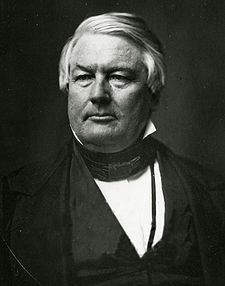
Millard Fillmore by Robert J. Rayback


Millard Fillmore
By Robert J. Rayback
Copyright 1959
American Political Library

Millard Fillmore is the poster child of the “obscure presidents.” His fame today lies in his obscurity and his name is a punch line for political wags. However, he held office at a precipitous time in American history and, for better or worse – his actions forestalled what would become the greatest constitutional and moral crisis in our nation’s history.

This book would more aptly be titled “In the Age of Fillmore” for it is not really a biography of the man. In the preface, the author states that his study of Fillmore was born of intellectual curiosity about the rise and fall of the Whig party which elected two presidents. John Tyler replaced William Henry Harrison upon his death and Fillmore succeeded Zachary Taylor upon his death, giving the party a total of four presidents. The book is as much a chronicle of the rise and fall of Whiggery as it is a biography of Millard Fillmore.

Fillmore’s childhood and early life are laid out in little detail. He was born in a log cabin in the Fingers Lake region of upstate New York to parents of limited means. He received very little formal education as his father apprenticed him to learn a trade so he could help support the family. With what limited education he did have, he remarkably landed an opportunity to clerk for a lawyer and study law. He married Abigail Powers (about whom Rayback provides no biographical sketch), moved to Buffalo and established a law practice. Fillmore was a capable trial lawyer and developed a lucrative practice among the city’s business and shipping interests.

What emerges from Fillmore’s early life is an emphasis on creating educational opportunities. He taught school while studying law and was instrumental in creating the first public schools in western New York. In his law practice, he was as much a pedagogue as a counselor, doting over his clerks studying law.

Fillmore’s entry into politics came through the Anti-Mason movement of the 1820s. This movement believed that Freemasonry was a secret society, lusting power to usurp republican principles to benefit a ruling elite. In describing this, Rayback does go into great detail. He tells the story of William Morgan, a Mason that had become disillusioned with Masonry and threatened to publish a book revealing the secrets of the mysterious organization. His murder in Batavia, NY created hysteria of anti-Mason sentiment.

Fillmore was elected to the state legislature as an Anti-Mason which included those who fanatically hated the secret society as well as banking and businesses that saw it as a vehicle to oppose the Jacksonian Democrats who held sway in Washington and in Albany with Martin Van Buren and other seasoned veterans of politics controlling state government.

Fillmore’s chief accomplishment in the New York state legislature was the ending of debtors’ prisons. Fillmore knew that it was silly to imprison a man for being in debt when he was more apt to pay the debt if he was free to earn. He had worked on behalf of his business clients in Buffalo and knew how hard it was to collect debts from a man who could not work.

Anti-Masons joined with the Whig party which developed to oppose Andrew Jackson’s policies. They favored renewing the charter of the Second Bank of the United States and favored high tariffs to promote domestic industry. They also favored federally funded internal improvements such as roads and canals to foster economic development.

Fillmore graduated from the state legislature to the U.S. Congress, elected from a western New York district where Whigs held sway. Fillmore was one of many New York Whigs that were carried to power in 1832 as the New York Democrats were in disarray with infighting. The man who assisted Fillmore in his rise to power was newspaper publisher, Thurlow Weed who owned the Enquirer newspaper which had the largest circulation of any newspaper in New York.

Rayback focuses intently on the relationship between Thurlow Weed, one of the great masters of New York politics, and Fillmore, the yeoman politician and legislator. Although they were allies early on when Weed was one of the men who galvanized the disparate interests of pro-Adams, anti-Mason, anti-Jackson men into a national political party, their relationship grew contentious and it seemed at every turn, Weed outsmarted the congressman, the vice president, and the president that were Millard Fillmore.

Much of the acrimony stemmed from the rivalry between Fillmore and newly elected governor William Seward. Seward was an adamant abolitionist and pushed abolitionist causes within the Whig party. The Whig party leaders – including Fillmore – preferred compromise between abolitionists and slave interests. In the 1840s and early 1850s, this was still possible. It’s this conflict, always beneath the surface, that would ultimately destroy the Whig Party.

Fillmore voluntarily left Congress in 1843 discouraged after having several pieces of legislation vetoed by the obstinate erstwhile Whig, John Tyler. It was Fillmore’s years out of politics where he perhaps made his greatest contribution to American enterprise and American governance.

The 1840s were some of the most miserable economic times our country has ever known. The destabilization of the banking system by the closure of the Second Bank of the United States and the subsequent Specie Circular that destabilized the individual state banks created a cash starved nation where hard currency was scarce and commerce meager.

While other states struggled with their finances, Fillmore, as Comptroller for the state of New York, set out to establish a banking system that relied on sound currency and extended wise credit. Weed would rally Albany legislators to Fillmore’s cause and New York emerged from the crisis as the financial center of the United States.

Fillmore was an able man, gifted not with a particularly strong intellect, but an uncanny attention to detail. He held many beliefs, but none of them strongly. His strongest belief was in compromise to maintain harmony. He appealed to northern men of commerce for his pro-business stance and he appealed to southerners for his lack of position on slavery. In 1848, when Whigs passed over presumptive nominee, Henry Clay, for darkhorse General Zachary Taylor, Fillmore was nominated to the ticket to bring ideological balance and geographic balance to the ticket.

He was also placed there to block Seward’s nomination. Seward’s views on slavery would have driven southerners from the party. Weed led the effort on Seward’s behalf as well as the Conscience Whigs who opposed the spread of slavery to new American states. This caused the split between Fillmore and Weed, a rift that would never quite heal.

Upon his election, Fillmore found whatever influence he might have with the president and the administration usurped by Weed. As vice president, it should have been his role to handle cabinet appointments as well as patronage for New Yorkers. Instead, Taylor looked to Weed and Weed held more sway with Taylor’s entire cabinet than did the vice president.

That Fillmore tolerated this with nary a fight is demonstrative of the man’s character. As the constant compromiser, he did not have the skills or the will for a power struggle. Instead, he sulked and struggled through his 15 months as vice president as the newly minted Senator Seward advised the president.

Fate intervened to put Fillmore in position to seize control of the machinery of government and New York politics when President Taylor died of gastroenteritis. It came at a precipitous moment in American history as Texas prepared for war with neighboring New Mexico over territory boundaries. Upon his death, Taylor had opposed expansion of slavery into the new southern states. He was also prepared to send federal troops to New Mexico to stave off the Texan invaders. His death prevented this action as Fillmore stepped in and put a temporary stand-off to a halt with a promise to reexamine the issue of borders, Texas debt, and slavery in the new states.

A compromise was well on its way through Congress and to the president’s desk when Taylor died and Fillmore’s pronouncement wrecked it. Texas and the surrounding territories, awaiting approval of their statehood waited anxiously as Congress went back to work to cobble together a compromise that would appease the south’s demand of each state’s right to declare itself on the issue of slavery.

The result was the Compromise of 1850, drafted and guided through Congress by Illinois Democrat, Stephen A. Douglas. The bill allowed New Mexico to become a territory with Texas ceding its territorial claim. In exchange, Texas got the area around El Paso within its borders. Southerners got a new, stronger fugitive slave law and the promise of the rights to determine their laws on slavery through popular sovereignty. Each interest got some of what they wanted.

This law helped the nation stave off civil war for 10 years. Yet, the president was absent in the development of the policy. Ever eager to adopt compromise in the face of a fight, Fillmore eagerly signed the bill into law.

Fillmore’s greatest achievement as president was the establishment of secure trade routes in the south Pacific, opening up markets in southeast Asia. He took steps to assure that Hawaii remained an independent international port. He also took the first tentative steps toward establishing a canal across the isthmus of Panama. Here, Fillmore demonstrated a grasp of larger issues than he did in domestic policies where averting the next crisis was usually the extent of his vision.

Fillmore confided to friends that he did not wish to be re-elected to the presidency and refused to make any effort to campaign for the job. The Whigs were a fractured party and Fillmore, as the presumptive leader of the party, made no effort to bring the sectional factions together around a cohesive platform. Daniel Webster, Fillmore’s Secretary of State was a leading contender along with “Old Fuss and Feathers” General Winfield Scott. However, Fillmore had people loyal to him as well. As the Whigs gathered to pick a nominee in 1852, they balloted for days with none of the three men able to secure a majority.

Once again, we see Fillmore’s inability to act decisively to stave off a crisis. Had he declared himself a candidate, Webster would have released his delegates. Had he removed himself from balloting, his delegates would have gone to Webster. Neither side wanted Scott. Finally, after 53 ballots, enough Webster and Fillmore men bolted to hand the nomination to Scott.

The death of the Whig Party was sealed at this convention. As Democrats clearly put themselves on the issue of popular sovereignty and states rights on the issue of slavery, the Whigs endorsed the Compromise of 1850 which was becoming increasingly ineffective at soothing sectional tensions. Scott was viewed as an anti-slavery Whig or “Conscience Whig,” he made no passionate pleas on behalf of the cause. Abolitionists deserted the party. Failure to take a principled position on the most pressing issue of the day fractured a major political party beyond repair.

Fillmore retired to Buffalo in 1853 and found that he was going to have to secure a means of income. His presidential salary was gone and he had no law practice to return to. The Whig party was in shambles, so he had no political base. He established a private law practice and picked up where he left off years before, representing Buffalo’s business elite.

He was not done with politics however. The rise of American nativism as an issue opened the door for him to make his first and only run for the presidency. The Silver Greys or “Know Nothings” gravitated to each other through their strong distrust and dislike of immigrants and Catholics. Anti-immigrant fever ran high in this area as the country rapidly industrialized and the demand for labor – particularly cheap labor – attracted immigrants from Europe who brought with them their culture and religion.

The Know Nothing movement morphed into the American Party and it developed a national following, electing officials in California, Illinois, Ohio, New York and throughout New England. It seemed as if a new political party had formed.

However, the American Party did not have a position on slavery. Perhaps this is why Fillmore gravitated toward the party. He was selected as the party’s nominee in 1856. However, the former conscience Whigs did not join the American Party and instead joined the nascent Republican Party who was decidedly anti-slavery. Fillmore managed to carry Maryland in 1856, but no other state.

There is nothing in Fillmore’s background that indicates that he was particularly anti-immigrant, so it is remarkable that he joined the Know Nothings. He did not demonstrate any particular passion for returning to the presidency. Rayback provides the reader with no particular details as to Fillmore’s thinking on the issue, so the reader is left to wonder.

That was the end of Fillmore’s life in politics. He returned to Buffalo and for the remainder of his days as its leading citizen in commerce, in volunteering, and in business. He spoke out on national issues, but seldom took strong stands. When Civil War broke out, he declared the time had passed to fix blame for the war and to do everything possible to bring the nation back together. He supported the war effort and did all he could to aid in the recruitment of a union army in New York.

But he, like many Americans, tired of Civil War and by 1864, he wanted to negotiate with the Confederates for peace. He endorsed George McClellan for president, but never became a Democrat.

Fillmore was not as lackluster as those who would follow him. He certainly was more effective than either Franklin Pierce or James Buchanan. But the man lacked any core convictions or guiding principles other than the avoidance of conflict. Politically, the Compromise of 1850 was a landmark moment in our nation’s history, yet it did not bare his imprimatur. His failure to actively run or withdraw from the election of 1852 contributed to the destruction of his party. His presidency is lackluster, but he did no harm. That puts him above several American presidents.

It may be that Rayback had no primary resources upon which he could base a more compelling narrative of Fillmore’s life. Fillmore was not a keeper of a journal and he did not keep a great deal of correspondence. That is the case with many of our early presidents. But missing from Rayback’s biography is any indication of what kind of man Fillmore was. What kind of husband was he to his two wives, father to his two children? As presidential biographies go, this one was as dry as Vodka without vermouth.

Richard Nixon - 1973 -1990: Ruin and Recovery by Stephen Ambrose


Richard Nixon - 1973 -1990: Ruin and Recovery
by Stephen Ambrose
Copright 1991

In this third, and final volume of Ambrose's stellar biography of Richard Nixon, Ambrose recounts Nixon's destruction in Watergate and the abortion that was the second Nixon Administration, Nixon's horrible depression and near death in the immediate aftermath of Watergate, and then Nixon's relentless pursuit and ultimate attainment of redemption and elder statesman status.

The book opens with the start of the second Nixon Administration. Instead of basking in his resounding mandate, Nixon was nearly as brutal to his allies as he was to his enemies. He and Bob Haldeman demanded and received resignations from all White House staff. Nixon's 1972 landslide had short coat tails and the Congress remained in the firm grip of hostile Democrats.

Also troubling Nixon was the pesky Watergate problem. By early 1973, it was certainly a topic of discussion in the halls of Congress and a congressional investigation was inevitable. The deeds that would seal Nixon's fate had already been committed. He saw cover-up as his only means of defense.

Ambrose does a wonderful job of describing and analyzing Watergate as it unfolded. Entire books have been written on this two year period, so Ambrose is forced to abridge the story to a large degree. But all of the essential elements are there to educate those who are not learned in Watergate lore.

Ambrose paints a masterful picture of Nixon's anguish as his enemies zeroed in on him and longtime friends and aides were indicted and imprisoned. Ambrose discusses, with some detail, Nixon's drinking habits during this time through named sources. This was always a matter of great speculation at the time and rumors of Nixon over-indulging were all over Washington in 1974. Ambrose reveals that Nixon was drinking more than usual then, but was by no means a drunk.

Spiro Agnew's troubles are described briefly and Ambrose dismisses him from his narrative just as Nixon dismissed him from his thoughts. The search for a replacement as vice-president is well documented. Nixon really wanted John Connally of Texas, but was cautioned by Republicans to appoint a Republican whose name would not cause controversy. He settled on Gerald Ford, the House Minority Leader. Although he was a veteran of many partisan battles, he was liked and respected on both sides of the aisle.

The narrative of Nixon's final days in office evokes an emotional response in the reader. Those who feel for Nixon today (and there are many) will sympathize for this man, so emotionally broken but determined to find some shred of dignity as he walked down the carpet to Marine 1.

These final days serve as a springboard for further analysis of Nixon's family relationship both publicly and privately. Privately, Pat Nixon was a wreck. Watergate nearly broke her. But she persevered and held the family together as Nixon pondered his final fate. His daughters believed in him always and urged him to stay on and fight. Behind the scenes, the Nixon's were a close American family struggling with horrible crisis like any other American family.

Publicly, Nixon was insensitive and cold as always. Moments after informing his family of his intention to resign, Nixon ordered the White House photographer in to record the moment for history. His family was privately devastated and about to be publicly humiliated -- and Nixon wanted the moment captured on film for posterity.

Ambrose also provides strong analysis of Nixon's farewell to the cabinet. I always found the speech to be one of Nixon's most powerful. He always spoke well off the cuff, and this speech was a definite ad lib. He invoked his mother and called her a saint. This was no exaggeration since many of Hannah Nixon's contemporaries used the word to describe her. I think he also left with a warning to future presidents when he imparted the lesson he had learned from his own conduct. He cautioned others not to hate your enemies, because your hatred will lead to your own destruction.

Ambrose didn't see it that way. He saw the speech as rambling and is highly critical of Nixon for not mentioning Pat. The public Nixon was as distant as ever from his family.

Ambrose captures the tension of the nation during that constitutional crisis quite well. He also captures the aftermath and Nixon's feeling of being besieged as lawsuits and the possibility of standing trial loomed before him. The man was despondent -- some thought potentially suicidal. There was a great deal of traffic between the White House and San Clemente in the days following resignation and Gerald Ford was alarmed at the reports he was getting -- about Nixon's health and Nixon's defiance. Nixon wanted to manipulate the custody of his documents via Al Haig, who had served as Nixon's chief of staff after Haldeman's departure and served Ford as an adviser on transition.

Ambrose is highly complimentary of Haig, and I don't agree with his assessment. Haig served Haig's agenda first and foremost. His conduct both before Watergate with the Moorer-Radford affair where the Joint Chiefs were discovered to be spying on the White House via pilfered burn-bag documents, and during Watergate when he often put his own well being before the president's. Bob Woodward also thought highly of Haig and made a noble hero in his book The Final Days . History and his future conduct in the Reagan administration have revealed him to be very much a villain.

Nixon's second tour through "The Wilderness" started with a blood clot in his leg that nearly killed him. In the final months of his administration, he took a tour of the Middle East and did quite a bit of walking while afflicted with phlebitis. Not seeing to the clot nearly killed him as he entered the hospital, seemingly having lost the will to live.

However, the Nixon instinct that motivated him to keep fighting kicked in and Nixon eventually recovered. He then was offered a full and unconditional pardon for all crimes committed in Watergate by President Ford. Nixon struggled because accepting the pardon would relieve him of the prospect of facing trial, but would require him to admit guilt. As badly as he wanted his day in court and ultimate vindication, he wisely accepted the pardon and then retreated to write his memoirs.

Nixon was out of the public eye for all of 1976. His name was not mentioned at the 1976 Republican Convention, nor was he invited. He began researching and writing his memoirs, having received a large advance from Simon and Schuster that allowed him to pay his legal fees. A young Diane Sawyer would be one of his assistants in this task.

The Bicentennial year also brought Nixon a major family crisis. Pat suffered a stroke while preparing breakfast. This was shortly after Woodward and Carl Bernstein published The Final Days and Nixon's daughters blamed the reading of that book for Pat's stroke. She would go on to recover, but would forever be afflicted with left-side weakness.

Nineteen seventy-seven saw Nixon emerge briefly for a series of interviews with David Frost that provided the nation with its first view of this formerly broken but resilient man as he recounted the bitterest moments in his life for public viewing. The interviews were his first effort toward rehabilitation.

Ambrose documents, with some degree of admiration Nixon's methodical, final comeback to respectability. His status with world leaders was on par with the sitting presidents that followed him. He was a prolific public speaker who never charged honorarium. He frequently appeared on Sunday morning news shows to provide commentary. He also privately communed with future presidents -- including Jimmy Carter and Bill Clinton -- who sought his advice on foreign policy. Foremost, he was an author who provided a succinct and introspective (if self-serving) recounting of his entire life in his autobiography RN: The Memoirs of Richard Nixon. His slow emergence onto the world stage culminated in 1989 when he opened his presidential library and all of the living presidents were on-hand to see Nixon's legacy put on public display.

As he grew older and began to enjoy private life, Nixon found the time to find joy in playing with his grandchildren. Having missed much of his daughters' childhood, he delighted in playing with them at his Saddle River, NJ home. After all those years, he'd finally learned to relax.

By 1990, Nixon's public standing had improved dramatically. Ambrose described how a trip to Capitol Hill to meet with Senate Majority Leader Bob Dole turned into a long autograph session as young staffers came to see this man who had shaped geopolitics like no one before him. The public bought his books while critics panned them. Historians and academics continued to hold him in low esteem, but to average Americans, who are much less dogmatic and much more forgiving, Nixon was rehabilitated.

Ambrose sums up his own feelings about Nixon at the end of the book. He, like most liberals of that time, was tremendously angry about Gerald Ford's pardon of Nixon. But time tempered his view and he now sees that pardon as a positive move. Watergate needed to end.

He also summed up his views of Nixon's legacy. His final conclusion was that the nation lost something valuable when it lost Nixon. Nixon's intellect and political acumen could have made him one of the great presidents, but his demons would doom him to ignominy.

Just a couple years after Ambrose published this volume, Pat Nixon died of a stroke. For the first time, the nation got a glimpse of the private Nixon laid bare. As he approached the funeral, supported by Billy Graham, Nixon stopped and began weeping uncontrollably. He wept openly during the funeral while the nation looked on. Nixon, who deliberately concealed his relationship with his wife through his entire public career, was exposed as a man who loved his family and was loved in return.

His 1994 funeral would have exceeded all of his expectations just ten years prior. The statesmen of his generation and the next generation came together to honor him. In the audience were all of the former presidents, Spiro Agnew, George McGovern, and other senators of past and present. He was eulogized by Bob Dole who, in a touching speech that left him breaking down in tears, described chapters of Nixon's life with the phrase "How American!" The nation mourned him as an elder statesman and his former foes in the media talked about his accomplishments as well as his failures. His death and funeral brought his life full circle and his final crisis was met.

Saturday, September 18, 2010

Book to Movie: The Girl with the Dragon Tattoo


Book to movie: The Girl with the Dragon Tattoo
2009 directed by Niels Arden Oplev

Stieg Larrson was a Swedish writer. The novel was set in Sweden. So, it makes sense that the first movie adaptation of Larrson’s bestseller would be a Swedish movie.

The movie is very true to the book. A strong cast turning in strong performances with well translated English subtitles, the movie moves as quickly as the book and incorporates the same well developed subplots, the same deceptive red herrings, and the same trail of clues that are developed so well in the book.

Salander’s character is a little less emotionally unstable than she is portrayed in the book. Most of her paranoia and distrust are developed in text through internal dialogue. However, we get a taste of her nature developed in the book when she deals with her legal guardian and her response to him raping her. I love the tattoo idea and her execution of it on film!

The clues in the pictures work well on celluloid – perhaps better than the book. This is not result of weak writing on Larrson’s part, but rather the simple fact that pictures are visual and movies are visual translations. On film, we are able to see Anita’s shock and dismay in recognizing someone across the street during a parade and her abrupt departure from her friends and the parade – which is of course the key clue to determining her ultimate fate.

Not mentioned in the book, but evident in the movie, is the slow feminization of Salander. Salander is bisexual and her female sex partners are in the movie. However, at the beginning of the movie, her multiple piercings, harsh makeup, spiked hair, and shoddy dress aptly portray her as a rebel against the traditional accoutrements and social mores of femininity.

However, after she meets Blomqvist, her appearance softens. Less evident are the multiple piercings. Her dress, while still heavy on the leather, nonetheless is more conformist. Most striking is the change in her hair. Her jet-black spikes are combed over to soften her facial features, making her a lovely young woman. I was told that this developing femininity is a feature of the later books.

The film’s chief fault is its quick resolution of the two major subplots: Anita’s fate which we’re led to believe is the central plot at the beginning of the movie, but is really a subplot leading to something much more sinister, and Blomqvist’s revenge on Wennerström.

In the book, once the sinister plot’s perpetrator is revealed and thwarted, Anita’s fate is quickly determined. However, the plot to get Wennerstrom is complex. The details of the journalistic espionage are carefully described. Salander’s independent financial espionage is also carefully detailed. Larrson was masterful in developing satisfying climaxes and denouements for Blomqvist’s revenge and redemption. In the book, the espionage is not mentioned at all and Salander’s clever computer hacking and play acting to achieve her goal of establishing Wennerstrom’s guilt while enriching herself is but merely glimpsed.

This is unfortunate because I found Larrson’s attention to developing these complex schemes after it seemed that the intrigue was over one of the most redeeming qualities of the book.

Running 2 hours, 26 minutes, the movie was plenty long and the script had already cut much to keep it that long. So, the producer may have deemed it necessary to tie up these ends quickly.

Despite the mentioned shortcomings, strong performances from Michael Nyqvist as Blomqvist and Noomi Rapace as Lisbeth Salander carry Larrson’s story well to the visual medium.

An American version of the film is in development. Daniel Craig, late of James Bond fame, is set to play Mikael Blomqvist. Rooney Mara, who had a leading role in the 2010 remake of A Nightmare on Elm Street is set to play Lisbeth Salander. The movie is set to be released in 2011.

Wednesday, September 15, 2010

Nixon: The Triumph of a Politician 1962-1972 by Stephen Ambrose


Nixon: The Triumph of a Politician 1962-1972 by Stephen Ambrose
Copyright 1989

The second installment of Ambrose's three volume history of Richard Nixon's life starts in the immediate aftermath of his "Last Press Conference". Nixon was bitter, angry with the press, angry at himself, and in a funk because he was no longer a player and, by his own behavior, had probably permanently marginalized himself. However, as he had done before and would do again and again in his career, once the bitterness passed, he plotted his comeback.

He first changed his political base -- relocating to New York. In New York, he could start anew in politics and he could make some lucrative money as a corporate attorney. On its face, this would seem foolish since Nelson Rockefeller dominated New York politics and especially New York Republicans who represented the Eastern Establishment wing of the GOP. Nixon knew what he was doing.

He needed money. As a former VP, he would have been a welcome addition to any law firm. It was in his legal practice, where his primary client was Pepsico, he met John Mitchell -- the man who would become his attorney general and would make many of the decisions that would ultimately lead to his downfall.

Nixon had no intention for contending with Rocky for control of New York politics. New York and its media served Nixon's ends of remaining a national figure. While working doggedly at his legal practice, Nixon also engaged in almost non-stop political commentary. He wrote for general circulation magazines such as Readers Digest and scholarly journals such as Foreign Affairs. He was a frequent television commentator.

Nixon was shrewd in how he pursued opposing politicians. He was remarkably soft on JFK. Some might conclude this stemmed from their strong friendship. However, it's more likely that he was smart enough not to attack the charismatic president during times of national crisis. When Lyndon Johnson became president and his popularity slowly eroded, Nixon stepped up his attacks on the president, taking him to task in any and all media.

Ambrose discusses, but does not plumb deeply, the relationship between JFK and Nixon. History needs to examine this closer because the ways and means of American events over a twenty year period could be more clearly studied were someone to delve into a study of these mismatched friends. You can see the heartfelt grief and sympathy in Nixon's note to Jackie shortly after JFK's death. Nixon felt a deep sense of loss when his greatest adversary and one of his few close friends, died.

Nixon was wise enough not to get caught up in the Republican debacle that was the 1964 election. He did do all within his power to limit the damage. As a party moderate, not loyal to the Goldwater conservatives or Rocky liberals, Nixon tried to broker a compromise between the two groups. He tried to convince Goldwater to not use the infamous, "Extremism in the pursuit of liberty is no vice," remark. Nixon and his fellow moderates lost that battle and Rocky's delegates walked out of the convention. Johnson's 1964 landslide was set and Congressional Republicans would not even start on the road to recovery until 1980.

By 1968, Nixon knew the time was right. Johnson was exceedingly unpopular. Vietnam had fractured the Democrats. Republicans had no clear front runner for the presidency. George Rommey of Michigan was the front runner in the polls, but neither conservatives nor liberals could get excited about him. Republicans wanted Nixon, who had come so close to success in 1960. Nixon remained coy and kept his name in play but himself out of the early race. He let the "Draft Nixon" movement build.

The only issue of 1968 was Vietnam and Nixon knew that he had Hubert Humphrey bent over on the issue as Kennedy had him bent over the issue of Cuba in 1960. Humphrey could not criticize the conduct of the war because, as vice-president, he could not openly criticize the conduct of an administration he was part of. Nixon pounded him relentlessly. Only when Johnson announced a well-timed bombing halt did Humphrey close the gap on Nixon. Nixon would ultimately win a close 1968 election.

Nixon's executive office and cabinet was the most Machiavellian since Lincoln's and did not function nearly as well. At Chief of Staff, Nixon put H.R. "bob" Haldeman -- a no-nonsense man of surly disposition. His other close domestic aide was Domestic Counsel, John Ehrlichman. Ehrlichman practically defined the term Machiavellian and would be the engineer of "The Plumbers" who conducted several activities on behalf of the White House. John Dean would be added later.

His cabinet was not strong. His old friend, Bill Rogers was named Secretary of State primarily because Nixon knew he would not challenge him. Nixon planned to run foreign affairs on his own and use the National Security Council and Dr. Henry Kissinger as his tool. George Shultz at Treasury was also a weak pick who was overmatched by runaway inflation. His old friend, John Mitchell was installed at Attorney General and did an adequate, but not stellar job, at running the Justice Department. Nixon's thinking according to Ambrose, was a weak cabinet would make the leader look stronger.

Ambrose debunks the myth that Nixon declared he had a "Secret Plan" to get us out of Vietnam. Nixon never made such claim. He did have a plan that he called "Vietnamization". This was the slow draw down of American troops while increasing the numbers of South Vietnam regulars to fight the insurgent Vietcong. Nixon began almost immediately withdrawing troops. He coupled it with constant bombing of North Vietnamese targets as well as secret op's directed at Vietcong posts in Laos and Cambodia.

Nixon had little interest in domestic politics. He grasped the essentials of macro-economics, but did not like to discuss economic policy. Antithetical to every conservative bone in his body, he embraced wage and price controls -- recommended by future Reaganite Schultz. He also introduced the Family Assistance Plan -- again, against every conservative principle he held. The FAP amounted to a guaranteed minimum income for every American. FAP was a pure political ploy, as Ambrose points out. He knew liberals could not embrace it and cede the issue to the Republicans. Nixon was confident that Democrats would overplay their hand and he was right. FAP went down to defeat, just as Nixon hoped it would, while Nixon took credit for trying to help the poor and blamed Democrats for playing politics.

Of course, the centerpiece of the Nixon presidency was the opening of China. Ambrose delves deeply into the delicate give and take of how this opening was achieved. There were careful negotiations to have the U.S. ping pong team to visit with American media covering. All the while, Henry Kissinger negotiated the first dialogue between the governments of the U.S. and Red China. Kissinger's one word telegram to the White House -- "Eureka!" set the stage. In 1972, he would visit China, dine with Mao Zedong and Dong Xiapong, and set the stage for the 21st century economy. It was his greatest triumph.

Nixon had more on his mind than being friendly with the Chinese. He wanted to put the Soviets on the hot seat. Nixon employed the old maxim "The enemy of my enemy is my friend," and the Chinese and the Soviets were quickly becoming enemies. The opening of China set the stage for Detente' -- another of Nixon's great achievements. Ambrose points out that Nixon, more than any other president other than perhaps James Monroe, could see the whole globe strategically and manipulate it to his liking.

The book closes with the election of 1972 when the Democrats imploded around the candidacy of George McGovern. Nixon should have behaved as Reagan did in 1984 and been a gentleman to the man he knew he was going to crush. Instead, his paranoia of losing and his drive to create a massive "mandate" that would empower him to completely reshape government and the federal bureaucracy to his liking, planted the seeds of his downfall.

The machinations of Watergate are covered in Ambrose's third volume. What emerges from Ambrose's text in this volume is an appreciation of Nixon's intelligence, strength in the face of adversity, and his personal conduct. What is also evident is Ambrose's frequent disgust with Nixon's ruthless and cruel conduct in both politics and government. Nixon was a study in the duality of man and Ambrose covers both sides well.

Saturday, September 11, 2010

The Girl with the Dragon Tattoo by Stieg Larsson


The Girl with the Dragon Tattoo
By Stieg Larsson

On my Facebook page, I exclaimed that I was reading a book currently on the New York Times bestseller list, and felt so. . . I left the phrase open because I wasn’t sure how I felt about it. It certainly wasn’t a feeling of snobbery. A guy who confines most of his reading to classic genre fiction can make few claims to intellectual snobbery. Reading a book that is currently the subject of discussion and movie making prospects is unfamiliar territory for me. I don’t know how to feel about it. I do know how I feel about the book and am happy for having read it.

The Girl with the Dragon Tattoo was the selection for September of my book/scotch/cigar club. Of the ten people who attended this month’s gathering, none disliked the book and most found it an exceptionally enjoyable reading. I was among them. Although this book’s genre (mystery) is outside my normal reading tastes and habits, and the fact that I had scant knowledge of the mystery genre, I found it to be a compelling page turner with strong red herrings, intriguing and realistic deductions by its hero, and well developed characters heavily engaged in various plots and subplots.

The device used to get the story moving was not original. A wealthy Swedish industrialist hires Mikael Blomkvist -- a seemingly washed up journalist, recently convicted of libel (a criminal offense in Sweden) -- to solve the 40 year old disappearance of the industrialist’s favorite niece who went missing from the island community where the Vanger family established its family compound.

In exchange for solving the mystery, Henrick Vanger promises Blomqvist not only badly needed financial backing for his failing magazine, but the information necessary to do in Blomkvist’s arch enemy –Hans-Erik Wennerström -- the man who sued him for libel.

The Vanger family patriarch, Hennrick Vanger, does not want the public or other members of the family to know the true nature of his mission. Their cover is to tell the family that Blomkvist is working on a chronicle of the Vanger family through the ages.

As he begins his forensic investigation of the case, Blomqvist encounters Lisbeth Salander – a diminutive and mentally reclusive but cunning private investigator and computer hacker. Together, they begin to dissect, then piece together the clues to the 40 year old mystery.

With witness accounts more than 40 years old and a thorough investigation conducted at the time of disappearance, it would seem to be an impossible task. Blomqvist sorts through what physical evidence remains – dozens of photographs taken on the island that day, whilst the residents worked ceaselessly to remove a tanker truck that had wrecked on the island’s only bridge. These pictures chronicled the location of each island resident and member of the Vanger family. Through these photographs, Blomqvist is able to ascertain Harriet Vanger’s whereabouts that day and how she met with her fate.

The story is fraught with subplots and industrial intrigue. Salander, fiercely independent even though she is legally a ward of the state because of diminished emotional capacity, operates with her own agenda. Back at Blomqvist’s magazine, the Vanger money is employed to keep the magazine operating while Wennerström’s forces labor to bring it down by pressuring advertisers to bring it down. The lusty Blomqvist moves from sexual partner to sexual partner through the story. Behind it all is Blomqvist’s need to get the goods on the corrupt Wennerström to restore his name and get revenge upon the man who had seemingly ruined him. Woven within all of this is a pattern of murder dating back nearly a century of women in the region, all with a similar means and motive.

The book climaxes its various subplots wonderfully. We learn Harriet’s ultimate fate. That alone might have been enough to end an average book. In a horrific climax to another subplot, the clues lead us to the identity of the serial killer who has preyed on young women in the region for decades. Finally, through chicanery, industrial espionage, and deft computer hacking, we see Wennerstrom get his just desserts. The last one hundred pages are a roller coaster of insightful and clever planning followed by well written action scenes that are emotionally satisfying.

Complex characters, intricately woven plots and subplots, intrigue and deception, are the recipe for good mystery writing. Larsson has excelled in all of these and produced a book that cost me hours of sleep as I was propelled toward each resolution.

The book had few drawbacks. Some in our group complained of Larsson’s tedious need to list items and record the minutiae of mundane tasks. Sometimes, mild A.D.D. has its advantages as my eyes glossed past such boring details. (Perhaps its this glossing over details that has kept me from enjoying mystery books for paying attention to small details is important in enjoying mysteries). However, it would seem that I missed nothing important as I understood each revelation as it unfolded and did not need to return to earlier text to find out what I’d missed.

For me, knowing virtually nothing of Swedish geography, climate, economy, or culture, parts of the book were mysteries. I had no idea where people were in relation to each other. It’s a small detail that I noticed because I read American history and American fiction writers who use my homeland for their settings.

The book is translated from its original Swedish text. Since English is the only language I speak, I rely heavily on good translation for enjoying books written by foreign authors. French author Guy de Maupassant is always well translated. But I once read a Japanese novel that was a retelling of H.P. Lovecraft’s The Mound where the translation made what was supposed to be horrific into something comical. I encountered none of these problems with the translation of Larsson’s work. Other than occasional stilted dialogue, one might have believed this book was written in English.

The book has two sequels: The Girl Who Played with Fire and The Girl Who Kicked the Hornet’s Nest. Most of my book club plans to complete the trilogy. Alas for me, other reading priorities make this unlikely for me. All are on the New York Times bestseller list now.


The book’s Swedish title is Men Who Hate Women and the book’s underlying theme is misogyny. Salander encounters it through her legal guardians. The Vanger women encounter it through their industrial baron fathers, husbands, and sisters. Blomqvist’s lust drives him to dish it out a bit himself. Certainly, the women who died at the hands of the region’s serial killer encountered it in its vilest forms.

I thoroughly enjoyed this book. In all honesty, I did not want to like it. I’m often at odds with my book club because our tastes in literature vary greatly. The greatest value of belonging to a book club such as mine – besides the fellowship, the good scotch and great cigars – is seizing the opportunity to read books outside your normal sphere of interest and discovering new things. I can’t say was my favorite of my book club selections, but I can say that I have never been more pleasantly surprised by any book I’ve read through the two years I’ve been a member. The Girl with the Dragon Tattoo ranks high on my list of enjoyable books.

Saturday, September 4, 2010

Eyes of the Dragon by Stephen King


The Eyes of the Dragon
By Stephen King

Published in 1986, The Eyes of the Dragon was King’s first novel-length attempt at fantasy. Most King fans rank it as one of his average works. It’s not anywhere near his top tier stuff and not as good as second tier stories such as The Talisman and The Tommyknockers.

The story is set in the Kingdom of Delain. King Roland of Delain has two sons. His elder son, Peter is earnest and commands respect. His younger son very much resembles his father who loves to indulge in revelry, but is not a strong leader. Roland is very much dependent on his chief advisor, Flagg – the same Flagg, also know as Randall Flagg – from The Stand

Flagg has spent centuries in Delain under a few guises and has fomented mischief and evil throughout his time there. He senses that, upon the ascension of Peter to the throne, he will be marginalized or worse, banished from the kingdom. He resolves to put asunder that ascension.

He knows he can not kill Thomas because the King’s love for his son is so great, Roland would stop at nothing to find Peter’s killer. Therefore, he decides to kill Roland and frame Peter for the murder.

His plan comes of without incident – except for one. Young Thomas uses a secret passage that brings him to an observation point that overlooks his father’s study. That observation point is inside the head of a dragon, slain by his father and mounted as a trophy upon the wall.

Incriminating evidence of poison is found in Peter's room by his loyal butler, Dennis. The evidence is used to show that Peter killed his father in a brazen attempt to ascend to the thrown. Because he is royalty, and no member of the royal family can be executed, he is instead banished to the top of The Needle, a high tower in the center of town that has played host to political prisoners in the past.

Peter begins a new life as a lifer inmate. There is seemingly no escape from atop the 300 foot tall Needle with just one heavily guarded door and one window as an exit. Peter, however, angry and distraught not only for the injustice done to him but the murder of his father, is determined to find a means of escape.

Find a means he does. To describe how Peter painstakingly constructs the apparatus of his escape would be too large a spoiler to add to a review. Assuredly, it is a clever bit of plotting and writing by the author.

Meanwhile, the insecure, new King Thomas finds himself totally reliant upon Flagg for guidance and Flagg becomes the ultimate power behind the throne. Taxes are raised beyond the ability of most to pay. Nobles and commoners alike flee the kingdom to the outer baronies. At first they call themselves exiles. They soon start to think of themselves as rebels. King Tom becomes known as Thomas the Taxbringer and is despised by his people.

Flagg has no fear of rebellion since chaos is what he craves. Thomas' nerves are constantly on edge and like his father, he finds solace in drink. His dreams haunt him and he begins to sleepwalk to that dragon’s head where he relives again his father’s painful death. He is observed by Dennis who overhears Peter’s somnolent ramblings and concludes that his former liege is indeed innocent.

Working with former friends who are now exiles, Dennis develops a plan of escape. Meanwhile, after four years of imprisonment high atop the kingdom, Peter’s own plan is nearing fruition. Flagg senses that, despite his impeccable planning and execution, something has gone awry. He moves to intercept Dennis, and his friends as Peter attempts his daring escape.

The story’s telling is much like that of Tolkien’s The Hobbit. King’s first person, disinterested narrative resembles Tolkien’s telling of Bilbo Baggins adventures. King, while not directly saying, “I am Stephen King,” injects himself into the narrative by offering occasional and brief personal observations on the setting.

The plot is the stuff of children’s stories. While the book might rate a “G” because it contains no foul language or strong sexual content, it’s not a children’s book. Like Tolkien’s tale, the verbiage is beyond the level of most children.

I’ve always viewed this book as incredibly average. King has certainly written much worse books. But there is no real hook. I feel this way not because it is outside the horror genre. I enjoy most, if not all, of King’s mainstream work outside of horror. It’s just that the story is only mildly clever and the characters mildly interesting.

What is remarkable about this book for King is its brevity. It is only 300 pages. Absent are the long character backstories and long history of the setting. Perhaps that is why it is a mundane story. King is at his best when writing epic novels.

The link to the Dark Tower is of course our old friend, Randall Flagg. He’s a minion of the Dark Tower who appears in many worlds and many times to stir up evil or step in to cause misery when evil has already occurred. King wraps up his story by telling us that Thomas and Dennis go on to confront Randall Flagg at another time in another place. We know that Flagg is around long enough to cause Roland Duschain and his Ka-Tet serious problems in another time and another world. We shall see what role Thomas and Dennis have in Flagg’s future endeavors.