Showing posts with label Castle Rock Maine. Show all posts

Wednesday, August 10, 2011

Book to Movie: Stand By Me (1986


Book to Movie: Stand By Me (1986)
Screenplay by Raynold Gideon and Bruce A. Evans
Directed by Rob Reiner
Based on the Stephen King novella, The Body

Stephen King’s novella, The Body, from Different Seasons, was made into a movie entitled Stand By Me in 1986. It starred River Phoenix, Wil Wheaton, Corey Feldman, and Jerry O’Connell. The movie was an instant hit, established Rob Reiner as a serious director and producer, and introduced Stephen King to mainstream movie audiences.

While the story closely follows the novella in its actions, its primary focus is changed. The novella, told as a first person narrative by character Gordie LaChance (played as a child by Wheaton and as an adult by Richard Dreyfuss), is a character study of four 12 year old boys and an examination of how the transformation from childhood to adolescence brings about changes that erode old friendships.

The movie is a character study of LaChance alone. Although the four boys all retain their formative roles in the story, the character of Gordie LaChance is fundamentally altered to make the story revolve around him.

We know from the very beginning where the story is going to end. At the end of the novella, Gordie relates to us the sad ending to the difficult life of his buddy, Chris Chambers (played by Phoenix). In the opening scene of the movie, we see the middle aged Gordon LaChance sitting along the country road where they found the dead boy years before, holding a newspaper. The headline of one of the stories visible in the paper tells of the murder of local attorney Chris Chambers. From there, Dreyfuss leads us into the narrative.

In King’s novella, Gordie’s older brother, who died in a military Jeep accident, is a remote figure in Gordie’s life. So much older than he, his brother and him had little in common. In the movie, through flashback scenes, we are shown that Denny LaChance is young Gordie’s hero. While his parents heap praise on Denny at the dinner table for his sports exploits and his attractive girlfriend, Denny tries to divert their attention to a new story Gordie has written. Gordie’s parents are dismissive, but Denny knows his brother is talented.

In another scene that is not in the novella, before he ships out, Denny gives Gordie his Yankee’s ball cap. We find that Gordie treasures that cap when, as he is walking through town, he and Chris Chambers are accosted by bullies Ace Merrill and Eyeball Chambers. The bullies steal the cap and Gordie is willing to fight hard against the town’s nastiest bully to get that cap back.

The changes strengthen LaChance’s character and sets up the movie nicely to center around the changes he experiences in the coming of age story.

Almost without deviation, the story of the trip down the train tracks proceeds. The other significant deviation from the King story comes at climatic confrontation between the four boys and the bullies over the dead body of Ray Brower. Instead of Chris Chambers producing the gun and firing at the feet of Ace Merrill, it is Gordie. The sullen Gordie is suddenly hard and animated, standing off Ace and his buddies and scoring a moral victory for himself and his friends.

Reiner ends his film nicely. Richard Dreyfuss tells us of how the four friends drifted apart over the next year, just as Chris Chambers had predicted they would and how Chris has opted for the college track, fought hard, and made it through high school, college, and law school. In the novella, Chambers was still a college student when he died and we had no foreknowledge of Chambers’ fate. But, Dreyfuss relates the sad tale of how lawyer Chris Chamber met his sad end.

The movie wraps up as author Gordon LaChance sits at his monochrome word processor typing the final words of his story. He states that the best friends he ever had were the friends he had when he was 12. He then shuts down the word processor and heads off with his wife and kids.

The Body and the book Different Seasons were Stephen King’s first published efforts at mainstream fiction and Stand By Me was the first movie based upon a King work that was made for the mainstream. Audiences who shunned King’s work and movies based upon it were amazed to learn who had penned such a marvelous character study.

Three of the four boys who starred in the movie went on to great fame. Jerry O’Connell never achieved the fame that Phoenix, Feldman, and Wheaton did, but is still a working actor and recognized talent in Hollywood.

Rob Reiner has, of course, gone on to achieve great things, make great movies, win many awards, and establish himself as a great director and producer. He had directed and produced several films before Stand By Me, but none as important.

Stand By Me is one of those rare movies that I enjoyed as much as the story upon which it was based. This is remarkable considering the fundamental change in the nature of the story that I enjoyed so much. Reiner’s interpretation of King’s work was not necessarily an improvement to the King story, but it made for a much more engaging and emotionally uplifting movie. That is why it is still recognized as one of the finer films ever made and ranks near the top of all King’s screen adaptations.

Saturday, July 2, 2011

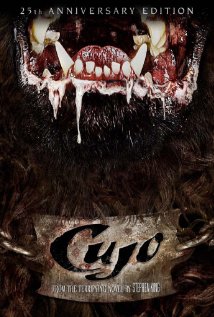
Book to Movie: Cujo (1983)


Book to Movie: Cujo (1983)
Screenplay by Don Carlos Dunaway and Lauren Currier
Based on a novel by Stephen King
Directed by Lewis Teague

Watch trailer here:

Stephen King’s Cujo had been on the shelf just a few months when the book was adapted for a short story. Most movies based on King’s books had done well on the big screen and nobody had yet made a truly bad movie based on a King work. It was a natural progression in the early and mid eighties for King novels to go right to the big screen.

Lewis Teague, just having finished directing the Stephen King anthology, Cat’s Eye, was drafted to do King’s dog movie.

Cujo the movie is essentially the same story as Cujo the novel. The screenwriters tinker at the margins of the story to make it better for the visual medium.

In the movie, we are immediately immersed in Donna Trenton’s (scream queen Dee Wallace) affair with Steve Kemp (played by Wallace’s real life husband, Christopher Stone). In the movie’s opening minutes, we see Donna stand up from Kemp’s bed and dress herself. Her visage is grim because of the guilt of the affair. It is here, in Kemp’s studio apartment Donna ends the affair in the movie version.

Kemp and Vic know each other because Vic delivers refinished furniture to the Trenton home. Early on, Vic has no idea there is an affair going on. Later, he spots Donna and Steve arguing outside of his apartment and gets the clue. His suspicions are confirmed when he comes home and finds Kemp in his kitchen, his wife crying, and broken eggs and glass on the floor.

Later, Vic drives off in his vintage Jaguar, leaving his wife in silence, heartbroken. He is off to try to save his business. She is left alone to wallow in guilt and remorse.

Just as in the book, the on evening excursion into town, the Pinto starts up again with its antics. Donna gets the car home and resolves to take it to Camber’s the next day.

Meanwhile, Gary and Joe Camber are getting theirs courtesy of Cujo – no longer the good dog.

The Pinto dies in the driveway. What transpires over the next 30 minutes is some of the most tense – and at times, tedious – movie making ever. Cujo is there to greet Donna and Tad. He is transformed from the fluffy, loveable St. Bernard to an evil looking beast with blood matted fur and a foam slathered face. Cujo tries to attack Donna as she approaches the garage looking for Camber.

Donna and Tad are trapped in the car and Cujo stands guard, waiting for his prey to die a slow death in the Detroit manufactured oven in which they are basting, or a much quicker, but painful death with their entrails dangling from his rabid jaws.

The makeup and effects people were in rare form when they shot the car scene because, even on the coldest winter night, one could not help but feel that stifling, muggy heat of a closed car on a summer day. For me, the viewing was more painful than pleasurable.

Eventually Vic is alarmed when his wife does not answer repeated phone calls. In the novel, his partner, Roger, is sympathetic and worried. In the movie, he’s narcissistic, pleading with Vic to stay and work on the campaign. Vic calls the authorities and heads for home.

Meanwhile, Donna resolves to try for the house. She can’t see Cujo. She doesn’t know where he is, but goes for it anyway. Cujo, lurking out of sight under the front bumper, pounces and bites deeply into her thigh. She barely makes it back to the car. She now is infected with rabies.

She and Tad swelter on. Tad now lives in a heat induced delirium.

Sheriff Bannerman is dispatched to the Camber home and Cujo greets him. They struggle and Bannerman drops his gun. While they struggle, Donna goes for the baseball bat lying off to the side of the car. Cujo and Donna Trenton square off. Tad Trenton’s life hangs in the balance.

Cujo attacks and Donna belts him across the head. He retreats and attacks again and Donna shatters his ribs and breaks the bat. Cujo is battered but not broken. He makes one final lunge. Donna thrusts the splintered handle of the bat upward, impaling Cujo on the wood. His teeth snap at her, just inches from her face. Then he fades. . .

She grabs Bannerman’s gun and breaks out the window of the house to let herself inside. She carries Tad in and starts showering him with cool water and trying to breathe life into him. Just as Tad responds, Cujo lunges through the window, making one last stab from Hell’s hot. Donna dispatches him with a bullet.

Just as this transpires, Vic shows up for a happy family reunion. There the movie ends.

I did care for this movie any more than I liked the book, but for different reasons. None of them have anything to do with the quality of the film. Dunaway and Currier did an excellent job of adapting King’s book to the screen and making the story work. Teague certainly created tension in his movie and the entire cast was solid.

I didn’t like the movie because it made me uncomfortable. I don’t mean it made me squeamish violated my core values. It made me physically uncomfortable. I felt as if I were dying of heat prostration just watching the last 30 minutes. The film left me feeling physically and emotionally exhausted. Perhaps that is a compliment to how well Teague directed the film. But I have no need to see this movie again.

The movie was well received upon its release in 1983, but it only rates 5.8 stars on IMDB. Perhaps it was more enjoyable viewing in the theater. Perhaps the casual viewer who didn't make a conscious effort to go to the theater and see it liked it less. For whatever reason, the movie's reputation has waned over time.

The obvious difference between book and movie is that Tad lives instead of dies. King fans may complain. Stephen King may complain (he did). But it had to be that way. Book readers are a different lot than movie goers. I didn’t care for Tad’s death in the book, but it works in literature. Unhappy endings work more often in books than in movies. Had Tad died, all those who went to see the movie and endured all that tension would have received no reward; no happy ending. After taking viewers through 30 minutes of mental anguish, there was no way Teague could have killed off Tad without movie goers being angry.

It was this movie rather than the book that injected the name, "Cujo" into our cultural lexicon. The name Cujo instantly stirs images of vicious dogs in the minds of people who’ve never read a King book and shun horror movies. Such was the impact of this movie.

There are those who enjoy movies where the tension is steady and long. I’m not one of them. I hesitate recommending this movie for that reason. If you are someone that does enjoy that kind of movie. Teague delivers a first rate motion picture.

Sunday, June 26, 2011

Cujo By Stephen King


Cujo
By Stephen King
Copyright 1981

Vic Trenton is a man with a lot of problems. His fledgling advertising agency has been beset with a major, national public relations crisis. His wife has been cheating on him, and worst of all, his Ford Pinto has a stuck needle valve in the carburetor. While problem number three should be the least of his problems, it is that mechanical difficulty in one of the worst automobiles in American automotive history that brings Vic’s world crashing down around him.

Cujo opens with a brief recounting of the horror that befell Castle Rock, Maine just a few years prior – the police officer, Frank Dodd – a monster that stalked, raped, and murdered young women in the town. Castle Rock, King the narrator tell us, is a town that has known monsters.

Vic Trenton lives in Castle Rock with his wife, Donna and his four year old son, Tad. Like many children of four (yours truly among them) Tad lives with the belief that a monster inhabits his walk in closet. Young Tad Trenton lives in fear of monsters in a town that has known monsters.

Vic and his business partner Roger, own an advertising agency with one major client, a manufacturer of breakfast cereals. The lucrative annual billing from that company has allowed them to move their agency from the big city of New York to rural Maine and establish comfortable lives for themselves and their families.

They have created a commercial character who, in the commercials, samples the cereals, and proclaims, “Nothing wrong here!” The catch phrase enters the national lexicon much like that old Wendy’s slogan, “Where’s the beef?” But there IS something wrong there. The company’s newest cereal, a berry flavored concoction, has as an ingredient a red dye that, while not toxic, causes profuse vomiting which, when ejected from the body, resembles blood. While the FDA is quick to put to rest any fear of mass poisonings, the company’s reputation takes a major hit and becomes the butt of a national joke.

Roger and Vic know that they must find a way to meet this public relations crisis, and quickly, if they are going to keep their major client and their business. They decide they must travel to Boston to meet with their video team, then on to New York to meet with public relations people, before moving on to the cereal company’s headquarters in Cleveland to pitch their solution to the company’s public relations nightmare.

Joe Camber lives outside of Castle Rock in rural Maine with his wife, Charity and their son, Brett. He makes his living fixing cars for local residents. The Cambers own a big, affable St. Bernard named Cujo who is as good as a good dog can be. Cujo is everybody’s friend.

As we come to learn through reading the stories of Castle Rock, many Castle Rock residents harbor dark secrets and Donna Trenton is one of them. She has been carrying on an affair with an itinerant. furniture refinisher. But she’s resolved to break it off, no longer excited by the illicit sex and secrecy of it all. When her lover, Steve Kemp shows up at the house, she spurns him and tells him to stay away from her from now on. Kemp, his huge ego bruised, does not take the breakup well and resolves to inflict cruel revenge.

One evening, as the happy family is returning from a shopping trip into town, their Ford Pinto begins to lunge and sputter. The car misbehaves for awhile before settling back into smooth operating condition. Vic diagnoses the problem as a faulty needle valve in the carburetor. He tells Donna that, while he’s gone to New York, he should take the car out to Joe Camber’s garage and get it fixed.

Meanwhile, the unlikely villain in our story is engaged in his favorite pastime – chasing things. Cujo chases rabbits, birds, and squirrels not to kill them, but for the simple joy of the chase. Cujo is not a killer, he’s a good dog who loves his boy, his man, and his woman.

Cujo’s pursuit leads him to a small hole in the ground that opens into a large, limestone cavern which serves as home to a flock of bats. Cujo sticks his muzzle into the hole, determined to capture his quarry. One of the bats bites Cujo on the nose. That bat has rabies.

Steve Kemp decides on the method of his revenge. He writes a crude note to Vic that says, in crude terms, how much he enjoyed having sex with Vic’s wife. To authenticate the letter, Kemp includes a short note about the placement of a mole on Donna’s body. He mails it to Vic’s office and then prepares to clear out of town.

Charity Camber also harbors a secret – one she decides to share with her husband. She has one the lottery to the tune of $5,000. This is a lot of money to the Cambers who get by on Camber’s repair work, but have little to show for it. Charity wants to visit her younger sister whom she has not seen in several years.

Joe Camber is not the most compassionate husband in the world. He is cold, distant, and prone to using his hands to make a point when the marriage takes a turn that doesn’t suit him. Charity knows that Joe resents Charity’s husband – a successful lawyer – and the money he earns. She concocts an elaborate bargain to gain Joe’s ascent.

She purchases a an engine puller for Joe's Garage that will allow Joe to take on and complete larger jobs faster. She presents Joe with the gift and asks permission to go to Connecticut to see her sister. At first, Joe adamantly refuses. Then, he figures with Charity and Brett gone for a week, he’ll have a chance to go to Boston with his buddy, Gary so they can go drinking and whoring. He agrees.

Vic receives his note and is shattered. Not only does he have to deal with the prospect of losing his livelihood, he now must confront the possibility of losing his family. He confronts Donna who is repentant and supplicant. She wants to save the marriage. Vic is undecided and uncertain about his marriage, but knows if there is any future for the marriage or for himself, he must make this trip to save his agency. Two days later, he takes off for New York with his partner, making no commitments one way or the other to his wife.

Charity Camber and her son Brett, board a bus and take off for Connecticut. After they depart, Joe goes to Gary’s house to plan their Boston debauchery. Cujo lays in the Camber garage, suffering and pondering his new misery with a heat and hatred building in his diseased brain.

Joe returns home that evening to find that Cujo is not around. He does find that Cujo, the most obedient and well mannered of dogs, has taken a dump in the middle of his garage. Joe is puzzled. This simple act, so out of character for his good dog, makes him suspicious, but he finally reasons that Cujo is simply upset about Brett leaving.

He summons Cujo to mete out some discipline but Cujo is not around. Cujo has gone to Gary’s house. Gary greets Cujo who he knows is a good dog. But Cujo is good no more. The 200 lbs dog sets upon Gary and rips him apart in an effort to rid himself of the painful fever ripping through his brain.

As Vic takes off for New York, Joe Camber prepares for his trip to Boston. He goes to Gary’s house to find the carnage in Gary’s living room. As he is pondering the mess, Cujo shows up. Joe’s last thoughts are of what could have happened to turn his good dog bad.

Cujo goes home to seek solace in the dark garage, his head raging with pain and fever.

The Camber home, in the rural woods of Maine, is empty except for its lone canine inhabitant whose desires are to be in the dark and quiet and to kill whatever disturbs his uneasy rest.

As Donna and Tad are returning home from a trip into town for ice cream, the Pinto starts to act up again. She nurses it home and decides that she will take it to Joe Camber’s garage the next day.

As she prepares to take the balky Ford out into the country to Camber's Garage, she tries to leave Tad with a babysitter. The skittish Tad doesn’t want to be left with a babysitter and is afraid of the monster in his closet. He wants to stay with his mom. Donna relents and allows Tad to come along.

The Pinto runs smoothly for most of the trip out through the Maine country roads. However, as they are just getting ready to turn into the Camber door yard, it balks, lunges, sputters, and dies in the driveway. She counts herself lucky to have made it to the garage. She gets out to find Camber, but it’s apparent that no one is home. As she looks around, she hears the throaty growl of a wild animal. Cujo, the loveable St. Bernard she had met months before when she and Vic had been at Camber’s house for a repair, emerges from the garage.

Cujo is no longer a good dog. His red, rheumy eyes hold malice. Strings of viscous slobber dangle from his powerful jaws, and foam covers his muzzle. He knows this woman and this boy are the cause of his agony. He is determined to kill them.

Donna makes a break for the car and barely gets inside before Cujo slams his bulk against the car repeatedly. She tries to start the engine without avail. She and Tad are alone. Nobody is in the Camber home. Nobody plans to be at the Camber home for at least a week, and her only means of escape is one of the biggest hunks of junk to ever come off a Detroit assembly line. Meanwhile, the summer sun beats down on the Pinto, heating its interior to intolerable temperatures.

Tad and Donna spend the night in the hot, sticky comfort of Ford vinyl seats.

In Connecticut, Brett Camber worries that no one has made provisions to feed his dog while he is away. Charity tries to call home to ascertain if Joe is home. There is no answer she can hear, but Cujo, enraged by the sound of the phone ringing in the house, answers by throwing himself against the door of the house and then launching into another attack on the Pinto, cracking the window and buckling the door. Finally, exhausted by the heat and the toll of his fatal disease, he collapses to rest in front of the Pinto.

Steve Kemp, cooling his heels in a rundown motel outside Castle Rock, also has hate festering in his head. His note hit Vic hard. He knows that. But his lust for revenge upon Donna is not slaked. He decides to return to the Trenton residence to mete out a little revenge and perhaps a little rape. He gets there and finds the house empty. He flies into a rage and trashes the home, then flees the state in his van.

Vic is working overtime with his partner to try to save their account. They have an idea and are working with videographers to develop a script and shot sequence. Vic tries to call home several times, to no avail. At first, he is able to develop plausible reasons for his wife and son to be gone. But eventually grows alarmed. He calls Castle County Sheriff Joe Bannerman for help.

Meanwhile, Donna is growing desperate. The unrelenting summer heat in a sealed car is taking a toll on the young boy who is having seizures and slowly dying of heat stroke. She resolves to try for the Camber back door to get into the house and call for help. She exits the car and starts for the door. However, Cujo has been waiting for this moment. Having concealed himself at the front of the car, he springs at her. Donna grapples with the dog who bites her in her midsection and her thigh before she is able to drive it off by driving her thumbs into Cujo’s eyes. She returns to the car, bleeding profusely and probably infected with rabies.
A Castle County deputy is dispatched to the Trenton residence and finds Steve Kemp’s handiwork. With memories of Frank Dodd fresh in his memory, the deputy and Sheriff Bannerman assume the worst. They call Vic Trenton who abandons his advertising project to come home.

State investigators swarm the Trenton home to gather evidence and question Vic about possible motives. They suspect that Steve Kemp has kidnapped Donna and Tad. However, one of the state guys notices that Donna’s Pinto is not there. Kidnappers don’t usually bother kidnapping vehicles along with people. While he doubts that it is an important detail, he doesn’t want any details overlooked. Vic tells them that the Pinto had a bad carburetor and that Donna had talked of taking it to Joe Camber’s garage. Sheriff Bannerman is dispatched to check out the Camber residence.

Bannerman arrives and is surprised to see that the blue Pinto is indeed parked in the driveway. He approaches the car and sees the damage to the driver’s side door and the two motionless figures in the front. Just as he sees Donna stir, Cujo sets upon Bannerman. The sheriff of Castle County who brought a horrific serial killer to justice just a few years before is no match for the animalistic killer that he meets in the Camber door yard. Cujo eviscerates Sheriff Bannerman.

Donna, working herself out of her heat and thirst induced delirium knows it’s now or never for her and her son who lies at death’s door. She jumps from the Pinto and grabs a wooden baseball bat. She and Cujo square off.

Vic is alarmed that no one has heard from Sheriff Bannerman and takes matters into his own hands and heads for Camber’s. Along the way, he passes Gary’s house and sees Camber’s car in the driveway. He stops to see if Camber is there. He walks into Gary’s house and finds the remains of the two men. He knows a monster is loose and knows that his family is in terrible danger. He flies toward Camber’s house, less than half a mile away.

Cujo leaps at Donna and she swings the bat with the might of Ted Williams and breaks Cujo’s ribs. Cujo gathers himself and makes another leap. Donna connects with Cujo’s hindquarters, breaking his hip. Not to be denied revenge on the woman the irrational dog is certain is the cause of his agony, Cujo makes one final leap. Donna swings for the fences and connects with Cujo’s head. Cujo falls to the ground dead.

Vic pulls into the door yard just in time to see Donna’s final swing. He runs to the car and pulls his son out and takes him to the shade. Donna, now in a mindless frenzy, pounds Cujo into a shapeless pulp. She is stunned out of her frenzy when Vic asks how long Tad has been dead.

Donna’s mind enters a whole new realm of frenzied action, trying to breath life back into her son’s lifeless body. Vic uses the Camber phone to call for help, but it is too late for Tad. The monster his dad assured him was not real, finally got him.

The book ends with Charity Camber looking forward to the rest of her life with mixed emotions. She is relieved to be unburdened of her slovenly, wife beating husband, but is sad for her son who has lost his father and beloved pet. She finds that by selling Joe’s equipment and by collecting on his life insurance policy, she and Brett will have enough financial breathing room to figure out where to go from there.

Vic and Donna reconcile. They grieve and they move on. Vic’s PR plan is accepted by the client and his agency is awarded with a new two year contract. Donna and Tad have time to figure out where to go from there.

As for the town of Castle Rock, more evil and misfortune lies in store. . .

I’ve read this book four times and I do not like it. Why read it again and again if I don’t like it you ask? Because, for the most part, it is exceptionally written and it is a good story with a strong premise.

I don’t like the book on an emotional level. First and foremost, I hate reading about Tad’s suffering. I think all but the most loathsome of us hate to see or read about children suffering. But for some reason, I am hyper sensitive to it. My wife finds it intriguing that I can read what I read and watch the television and movies that I watch, but I can’t stomach even the mildest amount of discomfort inflicted upon a child. I don’t know why that is, but it’s the way I’m wired. As you might imagine, I loathe the ending.

I’m also not particularly happy that an adulterous wife is the hero of the novel. I understand the concept of anti-heroes and redemption being powerful vehicles for stories. But Donna Trenton isn’t written as an anti-hero. She is remorseful, but not remorseful enough for me to be sympathetic toward her.

King’s writing through most of the novel is as tight as anything he has ever written. He cleanly and plausibly sets up the predicament. There’s no extraneous development of peripheral characters for the most part. The story is well paced and Vic Trenton is among the most sympathetic of all of King’s characters.

King usually visits the mind of his monster or villain to provide glimpses of their motivation. He does that better than any writer I’ve read. However, here the monster and villain is a dog and I absolutely loathe when writers try to write from the point of view of an animal. They usually have the animals engaging in reasoning and interior dialogue. Dean Koontz does this frequently and it’s just foolish since, while animals can adapt their behaviors and solve simple obstacles, they can’t reason. King keeps Cujo’s thoughts quite simple. Cujo doesn’t reason. He feels and we all know that animals – especially dogs are capable of complex feelings.

King really twists the roles of hero and villain and deserves a great deal of credit for pulling it off, my own personal feelings aside. The hero: an adulterous wife. The villain: a loveable, oafish dog. That’s an original twist.

The primary weakness of the book is King can’t decide if Cujo’s nature is part of a broader evil that lurks in Castle Rock or if he is an animal driven mad by rabies. He makes frequent reference to an evil that lies inside Tad’s closet. That is never developed. He also mentions an evil that resides in Castle Rock first manifested in Deputy Frank Dodd of The Dead Zone. But he never connects that evil, if it does exist, to Cujo. In fact, in the entire Castle Rock cycle of novels, that concept of an evil entity or being never really develops. When true evil finally manifests itself in Castle Rock, it comes in the form of a visitor in the final novel, Needful Things.

The other primary weakness is toward the end, King feints at character development of one of the most peripheral characters – that of the assistant district attorney who is at the Trenton home to lead the investigation. This is a bit character, but King pauses in the heat of his climax to give us a page of backstory on this guy that leaves you wondering why he wasted his time.

Most King fans rank this as one of his weaker works. I put it in the middle. Not as good as The Talisman, but better than Eyes of the Dragon. Many King fans revisited the story when King disclosed in his book, On Writing, that because of his alcoholism and drug addiction, he had absolutely no recollection of the writing of this book. He wrote it surrounded by piles of empty beer cans and with cotton stuffed into his nose to staunch the bleeding from cocaine use.

The next story in the Castle Rock cycle is The Body from the anthology, Different Seasons, which is a poignant and haunting coming of age story that is absolutely bereft of supernatural content. That story stands as one of his best and most revered by King fans and fans of mainstream stories and movies.

Sunday, May 22, 2011

The Dead Zone By Stephen King


The Dead Zone
By Stephen King
Copyright 1979

With the publication of The Dead Zone in 1979, Stephen King created a venue which would serve as a backdrop for several of his books and short stories. Castle Rock, Maine was the setting for The Dead Zone, Cujo, The Body from Different Seasons, The Dark Half, and The Sun Dog from Four Past Midnight. Needful Things was billed as the last Castle Rock book although it would be the setting for one more short story – It Grows on You in Nightmares and Dreamscapes.

The stories aren’t serialized and share loose connections at best. The sheriffs Bannerman and Pangborn are the most frequent recurring characters. Unlike ‘Salem’s Lot, the town is not a character, just a setting.

I’ve moved on from reading the Dark Tower and have started The Castle Rock series.

The Dead Zone opens with a prologue informing the reader that, despite the fact that he could not remember it, Johnny Smith suffered a head injury in his youth, colliding with another kid who was playing hockey on a frozen pond.

In the other half of the prologue, we meet a door to door Bible salesman working the Nebraska countryside, moving from farm to farm. While stopped at a farm where the owner was not home, he kicks their dog to death. His name is Greg Stillson and the young man on the move is sure great things lie in store for him as he drives off, dead dog miles behind him.

There are a few plot lines that run parallel in the story and meet at various points through the story. The opening chapter is set in 1970. We meet Johnny Smith, teacher and as mild mannered as his vanilla name implies, and his girlfriend, Sarah Bracknell. The two high school teachers are headed to a carnival and Sarah is anticipating this will be the first time Johnny spends the night instead of just dropping her off at her apartment.

They get to the carnival and enjoy themselves thoroughly. On their way out, Johnny spots a roulette wheel. He smells burnt rubber and develops a throbbing in his head and suddenly is drawn to play. He cleans the carnie out by guessing the right number. Johnny makes more than $500 in about fifteen minutes.

Sarah’s plans for a romantic evening are thwarted when she started throwing up a bad hot dog while watching Johnny play the wheel. He leaves her at her apartment and catches a cab home. On the way home, the cab is hit head on by kids drag racing. The cabbie is killed instantly, as are the kids. Johnny has been gravely injured with massive head trauma.

He is transported to the hospital. Emergency surgery saves his life, but he’s in a deep coma. The damage is so bad, the neurologist tells Johnny’s stricken parents and a dazed Sarah, that it is unlikely that Johnnie will ever awaken.

The world moves on. . . .

The Vietnam War ends.

Spiro Agnew resigns. Nixon resigns. Gerald Ford becomes president

Johnny’s mother falls into fanatical and fantastic religion, believing that flying saucers are going to transport Christ’s true believers to a star in Orion where Heaven is located.

Johnny’s dad gets older prematurely dealing with his wife’s mania and his son’s deteriorating physical condition. He wishes his son would just die.

Sarah Bracknell moves on, finds a young and politically upward bound attorney, falls in love, and marries him.

A serial killer starts work in Castle Rock, killing ladies from 17 to 70, strangling them with their own stockings.

Greg Stillson becomes mayor of a New Hampshire town and sets his sights on a congressional seat.

A man crisscrosses New Hampshire, selling lighting rods. His stops by a bar named Cathy’s in Castle Rock and tries to make a sale over a couple beers with the barkeep. The barkeep insists that he already has lightning rods, when in fact he does not.

And Johnny Smith wakes up from his coma after missing more than four years of his life.

His brain is damaged and he loses words and images in what he calls “the Dead Zone” of his brain, but he also develops telepathy and precognitive ability.

He first displays it when he grasps his physical therapist’s hand and immediately senses that her house is on fire. Then he is able to tell his neurologist that his mother actually survived the blitzkrieg of Warsaw after they were separated. Soon the media picks up on his ability and he becomes a reluctant celebrity.

He is finally discharged from the hospital and sent home to live with his father, now a widower since Johnny’s mom died from hypertension. Strangers from all parts of the country send Johnny little items for him to fondle and reveal their secrets. Find lost loved ones, reveal deep secrets, and even assistance in choosing lottery numbers. He is miserable and bored, hating the attention and missing Sarah who moved on while his world stayed still.

Sarah stops in to visit Johnnie. She is terribly conflicted, feeling guilt for having abandoned Johnny and moved on, for falling in love with someone else and for leaving him behind. As they part company, he grasps her hand to tell her where it was she lost her wedding ring while she and her husband honeymooned. It was stuck in the luggage. Sarah returns home and finds her long lost wedding ring. She flushes it without telling her husband and tries to forget what she knows is true about Johnnie and his abilities.

She visits again, enticing Johnny to invite her to his father’s place when her husband is away on business and she is visiting friends nearby. There, she tries to make peace with the past by making love to Johnnie, telling him that this one act must make up for the night they lost that tragic night and a lifetime of lost love.

Johnny receives a call from his old principal who invites him to come back to teaching at the high school when he’s physically ready. Johnny is thrilled at the opportunity to get back to utilizing his old skills at pedagogy. He also receives a call from Castle Rock Sheriff George Bannerman. Bannerman needs Johnnie’s new skills to help him. Johnny reluctantly agrees to meet with him.

There is another murder in Castle Rock. This time, it’s a 14 year old girl walking between the library and the school. The public pressure is on and Bannerman is desperate.

The meet and Johnnie agrees to try to discern some clues from a cigarette pack found at the scene. He then insists on visiting the crime scene. Upon arriving at the location of the latest murder, Johnny is able to discern that the rapist and murder always wore a raincoat so none of his victims could scratch him. He staggers to a nearby earlier crime scene that leads Bannerman to his suspect, who commits suicide just as Bannerman confronts him.

Johnny once again becomes the focus of national media attention. That high profile costs him his teaching gig and he moves on to tutoring the son of a textile magnate who has a reading disability and needs help desperately. Johnny moves into the guest house on the family’s estate and begins work.

While tutoring, he develops a fascination with politics and the 1976 election. He meets Jimmy Carter and knows instantly that he will win a close election over Gerald Ford. He also follows closely a New Hampshire independent named Greg Stillson, running for Congress.

Greg Stillson has come a long way from being a door to door Bible salesman. He’s now a successful insurance agent and mayor of a middle class New Hampshire city with a tough on crime philosophy. Greg also recruits outlaws to serve as his personal security. He runs an unorthodox campaign with wild policy pronouncements (We’ll blast the pollution into outer space), to unorthodox festival bordering on maniacal campaign rallies. Greg Stillson is a cult of personality and he is the favorite to win in the New Hampshire third congressional district.

Johnny decides to attend a Stillson rally and see the carnival of American politics for himself. He gets to the rally and fights hard against the compulsion to grab Stillson’s hand. Finally, he loses the battle and Stillson grabs his hand. Both are galvanized.

Johnny has visions of an older and grayer Greg Stillson taking the oath of office for the presidency. He then sees visions of a world on the brink of world war, with Greg Stillson leading the charge to Armageddon.

Johnny is stunned by what he’s just learned. He has just shaken hands with the man who will end civilization on earth. He ponders what his responsibilities are as custodian of this knowledge and what, if anything, he should do about it.

His tutoring job is going very well with his charge dramatically improving his reading and writing skills. He will now graduate on time with his class and, after a short stint in prep school will go to college.

The young man’s father hosts a party the night before graduation for friends and their parents. While there, Johnny learns that there is going to be a tragic fire at Cathy’s restaurant where most of the kids plan to go after graduation the next night. Johnny pleads with the father and the children not to go. Johnny’s pupil believes him and insists that his dad host a party instead and invite everyone to the house instead of allowing them to go to Kathy’s. Some kids accept, but many opt to stay with their original plans.

Events unfold just as Johnnie predicted. Lightning struck Cathy’s restaurant and sets the place ablaze. Kids rush for the exits and are stuck at the exits, trying to squeeze out when smoke and fire overtakes them. More than 40 kids died.

After the fire, Johnny opts to disappear.

Here, King dramatically alters his narrative style. No longer are we privy to Johnny Smith’s thoughts. In a detached style, King walks us through Johnny’s growing obsession with Greg Stillson and his campaign. He goes to a gun store and buys a sniper rifle and ammunition. People notice that he has a badly bloodshot eye.

He is living in Phoenix and working on a road crew, having disappeared from the world after the new, unwanted fame that came from the prediction of the disaster at Kathy’s. His former student’s father tracks him down and offers him a large sum of money (King never reveals the amount). Johnnie keeps refusing. Finally, after the man has sent several checks, Johnnie takes the money to fund what he has come to believe is sad duty to perform for history.

He writes several letters, to his father, to Sarah, to his neurologist, explaining what he is doing and why he is doing it. He mails them and then heads north for New Hampshire where he prepares to save the world.

He sneaks into a hall where Stillson is preparing to address a crowd. He waits with his rifle for his target to appear. Finally, Greg Stillson arrives and Johnny takes his shot and misses. He fires again and misses again. After he takes a third shot, Stillson’s body guards fire back and shoot Johnny. Mortally wounded, he fires one more shot. Just as he dies, he sees Greg Stillson grab a kid and use him for a shield. A photographer takes a picture of Stillson’s cowardly act.

In the epilogue, we read Johnny’s letters. We learn that he had developed a brain tumor. He insists to his father to never believe that the tumor had caused him to act. His mother’s parting words to him were that God had a special purpose for him and he should not act as Jonah, but act as God’s instrument. He was saving humanity from Greg Stillson.

There were also Senate hearings chaired by newly minted Maine Senator William Cohen. Here, we learn that Johnny’s tumor was operable, but that he refused the operation. His final days on the road crew were full of blackouts caused by the tumor. People testified to his how ill he looked in his final days.

The book ends with Sarah approaching his grave and weeping for all that had happened.

The Dead Zone was Stephen King’s first departure from horror. There are psychic elements to the story, but no true horror that was found in his earlier works.

The story of Johnny Smith is a tragedy. The story didn’t have a hero at the end. Jonnny Smith just wanted the life he lost to tragic circumstances. But every time he got a shot at resuming life, the curse of his new ability doomed him. Of all King’s works, this one is the most tragic.

Many King fans rank this as one of his best. I rank it as one of his second tier works with books like The Talisman and Eyes of the Dragon.

It’s an entertaining and engaging story with several plots evolving at once. The plots were simple and drawn together simply. A more mature King could have woven a lot more complexity into the story and made it better. But at this early stage of his career, horror was what he wrote best. His first deviation from the horror formula was not bad. He would later show the world with works such as Different Seasons that, as he matured, he was quite capable of writing outside the genre. But with The Dead Zone, he’s venturing forth for the first time, and a lack of maturity shows.

We will meet Sheriff George Bannerman again in King’s next Castle Rock installment, Cujo.

A movie starring Christopher Walken and Martin Sheen was made in 1983. The story is changed dramatically toward the end to give the ending greater drama. It’s a slightly above average adaptation of a slightly above average King work.

There was also a television series based loosely on the novel entitled Stephen King’s The Dead Zone and starred Anthony Michael Hall. I never watched the series. Fans give it 7.3 stars on IMDB, so it must not be too bad. It ran for six seasons, from 2002 to 2007 on the USA network.