Showing posts with label Richard Matheson. Show all posts

Sunday, February 12, 2017

A Stir of Echoes By Richard Matheson

A Stir of Echoes
By Richard Matheson
Copyright 1958

Tom Wallace is a workaday, blue collar joe in 1950s suburbia. He has a lovely wife, a little boy, and a baby on the way. One evening, he attends a neighborhood party and brings along his oddball brother in law. Everything changes for him and his neighbors.


Tom, his wife, Anne, and her brother, Phil, attend a party held at their next door neighbor’s house. They attend to oblige them, but dread it because they throw dreadfully boring parties. Phil, a Berkley psych major, decides to inject some excitement into the party by hypnotizing someone. All turn down his offer until Tom agrees. Phil puts him under.

Everyone has a good laugh at Tom’s antics under hypnosis. Tom and Anne go home that night and Tom is unable to sleep. He goes to the kitchen and finds there a woman, dressed in black. Tom and Anne are discomfited by the specter and her frequent appearances put a strain on their marriage.

Tom begins to sense the feelings of people around him and eventually can read their thoughts. He learns of the amorous desires of one of his female neighbors for him. He also learns that his best buddy is cheating on his pregnant wife.

Slowly, Tom and Anne’s life and the lives of their neighbors descend into chaos. Husbands and wives try to kill each other. Tom predicts disasters and death. All the while, the specter of the woman in black demands Tom’s attention. He needs to identify her and find out what it is she wants.

With a little sleuthing and use of his new abilities, Tom learns that the woman is his next door neighbor – and landlord’s – sister in law who moved away with nary a goodbye to her neighbors. Tom figures out that she was murdered and he’s confident that he knows who killed her. But at just the wrong moment, his enhanced intuition fails him and the murderer turns out to be the unlikeliest of the suburbanites.

I love the works of Richard Matheson – his print work and his screenwork. The man is nothing short of brilliant and was a pioneer in the art of small screen writing and teleplays. With that said, A Stir of Echoes left me a little disappointed.

One thing that every reader of Richard Matheson knows is that you are going to get sparse prose. Matheson was an old pulp writer and pulp writers had to economize on words to get as much story as possible into as few words as he could manage. This takes real talent and few – if any – were as good at economizing words as Matheson. In A Stir of Echoes, he could have used a few more words.

There were too many characters and none of them were developed adequately. Matheson is not a writer of character studies, but his books and stories usually give you a well developed main character that the reader can root for. Not so in this book. Tom is sympathetic, but not someone I really rooted for. Both his virtues and character flaws were underplayed. He was flat.

The periphery characters came and went as was necessary for the story, but also were lifeless. A rogue babysitter kidnaps their child for no apparent reason. His amorous neighbor is amorous, but we don’t know why. His landlord doesn’t like him, but we don’t know why. The ghost should have been chilling, sympathetic, ominous, or something. She was little more than a device for the story.

What did stand out as good in A Stir of Echoes was the mystery and the two plot twists that came near the end. I’m not a reader of mysteries, but enjoy them when they are part of a good ghost story or other story of the supernatural. Matheson had me thinking, analyzing and guessing up until the end, and then blue all of my predictions out of the water with a well-developed and plausible twist. Even when he falls short on character development, count on Matheson to come through with a solid plot.

The subtext of A Stir of Echoes was not hard to discern, given the time it was written. Suburbs of the 1950s were seen as idyllic where nice white people worked at a factory, paid their bills, and led nice, white people lives free from strife and misfortune. Matheson showed that every neighborhood has some sort of dark undercurrent. That those days and places of Ozzie and Harriet were not always as idyllic as portrayed or as Baby Boomers remember them.

A Stir of Echoes
was made into a movie in 1999 starring Kevin Bacon. This is a rare case of the movie being superior to the book. The movie better developed its characters and the script made the ghost story and the underlying murder much more ominous and creepy.

This book is a must read for any fan of Richard Matheson because, by virtue of the movie and its standing with fans of horror cinema, it is one of his better known and more popular titles. However, fans of the movie are going to be disappointed in the one dimensional prose and flat characters.

Thursday, March 10, 2016

Shock III By Richard Matheson

Shock III
By Richard Matheson
Copyright 1966

Girl of My Dreams
An extortionist uses his girlfriend’s precognition to extort money from the loved ones of people who are going to die. For the right sum, the man will provide the time and location of the accident so it can be avoided. But the man is getting tired of the weepy girl and is going to make a break from her after one last job.


Typical Matheson prose – tight and taut. Does anybody know better than Matheson how to pace a story and develop a character with fewer words? I love the guy!

‘Tis the Season to be Jelly

A family contemplates and discusses the marriage of one of their own in a world where their bodies are breaking down and deteriorating because of nuclear fallout.

This story was lackluster. Sometimes, writing phonetically and in a hillbilly patois is effective. Matheson misses the mark in this attempt – and misses it badly.

Return
A scientist travels ahead in time 500 years in a time machine, promising his wife he will return in time for dinner. When he gets there, he is told he is of that time and cannot return. But his wife can be brought forward for a limited time. He struggles to return anyway.

This is the kind of story that makes me love science fiction. No fancy literary props. No hidden message or subtext. Just a well told story full of action and emotion. Matheson is the king!

The Jazz Machine
A black jazz musician learns that a white guy in his audience has developed a machine that can take the music of a jazz musician and put words to describe the emotions behind it. The musician is disturbed and appalled.

I liked the clipped narrative and dialogue in this story. It was way too heavy on the phonetic dialogue for my tastes. Matheson’s love of jazz is clearly reflected in this story.

The Disinheritors
A married couple drives off into the woods to have a picnic. After a large meal, she wants to walk. He wants to take a nap. She wanders off and finds herself living out the story of Goldilocks and the Three Bears. Part of her disbelieves she is actually living a fairy tale. Another part of her seems to be ordering her to live the fairy tale.

This story had the feel of a young reader story. It was told like a story teller would tell a story to children – without dialogue and a steady rhythm of “this happened, then this happened, then she thought this.” The twist had a childlike feel and the last sentence was the capper that screamed for ages eight and up.

Slaughter House
A pair of fussy brothers move into a house haunted by the evil spirit of the former resident whose picture hangs over the mantle. Each in his own turn falls for the lusty succubus and turns on the other. The story is revealed through a manuscript mailed to a newspaper.

It’s interesting how Matheson can take all the worn out haunted house tropes and weave them into a story that is interesting and compelling reading. The main characters are brothers, but one can’t help but feel the homosexual overtones in the narrative. The two brothers react to each other’s feelings and emotions like lovers.

Shock Wave
A church organist tries to convince the lay leader that something is wrong with their immense pipe organ. It seems the organ does not want to be replaced and when it goes, it intends to take a few people with it.

How can you not love a haunted organ story? It’s not as tongue in cheek as the description might make it seem.

When the Walker Sleeps
A space hero must defeat aliens who threaten his planet’s power supply and defend a young, pretty nurse who is to see to his health.

Sound like a science fiction cliché? It is supposed to be. Matheson twists it in the end quite effectively. Most of the story is told in a second person narrative, which can make reading it difficult and the prose unwieldy. Again, all is revealed in the twist.

Witch War
Pre-adolescent girls with the powers of telekinesis are deployed as weapons in a war. They engage the enemy with no sense of right or wrong, sympathy, or empathy.

Today, the story would be considered sexist given the stereotypical dialogue employed by Matheson for the young girls. Perhaps it was social commentary on the amorality of teenagers or perhaps just teenage girls. It was a creepy story given the helplessness of the targets.

First Anniversary
As he celebrates his first anniversary with his wife, a man loses the ability to smell and taste his wife. He is perplexed, frightened, and sad. He sees a doctor who tries to help him psychologically. But one evening at home, he discovers the truth while still trying to convince himself that the problem lies within himself.

This story was not as risqué as it might sound in my summary and has the creepy ending that would have made it suitable juvenilia or comic book fare.

Miss Stardust
A public relations man is brought on board to promote a beauty contest that advertises itself as crowning the most beautiful woman in the universe. But when aliens arrive from other planets demanding their women be exhibited and judged, the whole event becomes complicated.

I am never too pleased when Matheson tries to engage in dark humor. It usually doesn’t work for me and falls flat. In this case, the trope is long worn out and probably was when Matheson wrote this story back in the 1950s. The humor might have worked if his descriptions of his various aliens weren’t so silly.

Full Circle
A newspaper writer is dispatched to attend and review a play put on by Martian performers. As he watches the show, the reporter is intrigued with the actor who plays Rip Van Winkle. He goes backstage to meet him and finds a man full of bitterness and anger at what Earth people have done to his planet and his race.

This story’s subtext was paper thin and time has dated its subversive intent and social commentary. Still, Matheson does capture the raw emotion American blacks must have felt – particularly entertainers – at being good enough to entertain white audiences and not good enough to be societal equals with whites.

Nightmare at 20,000 Feet
A man riding in a plane notices a creature on the wing determined to damage the aircraft’s engines. He alerts the stewardess, to no avail. The creature hides from everyone but him. Wilson is desperate to alert someone – anyone – as to the creature and the danger he presents.

I’ve always loved the Twilight Zone episode based on this story. Frankly, I enjoy it just a little more than the short story itself. Perhaps that is because I’ve seen the show so many times, any anticipation of the climax has been diminished.

Monday, October 12, 2015

Book to Movie: The Incredible Shrinking Man (1957)

Book to Movie: The Incredible Shrinking Man (1957)
Based on the novel The Shrinking Man by Richard Matheson
Screenplay by Richard Matheson
Directed by Jack Arnold

Richard Matheson had published several short stories, a couple books, and written two teleplays for early television by 1957. His screenplay based on his short novel was his first venture into that medium and may stand as his best effort on the big screen.


Matheson did not venture far from his original story when adapting The Shrinking Man to the big screen. He adapted the fractured narrative into a linear one to make the story work better.

The movie opens very much as the book did with Scott Carey (Grant Williams) exposed to the strange mist while out on the boat. A few months later, he notices his clothes are getting bigger and finally he is given the diagnosis that he is shrinking due to exposure to radioactive insecticide.

Stricken from the narrative was the babysitter and Scott’s lust for her as well as his lust for the tiny woman at the freak show. Instead of satisfying his lust, as she did in the book, she serves as an affirmation that he is not a small man. However, having earlier been told that his shrinking had been arrested, it is pointed out by tiny Clarice (April Kent) that he is shrinking again.

The bitterness Scott has toward his wife, Louise (Randy Stuart) is present in both the book and the movie, but is much more subdued in the movie. He is not unfaithful to her and rues his sometimes cruel treatment of her.

The first half of the movie is Scott and Louise (no daughter in the movie) dealing with doctors and the public as Scott shrinks. The second half is Grant Williams putting on a one man show as Scott fights to survive in the cellar. In the novel, the spider was Scott’s arch enemy. The spider makes an appearance in the movie, but the scene with the cat figures much more prominently. The cat is featured in many early shots in the movie, foreshadowing the menace.

Willams’ provides voiceover through the entire picture to move along the story and it is well written and delivered, if perhaps a bit cheap. But, given that this was his first screenplay, one can cut Matheson a little slack. However, as Scott is going to meet his final reward, Matheson’s script and Williams’ delivery of the voiceover is beautiful and serves as great closure.

The Incredible Shrinking Man is a highly regarded film and rightfully so. It is a well written, well directed, and well acted film. But the special effects really make the film. Sets with giant furniture were built. Giant match boxes, giant needles, and giant crumbs all appear realistic. Grant Williams’ appearance in front of the blue screen and the rendering on film were superb for the time.

This film really launched Matheson as a Hollywood talent. In just a couple years, he would make a name for himself in the television genre with The Twilight Zone, working with Rod Serling, Charles Beaumont, and other great screenwriters. He would go on to write screenplays for his own novel, I Am Legend (retitled The Last Man on Earth), and several others. His work with American International Pictures, adapting Poe tales for director Roger Corman and actor Vincent Price was a high point for the horror movie genre in the 1960s.

The Incredible Shrinking Man won the Hugo Award for Best Dramatic Presentation in 1958 and in 2009, was added to the National Film Registry for preservation as a historically significant film.

Some of The Incredible Shrinking Man’s special effects do not stand the test of time as well as Claymation and other effects of the time. But the script is strong and the movie is well made, making it a pleasure to watch today.

Saturday, October 3, 2015

The Shrinking Man By Richard Matheson

The Shrinking Man
By Richard Matheson
Copyright 1956

The Shrinking Man was Richard Matheson’s fourth novel, coming on the heels of his 1954 hit, I Am Legend. Like the protagonist from I Am Legend, the protagonist in The Shrinking Man is a bit of a anti-hero.


Scott Carey is out on his brother’s boat one afternoon when he is exposed to a cloud of radiated pesticide. Shortly thereafter, he notices he’s shrinking. He’s losing weight and, more alarmingly, he’s growing shorter by 1/7 of an inch every day.

At first, his shrinking size is an irritant, having to buy new clothes. But soon he becomes alarmed and goes for medical testing. After an intolerably long battery of inconclusive tests, Carey gives up and goes home.

He soon loses his job as he becomes shorter and shorter. He sells his story to a tabloid to make money, and soon finds himself the subject of unwanted attention. Eventually, he relocates to a new community with his wife and daughter to a new community and Scott stays out of sight.

He becomes smaller and smaller. One night, while he’s just 18 inches tall, he and his family stop by a carnival so his daughter can ride the rides. Scott agrees to stay in the car, but slips out after his wife and daughter head for the carnival. He goes to the carnival and finds a sideshow freak who is an 18 inch tall woman.

Scott is immediately taken with lust for the woman and she reciprocates. But she is to perform in just a few minutes. She leaves to perform and Scott returns to his car to find his wife. There, he begs her to be allowed to spend one night with the short lady to release his pent up sexual frustration. His wife agrees.

Things continue to go badly for Scott and as his stature shrinks, his bitterness grows. He is alienated from society. He’s alienated from his wife and child. He’s alienated from his employer. He has trouble managing even simple existence as he shrinks to become less than a foot tall.

One fateful afternoon, his six year old daughter treats him like a doll and injures him. His wife is forced to purchase a doll house for him to live in to protect him from his daughter. There, he lives in a house fitted with fake furniture and fake appliances, cutoff from the outside world.

One evening, Scott is outside his doll house and the cat notices him. Just a few inches tall, he looks like a fine toy or meal to the cat. He is standing off with the cat when his family opens the door to enter the house. Scott is swept outside by the wind and manages to get to the cellar where he finds new vistas of adventure.

The story is told in a fractured timeline. The story opens with Scott being exposed to the pesticide. In the next chapter, he is in the cellar doing battle with a black widow spider, using a needle to defend himself. The time in the cellar is present tense. As he moves about the cellar, trying to survive, he recalls his shrinking. This is past tense. These parts of the story are headed by his height at the time.

As I noted, Scott Carey is very much an anti-hero. He’s bitter, angry, and mean. He treats his wife horribly as he becomes distant to her. He misses intimate contact more than he misses any emotional bonding. He lusts after the teenage babysitter and devolves into a peeping Tom, sneaking peeks at her in the shower when he’s supposed to be out of sight in the cellar. He lusts after the carnival woman and even hurts his wife willingly to spend just one night with her.

The anti-hero works for this story and makes it much more interesting. The challenge of writing an anti-hero is to make the reader dislike him, yet root for him. Matheson accomplishes this. He disgusts the reader with his emotional shallowness, but the reader is rooting for him in his tribulations in the cellar.

The fractured narrative works as well. I enjoyed the interludes when Scott was recalling the events of his shrinking more than I did the action scenes where he’s overcoming the obstacles in the cellar. The big reveal isn’t as much Scott’s ultimate fate, but how he got into the cellar. The middle of the story comes near the end. When Scott’s final fate is reveals (and it is a really cool fate), two stories have ended at once.

It works, frankly, because the present tense story wasn’t nearly as interesting as the recollections. That’s probably not what Matheson was going for. But there’s a good chance I would have become bored with the second half of the story had he taken a more linear approach.

In his book, Danse Macabre, Stephen King recounts where Matheson got the idea for The Shrinking Man. He states that Matheson was watching a comedy film where a man was leaving a woman’s apartment in a huff. He grabs another man’s hat on the way out the door and it is entirely too large. Matheson thought to himself, what if that had been his own hat?

On the Wikipedia entry for the book, I saw an analysis sourced to a book titled, Rational Fears: American Horror in the 1950s. According to the analysis, the subtext of the book is the 1950s white male fear of loss of masculinity. Masculinity for the white male of the 1950s is linked to employment, fatherhood, domination over women, and sexual virility. As Scott shrunk, he lost these things. In the subtext, as he lost these things, he shrunk.

I don’t know if I buy that. Sometimes a story is just a story and this was a pretty good story.

Matheson adapted this novel into a screenplay. The Incredible Shrinking Man was the first Matheson novel to be adapted into a movie, adapted by Matheson himself. The script for the movie was Matheson’s first screenplay. He would go on to write many screenplays, many teleplays, and become one of the few authors who successfully crossed over and back and forth between books and visual media achieving excellence in both.

Matheson wrote better books than The Shrinking Man. But for an early work, Matheson shows the flashes of brilliance that would make him one of the most prolific and most recognized writers of our time.

Tuesday, November 26, 2013

Shock! By Richard Matheson

Shock!
By Richard Matheson
Copyright 1961

The Children of Noah

A holiday traveler in New England is stopped for speeding in a small Maine town. He is put in jail overnight until he can see the judge in the morning. He is told the next afternoon that the judge is sick, so they’ll have to go to the judge’s house for him to hear the case. The man is taken to the judge’s house, sentence is passed, and the visitor is invited to dinner.
Even the greats write stories that become dated. This story is dated. It may have surprised readers in the 1950s with its twist, but the twist, even though it was not telegraphed, came as no surprise to the modern reader who’s seen it many times before.

Lemmings

Two cops stand by and watch as people gather by the thousands along beaches and walk into the ocean to their deaths. They wonder why. . .

This was a short short story that was so cleverly written as to haunt the reader like a good novel. Superb stuff!

The Splendid Source
A quixotic millionaire becomes obsessed with ribald jokes and decides to invest his time and fortune in learning where they come from. He finds out they all come from one source – Chicago.

This story was mildly humorous and mildly entertaining. It’s certainly a change of pace from Matheson’s heavier themes, but not one of his better stories.

Long Distance Call

An old woman, bedridden and helpless at night, continues to receive strange phone calls during the wee hours. At first, there is just silence on the line. Then attempts at communication, with the person saying, “hello.” The woman demands that the phone company check out the line. When they do, our little old lady is shocked at where the calls are coming from. Late that night, she receives another call and her mystery caller informs her that he’ll be right over.

This is the stellar stuff of great black and white movies that used to entertain me as a child. This story is a little longer than some of Matheson’s material, but not a word is wasted. We know the voice is supernatural (after all, it’s a Matheson story), but Matheson’s ending was brilliantly conceived and written, letting us know what horror is to come, but not showing us.

Mantage
A frustrated writer leaves a film lamenting that life’s mundane moments could be glossed over or dismissed like they are in films. His entire life as a successful writer passes before him in a series of vignettes. All the while, he takes note of the time. His children are born, grow to adulthood with him having scant memories of them. His marriage is broken and fixed and his wife ages in leaps with him barely noticing. At the end, on his deathbed, he takes one final look at the clock and notices that it is 85 minutes later than it was the first time he looked at the clock so many years before when he made his fateful lament. Just 85 minutes of life – the perfect length for a movie.

This story required careful reading because it was deliberately written in disjointed “montages.” (The title is deliberately misspelled). It is a familiar theme of someone getting what they wish for and then regretting the wish. But Matheson tells a deeply emotional tale that all can relate to when we ask ourselves, where has the time gone?

One for the Books

A janitor wakes up one day and can speak French. As he goes about his job at the local college, he continues to acquire and catalog knowledge of various subjects. The psychology department becomes fascinated with him and his blue collar friends reject him. He wonders what it all means and why it is happening. A moment too late, it dawns on him.

This is a clever story that I read when I was a child and loved. I never saw the twist coming. In reality, Matheson is just spreading words, page after page, not advancing the plot at all. Instead, he’s building anticipation and he does it nicely.

The Holiday Man

A man in the “advertising” business dreads going into work. We learn that he is actually a compiler of statistics – holiday death statistics.

This story was every bit as short as it should have been, but it still missed the mark. The twist just wasn’t that remarkable.

Dance of the Dead

The setting is post apocalyptic Missouri and four teenagers are en route to a club in St. Louis to see a remarkable night show act with a horrifying star. Three of them are enthusiastic about getting to the show, using drugs to get into the right state of mind. The fourth has serious reservations about seeing this grisly show.

This was one of the darkest post-apocalyptic stories I’ve ever read. It brought to mind horrid images of the emaciated figures of the German concentration camps (though Matheson does not use that simile in his text). One of his finest efforts.

This story was made into an episode of the television show, Masters of Horror television series that aired on Showtime. The script was penned by Matheson’s son, Richard Christian Matheson, and was directed by horror legend, Tobe Hooper. Young Matheson expanded on ideas introduced by his father and revealed an imagination as dark and inspired as his father’s.

Legion of Plotters

A mild mannered tie salesman is driven slowly mad by life’s petty annoyances. The bus passenger who sits next to him daily and sniffs constantly, the nightly cries of the baby next door, the parties held by the neighbors upstairs, the cigarette smoke of restaurant patrons all add up to drive him toward madness. He starts to documents life’s little annoyances and grade them. He comes to the conclusion that the world is plotting against him.

I get the impression that little misbehaviors on the part of others really annoys Mr. Matheson. This story is much like Mad House. The focus on irritants by the main characters drive them to madness with sad results.

The Edge
A executive decides to take a break from his hectic day and eat at a restaurant far away from his workplace to avoid chance encounters with acquaintances. There, a man approaches him and claims to be close friends with him and even knows all about his life. Distraught the man goes home to find that he might be somebody else – or somebody else might be him.

This is very much a pulp story with a taut narrative and a quick twist. It was sort of vanilla, but well told.

The Creeping Terror
Los Angeles is alive and it’s taking over the world! Little by little, the city of Los Angeles – an organic being – spreads across the country. Citrus trees sprout in Nebraska. Residents of the Dakotas go insane and wander the plains in search of beaches. Massive cultural upheaval seizes the nation.

Obviously, this is a very thinly veiled commentary on urban sprawl and the vanity of LA culture. But it is fun reading and Matheson even provides scholarly citations since the story is presented as a masters thesis.

Death Ship
A rocket patrolling for planets to be candidates for human settlement finds a crashed rocket on one of those planets. When they board the derelict rocket, they find their own dead bodies in the crash. They struggle to understand the how and why of the situation.

This interesting tale was made into an episode of the Twilight Zone. It was a season four episode which was an hour long. Many of the longer Twilight Zones were dull, but this was one of the more intriguing and engaging.

Death Ship was originally published in Fantastic Story Magazine March 1953

The Distributor
A new man moves into Joseph Alston’s neighborhood and promptly introduces himself to Alston as Theodore Gordon. At first, Gordon seems amicable enough. But soon, he starts to “redistribute” the belongings of his neighbors. When they complain, Gordon seizes control of the neighborhood through nefarious and prurient means.

I have a passion for Matheson’s work. I have read about half of it and am looking forward to taking more soon. He is rivaled only by Bradbury in his ability to tell great genre short stories. Matheson’s prose is a forerunner to that of writers such as Stephen King who tells great tales in a straightforward manner (usually). The Distributor is just another of Matheson’s wonderful stories. Certainly not his best, but I’ve never read or seen anything by Matheson I would call bad.

Tuesday, August 14, 2012

Book to Movie: I Am Legend (2007)

Book to Movie: I Am Legend (2007)
Screenplay by Mark Protosevich and Akiva Goldsmith
Directed by Francis Lawrence
Based on the novel, I Am Legend by Richard Matheson

Thirty-five years after the Omega Man, Richard Matheson’s tale of the post apocalypse was brought to the big screen one more time. The first, The Last Man on Earth, stuck to the original premise and story of the Matheson book. The second was an action thriller with a bit of commentary on the death of the counter culture. This one was a medical thriller.

As did The Omega Man, this movie gave but a tip of the cap to the original Matheson concept. The movie opens with a CNN interview of a doctor who’s just developed a cure for cancer. She says she’s mastered using the components that destroy our body to heal it.

We then flash forward to Dr. Robert Neville driving through the streets of New York City in a hopped up Mustang. Deer roam the streets now. Corn grows in Central Park. Desiccated dead bodies lie in the streets. He wrecks his car (much as Dr. Neville in The Omega Man) and has to replace it. Neville drives the streets with his sidekick, a German Shepherd that somehow managed to avoid the plague.

He comes home to a laboratory full of zombified mice. He’s working on a vaccine he hopes will cure the disease. But each new attempt meets with failure.

We get some flashbacks of the spread of the plague. Dr. Neville uses his pull with the Army, (he’s also Lt. Col. Robert Neville) to get his family out of New York. He puts them on a helicopter and instructs his wife to take their daughter to a cabin in upstate New York. However, the helicopter meets with disaster and he watches his family die.

Director Francis Lawrence tries to retain some of the flavor of the Matheson story by showing us a little of Neville’s loneliness. He has set up mannequins in a video rental store. He talks to them as if they’re fellow customers and has even set up a sales clerk. He dutifully returns his videos before checking out new ones.

One day he sets a trap to capture one of the zombies. (The zombies in this film are quick, stealthy, and dangerous). He captures a female zombie and takes her back to his laboratory where he chains her down and takes her vitals. The zombies in this film aren’t really zombies at all. Rather, they are mutated humans. They have heart beats and breath. After taking the zombie’s vitals, he injects her with his latest serum.

One day he’s out exploring when he falls for a trap apparently set by the zombies – a trap exactly like they set for him. He manages to escape the trap, but accidentally stabs himself in the leg. His dog stands off with a pack of zombie dogs who are held back by the last rays of sunshine. When the sun finally sets, the zombie dogs get his companion and he fights off zombies until he’s rescued. He loses consciousness just as he’s being rescued.

He awakens in his apartment to find a woman and a boy in his kitchen. They have rescued him and brought him back to his house. The woman, Anna (not Ruth) says they are headed for a survival colony in Vermont. Neville says there is no survival colony. There are no survivors, he tells her. They are what’s left.

He takes her down to show her his laboratory. That’s when he notices the zombie chained to the table has changed. Instead of the gray, pallid skin it had before, it has started showing color. The pulse and respiration is down. He’s confident he’s got the cure.

When they go back upstairs, the zombies, having followed them back to Neville’s lair, attack. There are hundreds of them storming his brownstone. He kills many of them with booby trap bombs, but still the come. He, Ruth, and the boy, Ethan, head for the cellar and the laboratory and hide behind reinforced plexiglass. The zombies start throwing themselves at it, slowly breaking it down.

Neville draws blood from his cured zombie and gives it to Anna. He tells her to take it to the survival colony if one exists. He then tucks the two of them into a shelter behind an iron door. As the zombies burst into the laboratory, he detonates a grenade, killing himself and the zombies.

The next day, Anna and Ethan find the survivors colony in Vermont. They enter and she hands over the serum.

This movie ranks slightly higher in the IMDB.com rankings than the other two and I have no idea why. Its characters are thin. In the first two, Neville is thoroughly developed as a lonely man. In the third incarnation, Neville just isn’t that sympathetic because he’s only given a few minutes of backstory.

Matheson’s original tale is one part vampire, two parts zombie. This film has none of the vampire or zombie lore in it other than the creatures are resistant to light. Much of what made the first film so engrossing was the mindless nature of the creatures. The second film made them intelligent. This film made them into CGI eye candy. They had no depth. They were nothing to fear and lent nothing to the atmosphere of the picture.

Will Smith does what he can with the role of Neville. But, with a thin character and a few poorly shot action sequences, there wasn’t much for him to work with. The pervasive loneliness of the book and the first two films just weren’t in the script and that makes him the weakest of the three Nevilles.

The final zombie assault on Neville’s apartment almost felt like it was the obligatory CGI scene. It was overdone and directed with a ham hand. They could have used a couple dozen human actors and achieved a much better effect and drawn out the final fight for much longer.

We are given no context of the plague, why it started, why Neville, Anna, Ethan, or any of the survivors at the survivors complex are immune. We know its cause, but we get nothing beyond it. Nor are we emotionally affected by it. The one emotional scene in the movie was caused by a collision of helicopters.

The writers and directors of The Omega Man jettisoned much of Matheson’s story and still made a half way decent movie that was silly at times with all of the hippie patois, but still had depth and well developed characters. This story had shallow characters, dull plot, and a limp ending compared to the other two. Of the three movies based on the Matheson masterpiece, this one is the worst.

Thursday, August 9, 2012

Book to Movie: The Omega Man (1971)

Book to Movie: The Omega Man (1971)
Screenplay by John Corrington and Joyce Corrington
Directed by Boris Sagal
Based on the novel I Am Legend by Richard Matheson

Unlike, The Last Man On Earth which closely resembled Richard Matheson’s post apocalyptic vampire story, The Omega Man goes far afield of Matheson’s vision. In this version of the story, the vampires are actually a cult of light allergic stalkers who plot to kill Robert Neville who appears to be the last living man on earth.

The movie opens with Robert Neville cruising through the empty streets of New York in a stunningly beautiful 1971 Ford Gran Torino convertible. He puts on some easy listening music, then brandishes a machine gun and fires into a building window where he sees movement.

Much like the novel, we are seeing Robert Neville (Charlton Heston) go through his daily routine. He wrecks his car and "buys" a new one. He stops and watches the movie, Woodstock, held over for a third year, reciting all the lines to the dialogue. He also hunts vampires.

The vampires of The Omega Man are intelligent and cunning, lead by a messiah called Matthias. They are very much like hippies. They call each other “brother” and refer to themselves as family. They want to kill Neville because he is the last of a race that used medicine, weapons, machines, electronics and such to bring about the world’s end.

They really aren’t vampires in The Omega Man because there is no reference to them needing or desiring blood. Bullets kill them without a problem. They are mutants who want to rid themselves of Neville – the obsolete man – and begin society anew.

We learn through flashbacks that Neville was an Air Force doctor, working on a serum for a pandemic that emerged from germ warfare waged in a Sino-Soviet conflict. Most people who caught the disease died in a matter of hours. Others ended up like Matthias and his followers – unable to withstand any form of light.

Neville lives on the fifth floor of a Los Angeles apartment building. He has a bust set up in a chair to which he talks and is his chess “partner.” Unlike Neville of Matheson’s novel, he doesn’t have the passionate hatred of the vampires. It’s the vampires who are full of hate. Neville watches them nightly as they burn books and machinery in the streets to eradicate relics of the old world. He's rather dispassionate about it.

One day, Neville is shopping for new clothes when he hears a noise. He is surrounded by mannequins, but one of them twitches, then bolts. He gives chase, but the woman eludes him. He returns to the store, picks out his clothes and is examining the liquor selection when he is attacked and captured by Matthias’ followers. He is knocked unconscious

He awakens in a football stadium, chained to an alter. Matthias is preaching the gospel of the new race of undead when suddenly the stadium lights come on, blinding the undead. A group of people rush in to release Neville. One of them is the woman he chased from the department store. She points a gun at him, tells him to get on a motorcycle and drive. She gets on the back and the pair escape from the stadium.

They flee into the mountains where Neville finds there are a few other humans who are not yet infected or are in the earliest stages of infection. Lisa – the woman who rescued him (and played by Rosalind Cash) is the only adult female among the group. There is one man – a former medical student – and a small group of children and teenagers. One of the teens has contracted the disease and is lapsing into an undead state. Neville volunteers to take him back to the city to work on a serum to cure the disease.

He and Lisa take Richie back and put him up in Neville’s apartment. Using his own blood which contains antibodies he injected into himself near the end of the collapse of society, he creates a serum and is able to reverse Richie’s condition. They prepare to rejoin the others in the mountains and then move on to someplace where they can start over.

Lisa goes into town to get clothing. Neville stays with Richie. When Richie awakens, he asks Neville to share his serum with Matthias and his followers. Neville tells Richie it isn’t worth the effort. Richie tells Neville to either save them or kill them. Neville plans to do neither. He just wants to move on.

He tells Richie to return to bed to rest. He heads back to the mountain retreat to tell the people there to prepare to move onto a new location.

While he’s gone, Richie decides to approach Matthias and tell him that Neville has the cure for what ails them. Matthias is an adherent of the new gospel that preaches that the old ways are wicked and evil. He has no desire to see man returned to his former state. He kills Richie.

When Neville returns, he finds Richie’s note and heads for the undead’s lair. He finds Richie’s body, but finds that the undead have moved out. He then hears them marching through the streets, headed for his place. He jumps into his vehicle and heads out. Before he can make it back, he wrecks and is taken hostage by the Matthias’ followers.

Someone else hears the undead marching. It is Lisa. Except now, she’s infected and joins them. She apparently lets them into Neville’s apartment because they are there waiting for him when he’s brought in. He is tied up and made to watch as Matthias and his people completely wreck his place. They tell him they have destroyed his art, his science, his machines, and his old way of life that led to the destruction of the human race. They prepare to kill him.

He breaks loose and flees outside to the fountain in front of his building. There, he encounter’s Lisa who is not quite so far gone she that she doesn’t have affection for Neville, but sees herself as one of Matthias’ people. Neville is trying to coax her away when Matthias tosses a spear from the balcony of Neville’s apartment and pierces his chest. They leave him for dead.

The next morning, the doctor and the kids arrive to pick them up and find Neville near death, the pool full of blood. Before he dies, he hands the bottle of serum over to the doctor and slumps down dead, his arms splayed to simulate a crucifixion. The doctor finds Lisa hiding in some shrubs nearby. They put her in the truck and head off with the serum and the promise of a new life.

I’m not sure this movie resembled Matheson’s story enough that they had to give him any credit. Movies like 28 Days Later were as much similar and make no reference to Matheson.

Having said that, the movie is an average post apocalyptic thriller. Heston’s performance is standard Heston fare for that time and his mere presence lifts the movie. The plot is linear, but well paced and there is enough action to keep the viewer engaged.

What is apparent is the allegory of the rise and fall of the counter culture of the 1960s. Making Neville the last bastion of establishment that the new counter culture can’t quite kill sets that tone. The patois of the undead was obviously supposed to be hip.

Some of the cinematography was great with the open, abandoned streets of Los Angeles looking surreal. In other parts of the movie, the robes and pasty faces of the undead made those scenes look like a casting call for Scream!. Those robes and the silly hippie jargon take away from the movie. Maybe it was easier to take seriously in 1971.

It was a different story with different characters, bereft of subtext, and a goofy allegory. Nonetheless, as a fan of post apocalyptic movies I enjoyed it. It won’t rival other Heston sci-fi dystopian features such as Planet of the Apes or Soylent Green, but is worth watching and not a bad movie.

Monday, August 6, 2012

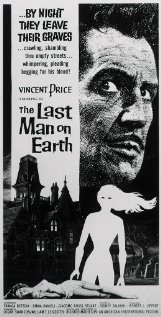
Book to Movie: The Last Man On Earth (1964)

Book to Movie: The Last Man On Earth (1964)
Screenplay by Richard Matheson (writing as Logan Swanson) and William Leicester
Directed by Ubaldo Ragona
Based on the novel I Am Legend by Richard Matheson

By 1963, Richard Matheson was an established novelist and screen and teleplay writer. He’d written for numerous television shows – most notably, The Twilight Zone. He’d adapted several Edgar Allan Poe works for American International Films, and he’d adapted one of his early novels, The Shrinking Man, into a screenplay retitled The Incredible Shrinking Man. In his second effort to adapt his own work, he apparently was not pleased with the result.

The Last Man On Earth closely parallels the Matheson novel. The main character is renamed Robert Morgan instead of Robert Neville. The movie opens with Morgan going through his daily rituals with Vincent Price (who plays Robert Morgan) providing voiceover narration.

In the movie version of Matheson's story, Morgan is a scientist who works with his friend, Ben Cortman at a laboratory that is searching for a cure to a pandemic that originated in Europe and is working its way to the United States. The disease turns ordinary people into vampires.

The film version fleshes out much more backstory on Morgan and his relationship with Ben Cortman than does the novel. In his novel, Matheson tells us that he and Cortman worked together and carpooled. He never describes them as friends. In the movie, they are close friends and neighbors.

The movie flashes back to the struggle to find a cure as the plague progresses. One day, Morgan comes home from work and sees a military truck loading a body from his neighbor’s house. As the plague progresses, the government goes from burning dead bodies to burning those infected but still alive.

Morgan’s daughter contracts the disease. Although he is supposed to report it, he does not, hoping against hope that he will develop a cure. His wife, desperate to relieve her daughter’s suffering, calls a doctor who reports the illness. Morgan arrives home just in time to see the truck carting away his sick daughter. He travels to the local burning pit in a vain effort to stop his daughter from being incinerated.

As in the novel, his wife becomes ill and eventually dies. He buries her and she comes back to him as a vampire. He kills her.

Most of the story elements from the book are included in the movie. He visits his daughter’s tomb and stays beyond dark. In the book, it’s because he’s dragged a zombie out into the sunlight and is conducting a study of its death. In the book he falls asleep until after dark. He races home, evades the zombies, but finds his car destroyed the next morning.

He also spots the dog. The movie encounter with the dog is reduced to just him chasing it and it returning the next day wounded and infected.

Where the movie takes a dramatic turn from the novel is near the end with the arrival of Ruth. Just as in the novel, he spots Ruth walking in a field and chases her down. He brings her back to the apartment and subjects her to the garlic test. He determines she is infected.

She discloses there that she is part of a group that has discovered a medicine that reduces the effect of the disease and allows them to move about in the daylight. Being a scientist, Morgan has an idea. He injects her with his blood which contains antibodies. Ruth is cured. She panics because she knows there is a group on its way to kill him. He is legend among her people for stalking by day, killing the innocent.

Ruth’s people arrive and break down the door. She pleads with them to stop, telling them he has found a cure. But the vampires give chase. He flees and ends up in a church. The vampires arrive in an assortment of miltary vehicles and corner him in the chapel. As Ruth looks on, they spear him with an iron fence post. He dies as Ruth looks on crying.

The entire community has gathered in the church to witness the execution. Ruth walks slowly back from the alter and sees a little girl crying. She walks over to the little girl and tells her to stop crying, there is nothing to fear anymore.

Of the movies based on I Am Legend, this is my favorite. Most movie fans tend to favor The Omega Man. I like it because it stays close to Matheson’s original story. However, it is hurt by poor production values. The film is shot in black and white which by 1964 screamed, “low budget.” It was filmed in Italy with a mostly Italian cast which required dubbing of dialogue.

While some of Price's narration whilst going about his lonely, daily routine was a bit hokey, the film captured Matheson's subtext of the pain of loneliness and the isolation of being the last of his kind in a world dominated by a new race of being. The Omega Man was much more action oriented with shootouts and car chases. I Am Legend was a medical thriller.

Matheson pulled his name from the film credits. According to Matheson, in an interview with Cemetery Dance Magazine, he felt that the movie was not well directed and that Vincent Price was not the best actor to play Robert Morgan.

The vampires in the movie more closely resemble zombies than vampires and I think it was probably this adaptation that created the zombie image in George Romero’s mind when he conceived Night of the Living Dead. In the book, some of the vampires are slow and stupid and often fall prey to the stronger, faster vampires. In the movie, they are all slow and dimwitted.

I saw this movie as a child and it made a strong impression on me – so strong that I made the effort to see it whenever it was rerun on television and eventually taping it to watch over and over again.

It apparently was not a success upon its initial release in 1964, but its reputation has grown. I think this is mostly due to Matheson’s rise in stature. More people have read the novel and appreciate the emotional depth of the story that may have got lost in the dubbing of dialogue and poor filming.

Saturday, August 4, 2012

I Am Legend By Richard Matheson

I Am Legend
By Richard Matheson
Copyright 1954

In his 1954 novel, I Am Legend, young novelist, short story writer, and screenwriter, Richard Matheson, redefined the vampire for modern audiences. His book, I Am Legend, provided some scientific explanation of the vampire phenomena and some spiritual insight as well. As much has he did to redefine the vampire, his novel was more a subtext for the human condition of isolation than it was a raucous tale of battling the undead.

Robert Neville lives alone in a world dominated by vampires. He is the last true man on earth with the rest of the population either dead or undead.

The novella opens by introducing the reader to Neville’s routine in his life. He’s lonely. He’s frustrated. And after two years of forced celibacy, he’s horny. During the day, he prepares garlic cloves to hang by his windows to keep the vampires at bay. He makes repairs to his house to keep it secure from vampire invasions. He makes wooden stakes and sets out to find and kill as many vampires as he can with those stakes.

At night, he listens to music powered by his generator in his garage, drinks, and listens to the vampire that used to be his coworker, Ben Cortman, call out to him, demanding he leave his house.

After two years of fearless vampire killing by day and drinking himself into oblivion at night, Neville decides to try to ascertain the cause of the disease and a possible cure. Neville suspects it’s an airborne pathogen and starts studying on the subject.

He learns a great deal about the biology of bacteria, blood, and how the two interact in the human body. He believes he’s isolated the bacterium that causes vampirism. He cannot figure out why vampires are repulsed by garlic, crucifixes, and mirrors. He theorizes that he is alive because, years before, he was bitten by a vampire bat that was infected and passed the antibodies along to him. As he ponders this, he grows frustrated trying to isolate all of the variables and gives up.

We flash back to Neville’s life before the plague. He had a wife and daughter. He worked in a factory and carpooled with Ben Cortman. His daughter died early in the plague. His wife caught it later. He tried desperately to keep her alive, but she, like everyone who got the plague, died. Instead of taking her body to one of the open pits where the government burned bodies to reduce the spread of the plague, he took his wife to a remote location and buried her. She showed up at his house a few days later as a vampire. He has to kill her.

One day while cleaning up after the undead in his front yard, he spots a dog out in the daylight. This is the first living creature he’s seen in more than two years. He first chases the dog, but loses it. He then begins to place daily offerings of food, milk, and water at his door to entice the dog. But before he can befriend it, it is infected and dies. Neville is devastated.

About a year later, Neville is wandering about the city when he spots a lone woman in a field, standing there in broad daylight. He chases her and eventually catches her. He takes her back to his house where he starts to question her.

Ruth says that she and her husband lived together in a fortified home in a nearby town. Since vampires got her husband recently, she’s been on her own. Despite her claims of having been victimized by vampires, she questions Neville on why he needs to kill them. She is intrigued by his studies of the vampire blood.

Neville had deduced that the stake through the heart is not necessary. Any wound that is not allowed to close will cause a vampire to die. Chemicals in garlic, when inhaled, cause pain in the vampire when the chemicals react with the virus. They can’t stand mirrors because they can’t stand the sight of themselves. Ruth listens attentively as he reveals all this.

Neville become suspicious and dares her to sample some garlic. She is repulsed by it. She says she’s sick of the smell, but is not affected by it. Driven by his desire for human contact, Neville dismisses his own doubts.

One night, Neville awakens to find Ruth fully dressed and evidently preparing to leave. Neville challenges her to submit a sample of her blood. She does so reluctantly. But as Neville is examining it, she knocks him unconscious and flees.

When Neville awakens, he finds Ruth gone and a note left behind. She tells him that she is a vampire and part of a large group of intelligent, civilized vampires that are trying to rebuild society. She was sent to spy on him. Neville has killed many of their group in his daily outings – including her husband. She warns him that the vampires will be coming for him and that they want to kill him. She urges him to flee.

Neville is tired of his life and tired of being alone. He no longer values his life and decides not to flee. He decides to live out his days in his home as the vampires rage about outside at night.

Several months later, Ruth’s prediction comes to fruition. Vampires with obvious intelligence and cunning come to Neville’s house. They rush in, beat him up and abduct him. He awakens in a prison. He lies in bed, unable to move because of the injuries he received in the beating. Ruth comes to him and tells him that he is to die by hanging. She says that there are hundreds of vampires assembled outside, awaiting his execution with great anticipation. Neville surmises that she is, in fact, their leader.

Neville resigns himself to his fate, even welcomes it. He tells Ruth to make sure that the new civilization is civilized and that they treat each other with kindness. Ruth responds with an act of kindness. She gives Neville some pills that will make his execution easier for him to endure.

The book ends with Neville coming to the realization that he is the last of his race and that a new race, the race of vampire, will now dominate the earth. Once upon a time, vampires were legends. With his passing, he, the human man, is legend.

Matheson doesn’t tell a lot of story in his short novel. There’s enough story and a strong enough story to make it compelling reading. But the subtext is loneliness. More than a raging vampire killer, Robert Neville is a lonely man who first rages against the cause of his loneliness, then tries to find a cause and solution to his problem before he passes into legend.

The book is one of the finest horror novels ever written and ranks among the most influential. It is revered by great writers like Stephen King and great movie makers like George Romero who used it as a blueprint for his groundbreaking independent movie, Night of the Living Dead. Its influence can be seen in King’s work in ‘Salem’s Lot, Robert R. McCammon’s They Thirst, and Dan SimmonsChildren of the Night.

It has been called the first modern vampire novel. But there is some debate as to whether it was really a vampire novel or a zombie novel. It adheres to the vampire archetypes with the garlic, the crucifix, the mirror, and the need for blood. But vampires have generally been held as intelligent, cunning creatures of evil. Matheson revised them. He created two different degrees of vampire. Neville notes that many are mindless, unintelligent plodders. Others, he notes, act with a degree of intelligence.

Those plodding, mindless vampires became the archetype for the modern zombie which has seen an incredible resurgence in the last five years with dozens of zombie movies and even a zombie television series in AMC network’s The Walking Dead. All of these modern zombie stories can be traced back to Matheson’s revision of the vampire archetype.

This is Matheson’s most noted and best known work, but certainly not his best. It is short which I usually appreciate. But I thought there was room for more backstory on Neville and the development of the plague. There was also room for more plot. With those shortcomings noted, it was still one hell of a book and is required reading of any fan of horror.

Four movies have been made based on the novel. The first was The Last Man On Earth in 1964. Matheson wrote the screenplay under the penname Logan Swanson and it starred Vincent Price. In 1971, it was heavily revised for the movie, The Omega Man, starring Charlton Heston which contains allusions to the rise of the counter culture of the 1960s as well as the power of the blood of Christ. In 2007, it underwent heavy revision to give it a medical thriller flavor in a movie called I Am Legend starring Will Smith. There was a fourth, direct to video release called I Am Omega which I have not seen.

Richard Matheson’s influence over the horror genre is difficult to overstate. While there are many examples, one need not look any further than I Am Legend to appreciate that influence.

Monday, March 26, 2012

Book to Movie: Night Call (1964)

Book to Movie: Night Call (1964)
Based on the short story, Long Distance Call by Richard Matheson
The Twilight Zone, Season Five, Episode 9
Original Air Date: February 7, 1964

By season five of the Twilight Zone, Rod Serling was burning out on the show. He told one interview by the time the show had reached its fifth season, which was a long run for a television show in the early days of TV, he could not tell a good script from a bad script anymore.

I think Serling was being hypercritical of himself and his fellow writer because I would rank it as the show’s finest season and the Episode Night Call as the show’s finer attempts at pure horror.

Matheson adapted his short story, Long Distance Call, into a 24 minute script. He changed the twist at the ending to fit the Twilight Zone motif, and made one of the better episodes of horror television I’ve ever seen. It was so far out of character for the show that, although I knew I had seen a television adaptation of the story upon reading it, I could not recall which show it was, thinking perhaps it was Thriller.

Just as in his short story, an old, infirm woman starts receiving strange phone calls at night. At first, there is silence on the line. She calls the telephone company who tells her a storm has knocked down lines and she is probably receiving errant phone calls. They assure her the problem will be fixed soon.

The calls continue. Instead of silence, there is a man’s distorted voice on the line, saying hello to her. She is frantic and frightened. She pesters the phone company to find out who it is calling her and to repair the line.

In the book, the calls start to become menacing. However, in Matheson’s script, there is only a the attempt to communicate. She finally tells the caller, “Never call here again!” and hangs up.

The next day, the phone company calls her to tell her they have located the problem. The old lady asks who was calling her. The operator says it is impossible for anyone to have spoken to her from the downed line because there is nobody at that location. That location, the operator tells her, is the cemetery.

Matheson’s story ends with one final phone call where the voice on the line assures her he “will be right over. . .” Matheson’s teleplay twists the story to give it a less chilling, but more shocking ending.

The old woman and her nurse travel to the cemetery. They locate the downed line. It is draped over the headstone of a man named Brian Douglas. Brian, the old woman tells her nurse, was her fiancé. He died a week before they were to be married. They were in a car accident together. She was driving and survived. He did not. “He would always do whatever I told him to,” she recalls fondly.

That night the phone rings. Instead of dread, the old lady answers it with anticipation, hoping to talk to her long lost love. She picks it up and screams, “Talk to me!” The voice replies, “I always do what you tell me,” and hangs up. She remembers bitterly her admonition to not call her again. She is left plaintively crying for Brian to talk to her.

The fifth and final season of Twilight Zone was not the subpar effort Serling thought it was. Many of the episodes I recall fondly from my childhood were in this season including Matheson’s Steel and Nightmare at 20,000 Feet. Other great episodes include The Old Man in the Cave, An Occurrence at Owl Creek Bridge based on the superb Ambrose Bierce story, Living Doll, and I am the Night – Color Me Black. The rock band, Rush, memorialized A Stopover in a Quiet Town in their song off the 2112 album, Twilight Zone. The best of the season, and in my opinion the best episode of all time, aired in the fifth season. That was Probe Seven, Over and Out.

Matheson was a master at adapting works to the big and small screen. He knew where to make changes to adapt the story, what to leave alone, what dialogue belonged and what didn’t. While Night Call might not be the finest example of this, it is perhaps the most textbook example of Matheson’s mastery of screen writing adaptation.

Tuesday, March 20, 2012

Book to Movie: Dance of the Dead (2005)

Book to Movie: Dance of the Dead (2005)
From the television mini-series, Masters of Horror
Directed by Tobe Hooper
Teleplay by Richard Christian Anderson

Richard Christian Matheson, son of horror writer extraordinaire Richard Matheson took one of dad’s more riveting short stories, expanded it, and made it into one of the finer episodes of this superb television series, Masters of Horror.

In young Matheson’s vision, we get flashbacks of World War III and a biochemical agent that kills or horribly disfigures those whom it contacts. Peggy has flashbacks to her sister’s birthday party when such an attack occurred and many of her friends were killed. When the attack comes, Peggy’s mother takes her two daughters into their home and locks the doors. The two young girls are forced to watch as The Fiz as it’s called, falls on their friends and neighbors and kills them.

All grown up to the sage age of 16, Peggy helps her mother tend to their diner in a rural town. World War III is over, but not much society or structure remains. The streets are essentially lawless (as in Matheson’s story). Young Matheson throws in an added element. Bandits rob people of their blood not for medical purposes, but for something vile and morally rancid.

Two blood thieves catch an old couple out for a walk and rob the woman of her blood while beating the old man. They then travel with their exceptionally slutty girlfriends to Peggy’s little diner.

Three of the group act as obnoxious and as intimidating as possible. One of the two young men, with hardened features and soft eyes (and played superbly by Jonathan Tucker) talks to Peggy. He entices her to meet him later for an adventure.

Mom spots the two mooning over each other and tosses out the whole group. She reminds Peggy that, with her older sister and father victims of the war, she has a duty to stay on and live a good and clean life. Most of all, she is to avoid the town of Muskeet, known for its lawlessness and licentiousness.

Her new beau, Jak, returns with his obnoxious friend and his girlfriend. She climbs into their car and they head for Muskeet. Along the way, they drink, huff inhalants, and “muscle tussle” which is slang developed during World War III which means to inject drugs into one’s muscle.

They arrive at a creepy pseudo goth club in Muskeet where Jak and his buddy are to sell their stolen blood to the club owner to give to his performers. While they deal with the owner, the girls are left to listen to the house band (featuring Smashing Pumpkins’ front man, Billy Corgan).

The deal for the blood is complete and the club host, (played over the top by Robert Englund), returns to the stage to announce the feature act of the night – Dancing Loopies. Loopies are dancing corpses. Loopy is slang for (L.U.P. or Lifeless Undead Phenomena). The MC assures everyone that what they are about to see is purely a scientific demonstration and not meant for entertainment. Such disclaimers are required by law.

An animated corpse is guided onto stage. Her body is fueled by the blood provided by bandits. Her dance motivated by repeated shocks from cattle prods wielded by stage hands. The dead body gyrates while industrial music pounds. Peggy is shocked and disgusted by what she sees.

Meanwhile, mom has found Peggy gone and pursues her to Muskeet.


The next Loopy performer is brought on stage and the cattle prodders go to work. She thrashes and kicks until her body is exhausted. She falls forward off the stage and onto the table where Peggy and her friends sit. Peggy looks into the face of the twitching corpse and recognizes it as her sister. She freaks out.

The gallant Jak, having promised Peggy that nothing bad would happen to her, grabs the corpse and Peggy and heads out of the club. The MC, seeing one of his most valuable performers being stolen, pursues them.

They meet in the street, each with a gun trained on the other in a standoff. Just then, mom arrives to try to take Peg home. The MC demands the return of his property. He says it’s rightfully his because he paid for it. He proceeds to then tell the story of how he acquired Peggy’s sister in a deal he cut with Peggy’s mother.

Just when it seems that someone must die in the standoff, Peggy speaks up and says that she will settle up with the club owner.

We then cut to a scene where Jak and Peggy are burying a body while Peggy cries over it. As that fades, we return to the club where the MC is introducing his new Loopy – Peggy’s mother.

A tip of the cap to R.C. Matheson and Tobe Hooper on an excellent piece of television horror. Matheson’s story, published in the 1950s and set in 1997, was a creepy piece of post-apocalyptic horror. R.C. Matheson modernized it. He added a new conflict to give the story the heft it needed to translate into the visual medium.

Tobe Hooper’s direction made the entire show dreary and foreboding. Bereft of cheap “gotcha” moments and excessive gore, Hooper delivers the chills the old fashioned way – with exceptional direction and cinematography.

Masters of Horror ranks as one of the finest horror anthologies I’ve ever seen. Dance of the Dead is one of the finest episodes of this fine series and one of the finer adaptations of Matheson’s work I’ve ever seen.

Monday, March 12, 2012

Book to Movie: Nightmare at 20,000 Feet (1963)

Book to Movie: Nightmare at 20,000 Feet (1963)
The Twilight Zone Episode 5.3
Original Air Date: October 11, 1963
Teleplay by Richard Matheson based on his short story, Nightmare at 20,000 Feet

Many consider the fifth and final season of Rod Serling’s innovative series to have been uneven. Serling himself said he was beyond being able to discern between good and bad scripts anymore. Certainly there were some bad episodes that final season. But there were a couple masterpieces in there as well. One of them was Richard Matheson’s adaptation of his own short story, Nightmare at 20,000 Feet.

The teleplay is almost a straight retelling of the short story as Matheson had written it more than a decade prior. The primary change was the addition of a wife with which Bob Wilson can interact. In the story, Wilson directs much of his terror inward with interior dialogue. The wife gave him someone with whom he could verbally interact with which was necessary for the story to work in the visual medium.

In Mathesons’ teleplay, Wilson and his wife board the plane. We learn he was recently released from a mental asylum after a six month stay. He’s still nervous and shaky. He’s also dreadfully afraid of flying.

Shortly after takeoff, he sees the creature on the wing (which the costume department outfitted to look like a morbidly obese teddy bear). He tells his wife and the flight attendants, none of which are able to see the creature who always jumps out of site just before they can see.

Finally, as he watches the creature start to dismantle the engines, Wilson decides he has to act. He steals a pistol from a sleeping police officer. The then opens the emergency hatch and begins shooting at the creature. He is eventually pulled in by the flight crew, confident that he hit the creature and saved the flight.

In the final scene, we see poor Bob Wilson, in a straitjacket, being loaded into an ambulance. He is calm and at peace because he knows he just saved his own life and the life of all the plane’s passengers.

This ranks as one of the most critically acclaimed and universally recognized of all the Twilight Zone episodes. A large part of that is Matheson’s brilliant script which plays into a very real fear suffered by hundreds of thousands of people. But I think part of the acclaim the episode draws comes from William Shatner’s performance.

Criticisms of William Shatner’s clipped dialogue deliver and penchant for overacting are as old as Shatner’s career itself which spans almost 60 years. Much of that criticism is warranted although a lot of it can be blamed on ham handed directing of the 1960s and 1970s.

Shatner’s maniacal, over the top acting style are precisely what the role of Bob Wilson called for. His eyes wide, his face fixed in a rictus of terror, Shatner delivers what might well be his one true tour de force of acting.

Also credit director, Richard Donner for building tension in the story. By the time Donner directed this episode, he'd already built an impressive resume in television directing with Combat, Have Gun, Will Travel, and The Rifleman. This was his first foray into horror/sci-fi and this was by far his best television work. He directed other fifth season episodes -- most of which were forgettable. Given a good script and a good leading man, Donner showed that he could direct outside of westerns and action shows.

Wednesday, March 7, 2012

Book to Movie: Trilogy of Terror (1975

Book to Movie: Trilogy of Terror (1975)
Teleplays by William F. Nolan and Richard Matheson
Based on the short stories by Richard Matheson
Directed by Dan Curtis

Trilogy of Terror was a made for television movie that aired on ABC in March 1975. It featured three stories, each authored by Richard Matheson. Each story bore the name of its female protagonist. William Nolan – known best for his scripts for Logan’s Run and Burnt Offerings adapted two of Matheson’s stories. The final (and best) script was penned by Matheson himself. All three segments star Karen Black.

The first story is entitled, Julie and is based on the short story, The Likeness of Julie. In the Matheson story, the nasty college student falls for a plain-Jane student who sits behind him in literature class. In this screen version, it is the lit professor for whom our evil antagonist falls. Nolan sets the misogynistic tone right away when Chad and his buddy are sitting on the campus, discussing how ugly all of the female students are. When Julie, the lit professor walks by in her brown wool sweater and wool skirt cut far below the knees, Chad just has to know what flesh lies beneath all that wool.

As in the story, he takes her to a drive in theater (where they are watching the Matheson film, The Night Stalker) and drugs her. Being made for television, we are left to our imaginations to recreate what happens in the cheap motel room later.

Chad’s an amateur photographer and takes pictures of Julie. Again, our imaginations are having to do the work here. He demands that Julie meet him. They drive out into the country in Chad’s stunningly beautiful 1972 Mercury Cougar XR7 Convertible where Chad shows her the photos and informs her that she will gratify his every demand.

So it goes for awhile. Chad demands and Julie submits. Her roommate is worried about her hours and her morose disposition. Julie assures her it’s nothing to worry about.

One evening, Julie is at Chad’s and without notice, her mousy countenance changes and her appearance takes on a menacing quality. She informs Chad it’s over. She’s done. She’s done because she’s bored. Chad tells her it’s not over until he says it is, believing he’s still got her by the short hairs. Julie tells him the whole affair was never his idea. None of it was. Chad perishes when the chemicals in his developing studio catch fire.

The next day, a student failing literature arrives at Julie’s house. He needs help. Julie is willing to oblige.

This was well scripted and Black takes the “turn” in magnificent fashion which I’m sure was stunning for television audiences in 1975 who’d not read the story. With Karen Black covered in all that wool, I couldn’t keep my eyes off of Chad’s stunning car. What a beauty she was!

Millicent and Therese are sisters who live together in a luxurious mansion left to them by their father. Millicent, an uptight, prudish woman, pesters the family doctor with complaints about her coquettish sister, Therese. Therese seduces men. She leaves her cigarettes burning in the house, their tips resplendent with her deep red lipstick. Millicent wants the doctor to something about Therese.

One of Therese’s “suitors” arrives at the home and encounters Millicent who is there to rant and rave about her sister’s moral depravity until the poor guy leaves.

The doctor arrives and finds Therese in the home. She tries to seduce him, but he’s not having it. He talks to Therese, trying to draw her out, but Therese has but one thing on her mind. The doctor leaves.

When the doctor does nothing to help her, Millicent decides it’s time to take matters into her own hands. Gathering the necessary materials, she constructs a voodoo doll of Therese and plans to kill her.

When the doctor returns to the house, he finds Therese dead. Millicent has fled the scene, or so it would seem. When the authorities arrive, the doctor explains that the prudish Millicent is actually Therese. Therese slept with her father and killed her mother. She then developed a dual personality disorder, creating the prudish Millicent to cope with the prurient Therese.

This segment was not good at all. I stop short of saying it was awful, because there was nothing in it that made you groan with bemusement. But the story’s twist was obvious about five minutes in and there was nothing particularly horrifying about it. Black’s portrayal of Millicent was over the top and she seemed to be phoning in the part of Therese.

I’ve not read the short story upon which this segment was based. But I have to believe it was more textured and nuanced than the made for television segment.

The third and final segment is entitled, Amelia and is universally regarded as the best of the three. Black plays a woman stalked in her New York apartment by a Zuni Fetish doll. It is based on the Matheson story, Prey.

Amelia buys her boyfriend a Zuni Fetish doll for his birthday. In the story, it was because he loved to hunt. In the movie, it’s because he’s an anthropology professor. The chain that keeps the doll’s wild hunting spirit at bay comes off and the doll, with his tiny spear and Amelia’s kitchen knives, pursues Amelia through the apartment and proceeds to cut her up just a little bit at a time.

I won’t choreograph the entire chase here. Black stands alone in a one woman performance paired with a doll and at least one puppet.

We think Amelia has won the contest when we hear her call her domineering mother and invite her over in the sweetest voice possible. We know differently when we see Amelia put down the phone, pick up the knife, and crouch in a stalking position inside the front door, rhythmically pounding the knife into the floor and swaying back and forth to drums only she can hear. And the smile! The haunting, disturbing smile on Black’s face in the end is spine tingling!

Amelia reminds me very much of the episode of the The Twilight Zone, The Invaders where Agnes Moorehead delivers a stellar, one woman performance as she fights off tiny invaders from another planet. She does it without a single line of dialogue. Black’s performance doesn’t quite rise to that level, and there is dialogue to drive the story, but it is in the same ballpark and that is high praise.

For 1970s television, Trilogy of Terror was creative and provocative. Karen Black shows that she’s a versatile talent and her performance in Julie and Amelia outshines her performance in the better known, Burnt Offerings.

Apparently, the movie of the week was supposed to be a vehicle through which Matheson and Nolan hoped to launch a television series. Matheson had worked on concept development (although he did not contribute scripts) to a horror anthology show originally entitled Ghost Story and renamed Circle of Fear in its second and final season. The show, which featured some great scripts and acting did not survive. I remember it terrified me as a child and its scripts were hard core horror (at least for television audiences of the 1970s). It terrified me as a child. Alas, it did not survive and, along with Night Gallery, was canceled in 1973, leaving a void that perhaps Matheson and Nolan hoped to fill with slightly tamer, more ponderous fare.

Sunday, February 5, 2012

Nightmare at 20,000 Feet by Richard Matheson

Nightmare at 20,000 Feet
By Richard Matheson
Copyright 2002

Introduction by Stephen King
Stephen King, unrivaled master of the genre of horror, credits Richard Matheson for reinvigorating it after masters such as Robert Bloch abandoned it in the late 1950s. Without Richard Matheson, there would be no Stephen King.

It is remarkable that it is Matheson that King looks to and names as his inspiration. Not because Matheson is not worthy. He is one of the most remarkable writers who ever lived with extensive work in books, television and movies. It is remarkable because Matheson’s prose is delightfully honed. King’s prose is expansive and massive. No two writers could be more different in their style.

Nightmare at 20,000 Feet

A man who desperately fears flying, boards a DC 7 and prepares for takeoff. When they reach a cruising altitude, he looks out the window and sees a strange creature capering about on the wing with intent to do harm. He tries to convince the flight crew that there is something out there.

This finely told story was made into one of the most famous episodes of the Twilight Zone. It was a pleasure to read it as Matheson had laid it down in print for the first time all those years ago.

Dress of White Silk
A little girl lives with her grandma in the home where her mother died. When one of her friends comes to visit and pokes a little fun at her and her dead mom, our little heroine puts on a brutal fashion show for her tormentor.

Written in the patois of a six year old girl, Matheson tells a simple and inelegant tale of supernatural revenge with flair. Bravo! It was this story that, according to Ann Rice, inspired her to write horror.

Blood Son
This is the tale of a boy born to be a vampire. At a young age, he is drawn to all things that involve vampires. He disturbs his teacher and fellow classmates with lurid tales of vampirism told in class. He steals a vampire bat and allows it to drink his blood. His entire life is dedicated to achieving status of the undead.

Matheson is really the anti-Poe. Poe used lofty rhetoric and obscure words to weave his tales of terror. Matheson’s use of simple language and sparse prose is just as effective. Nowhere is that more evident than in this tale.

Through Channels
Police interview a teenager who has arrived home to find his parents and their friends dead. The friends had come over to watch television. But on the family television, instead of a test pattern, the word, “feed” is sometimes displayed. When the kid comes home to the carnage, he finds one of the e’s is gone, changing the word to past tense.

Here we see Matheson adopting the style of Isaac Asimov, driving his story almost entirely through dialogue. The tale is told through a series of tapes of the interviews the police conduct with the kid.

Witch War
A group of young, teenage girls use their magical powers to destroy an army of attacking men.

Matheson’s writing here is so sparse, that there is nary a complete sentence in the prose. Most of the narrative is sentence fragments and prepositional phrases. I’ll give him credit for trying an offbeat writing style, but the story didn’t work for me. I got the cold dispassion from the girls, but didn’t feel any sense of loss or injustice when the men, who were not developed in the narrative, died.

Mad House
A teacher becomes so bitter, angry, and depressed, that his rage is transferred from him to the inanimate objects within his home, making the most mundane and everyday tasks untenable and maddening.

All I can say is sometimes, I can relate. . . What a wonderful story.

Disappearing Act
A journal is found in a coffee house, three hours after its owner and writer left it there. It tells a story of a young man, in constant conflict with his wife about his inability to earn enough to support them. After a one night stand with a woman he meets in a bar, he chronicles the slow and random disappearance of all the people and places that make up his life.

Matheson’s tale is a first person narrative taken from a journal. He is able to tell his tale to its conclusion without providing a reader a clue as to why the man’s life is disappearing one person and place at time. The not knowing is always more satisfying than a ham handed explanation.

Legion of Plotters
A mild mannered tie salesman is driven slowly mad by life’s petty annoyances. The bus passenger who sits next to him daily and sniffs constantly, the nightly cries of the baby next door, the parties held by the neighbors upstairs, the cigarette smoke of restaurant patrons all add up to drive him toward madness. He starts to documents life’s little annoyances and grade them. He comes to the conclusion that the world is plotting against him.

I get the impression that little misbehaviors on the part of others really annoys Mr. Matheson. This story is much like Mad House. The focus on irritants by the main characters drive them to madness with sad results.

Long Distance Call

An old woman, bedridden and helpless at night, continues to receive strange phone calls during the wee hours. At first, there is just silence on the line. Then attempts at communication, with the person saying, “hello.” The woman demands that the phone company check out the line. When they do, our little old lady is shocked at where the calls are coming from. Late that night, she receives another call and her mystery caller informs her that he’ll be right over.

This is the stellar stuff of great black and white movies that used to entertain me as a child. This story is a little longer than some of Matheson’s material, but not a word is wasted. We know the voice is supernatural (after all, it’s a Matheson story), but Matheson’s ending was brilliantly conceived and written, letting us know what horror is to come, but not showing us.

I am troubled by this story because I know I’ve seen it on television, but don’t know where. There was a Twilight Zone episode called, “Long Distance Call,” but that was the one where the little boy with constantly fighting parents used the toy phone to call his dead grandmother. Great story, but it was not Matheson’s. I’ve Googled it, but can’t find it. I’d love to know where I saw this.

Slaughter House
The narrator tells how he and his bachelor brother purchase a large, old home that had stood vacant since they were kids. They restore it to its original state and settle into a comfortable existence. Over the fireplace stands a picture of a nameless beautiful woman that fascinates them. Soon, the younger brother becomes slothful, angry, and incommunicative. His brother fears he’s been overtaken by a malevolent spirit that resides in the home.

The story was ok, if not terribly original. What was remarkable about this story and what made it interesting to read was the writing style. The style here was a departure from Matheson’s sparse prose. The plot, the characters, and the style of writing were all reminiscent of the screenplays he cranked out for American International Films in the Poe adaptations and other scripts he authored for Roger Corman in the early 1960s.

Wet Straw
A man living alone in a boarding house has a recurring dream where he smells wet straw. Soon, the dream evolves into a recollection he and his now dead wife had when they were young, waiting out a rainstorm in a hayloft. His recollection of this seemingly romantic memory masks memories of the unfortunate conclusion of their marriage – and her life.

This story was suitable perhaps for grade schoolers. The twist, such as it was, was reminiscent of ghost stories kids tell each other.

Dance of the Dead
The setting is post apocalyptic Missouri and four teenagers are en route to a club in St. Louis to see a remarkable night show act with a horrifying star. Three of them are enthusiastic about getting to the show, using drugs to get into the right state of mind. The fourth has serious reservations about seeing this grisly show.

This was one of the darkest post-apocalyptic stories I’ve ever read. It brought to mind horrid images of the emaciated figures of the German concentration camps (though Matheson does not use that simile in his text). One of his finest efforts.

This story was made into an episode of the television show, Masters of Horror television series that aired on Showtime. The script was penned by Matheson’s son, Richard Christian Matheson, and was directed by horror legend, Tobe Hooper. Young Matheson expanded on ideas introduced by his father and revealed an imagination as dark and inspired as his father’s.

The Children of Noah
A holiday traveler in New England is stopped for speeding in a small Maine town. He is put in jail overnight until he can see the judge in the morning. He is told the next afternoon that the judge is sick, so they’ll have to go to the judge’s house for him to hear the case. The man is taken to the judge’s house, sentence is passed, and the visitor is invited to dinner.

Even the greats write stories that become dated. This story is dated. It may have surprised readers in the 1950s with its twist, but the twist, even though it was not telegraphed, came as no surprise to the modern reader who’s seen it many times before.

The Holiday Man
No one likes to work holidays, but one man has the horrific task of calculating holiday death tolls. What makes him so good at his vocation is that he makes the calculation before the holiday, and sees every one of them unfold before his eyes.

This is an example of Matheson being too sparse with his prose. The story idea is great and there is a gift in being able to tell a great tale with just a few words. This story, however, begged for more character development and more plot.

Old Haunts
A middle aged man returns to the boarding house in which he lived while attending college, hoping to take a nostalgic trip down memory lane. He rents the room and then begins roaming the area, seeing old haunts. He feels as if he’s being watched or followed. Instead of bringing back good memories, the trip instead has him reflecting on a life wasted. As he goes to sleep that night in his old room, a figure appears telling him he can’t come back and he needs to get gone.

This is obviously a supernatural midlife crisis. Each of us has returned to someplace formative in our lives, relived the memories there, and thought about how our lives might have been different had we seized different opportunities. Unfortunately for Matheson’s character, his younger self isn’t happy with the choices his older self made.

The Distributor
A new man moves into Joseph Alston’s neighborhood and promptly introduces himself to Alston as Theodore Gordon. At first, Gordon seems amicable enough. But soon, he starts to “redistribute” the belongings of his neighbors. When they complain, Gordon seizes control of the neighborhood through nefarious and prurient means.

Theodore Gordon must be a Democrat. . .

Crickets
A vacationing couple encounter a man who claims he’s decoded the language of crickets. These noisy nocturnal insects, he tells them, telegraph the names of the dead. He tells them that he’s heard his own name on the crickets’ list and he wants their help.

Crickets as psychopomps is an interesting concept. They are black like death. They haunt the night. I’ll never listen to a cricket again without wondering whose name they are chirping. Brilliant story!

First Anniversary
A man kicks off his first anniversary with his lovely bride by telling her she tastes sour. She is peeved. Then he quits tasting, smelling, and feeling her. It’s finally time for him to face some hard realities and she’s going to make him do it.

I knew it was a space alien – and it wasn’t. Matheson comes at marriage from an unlikely direction and creates an intriguing story.

The Likeness of Julie
A college student in is inexplicably attracted to the plain, childish looking girl who sits behind him in his literature class. He’s more than attracted to her. His emotions devolve into violent fantasies of rape and debasement. He hatches his plan of debauchery and asks her out. But whose idea is it really?

Definitely not one of Mr. Matheson’s most politically correct stories. But the woman gets the last laugh and we find that the poor college student, whom we come to loathe in the narrative, is actually the victim. Matheson stories have more twists than a hemp rope.

Prey
A woman buys a Zuni fetish doll for her boyfriend who likes to hunt. The doll is called He Who Kills and the package comes with a warning that the little gold chain must be kept on the doll to keep the Zuni spirit at bay. But when she is arguing with her mother on the phone, the doll is knocked over and the chain comes off. The woman fights for her life against a six inch tall Zuni hunter.

This is one of Matheson’s best known stories, made famous by the television horror movie, Trilogy of Terror which starred Karen Black in three different roles in three stories based on Matheson’s work. This segment, entitled Amelia, was the only one of the three in the movie given the screen treatment by Matheson himself. The story is average, but the transfer to film is brilliant. King gave it an update, using plastic toy soldiers in his story, Battleground from Night Shift. In the Nightmares and Dreamscapes television miniseries episode based on the King story, the doll appears briefly in a shot – King’s homage to his mentor.