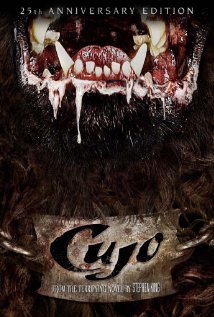
Cujo
CujoBy
Stephen KingCopyright 1981
Vic Trenton is a man with a lot of problems. His fledgling advertising agency has been beset with a major, national public relations crisis. His wife has been cheating on him, and worst of all, his
Ford Pinto has a stuck needle valve in the carburetor. While problem number three should be the least of his problems, it is that mechanical difficulty in one of the worst automobiles in American automotive history that brings Vic’s world crashing down around him.
Cujo opens with a brief recounting of the horror that befell Castle Rock, Maine just a few years prior – the police officer, Frank Dodd – a monster that stalked, raped, and murdered young women in the town. Castle Rock, King the narrator tell us, is a town that has known monsters.
Vic Trenton lives in
Castle Rock with his wife, Donna and his four year old son, Tad. Like many children of four (yours truly among them) Tad lives with the belief that a monster inhabits his walk in closet. Young Tad Trenton lives in fear of monsters in a town that has known monsters.
Vic and his business partner Roger, own an advertising agency with one major client, a manufacturer of breakfast cereals. The lucrative annual billing from that company has allowed them to move their agency from the big city of New York to rural Maine and establish comfortable lives for themselves and their families.
They have created a commercial character who, in the commercials, samples the cereals, and proclaims, “Nothing wrong here!” The catch phrase enters the national lexicon much like that old Wendy’s slogan, “Where’s the beef?” But there IS something wrong there. The company’s newest cereal, a berry flavored concoction, has as an ingredient a red dye that, while not toxic, causes profuse vomiting which, when ejected from the body, resembles blood. While the FDA is quick to put to rest any fear of mass poisonings, the company’s reputation takes a major hit and becomes the butt of a national joke.
Roger and Vic know that they must find a way to meet this public relations crisis, and quickly, if they are going to keep their major client and their business. They decide they must travel to Boston to meet with their video team, then on to New York to meet with public relations people, before moving on to the cereal company’s headquarters in Cleveland to pitch their solution to the company’s public relations nightmare.
Joe Camber lives outside of Castle Rock in rural Maine with his wife, Charity and their son, Brett. He makes his living fixing cars for local residents. The Cambers own a big, affable St. Bernard named Cujo who is as good as a good dog can be. Cujo is everybody’s friend.
As we come to learn through reading the stories of Castle Rock, many Castle Rock residents harbor dark secrets and Donna Trenton is one of them. She has been carrying on an affair with an itinerant. furniture refinisher. But she’s resolved to break it off, no longer excited by the illicit sex and secrecy of it all. When her lover, Steve Kemp shows up at the house, she spurns him and tells him to stay away from her from now on. Kemp, his huge ego bruised, does not take the breakup well and resolves to inflict cruel revenge.
One evening, as the happy family is returning from a shopping trip into town, their Ford Pinto begins to lunge and sputter. The car misbehaves for awhile before settling back into smooth operating condition. Vic diagnoses the problem as a faulty needle valve in the carburetor. He tells Donna that, while he’s gone to New York, he should take the car out to Joe Camber’s garage and get it fixed.
Meanwhile, the unlikely villain in our story is engaged in his favorite pastime – chasing things. Cujo chases rabbits, birds, and squirrels not to kill them, but for the simple joy of the chase. Cujo is not a killer, he’s a good dog who loves his boy, his man, and his woman.
Cujo’s pursuit leads him to a small hole in the ground that opens into a large, limestone cavern which serves as home to a flock of bats. Cujo sticks his muzzle into the hole, determined to capture his quarry. One of the bats bites Cujo on the nose. That bat has rabies.
Steve Kemp decides on the method of his revenge. He writes a crude note to Vic that says, in crude terms, how much he enjoyed having sex with Vic’s wife. To authenticate the letter, Kemp includes a short note about the placement of a mole on Donna’s body. He mails it to Vic’s office and then prepares to clear out of town.
Charity Camber also harbors a secret – one she decides to share with her husband. She has one the lottery to the tune of $5,000. This is a lot of money to the Cambers who get by on Camber’s repair work, but have little to show for it. Charity wants to visit her younger sister whom she has not seen in several years.
Joe Camber is not the most compassionate husband in the world. He is cold, distant, and prone to using his hands to make a point when the marriage takes a turn that doesn’t suit him. Charity knows that Joe resents Charity’s husband – a successful lawyer – and the money he earns. She concocts an elaborate bargain to gain Joe’s ascent.
She purchases a an engine puller for Joe's Garage that will allow Joe to take on and complete larger jobs faster. She presents Joe with the gift and asks permission to go to Connecticut to see her sister. At first, Joe adamantly refuses. Then, he figures with Charity and Brett gone for a week, he’ll have a chance to go to Boston with his buddy, Gary so they can go drinking and whoring. He agrees.
Vic receives his note and is shattered. Not only does he have to deal with the prospect of losing his livelihood, he now must confront the possibility of losing his family. He confronts Donna who is repentant and supplicant. She wants to save the marriage. Vic is undecided and uncertain about his marriage, but knows if there is any future for the marriage or for himself, he must make this trip to save his agency. Two days later, he takes off for New York with his partner, making no commitments one way or the other to his wife.
Charity Camber and her son Brett, board a bus and take off for Connecticut. After they depart, Joe goes to Gary’s house to plan their Boston debauchery. Cujo lays in the Camber garage, suffering and pondering his new misery with a heat and hatred building in his diseased brain.
Joe returns home that evening to find that Cujo is not around. He does find that Cujo, the most obedient and well mannered of dogs, has taken a dump in the middle of his garage. Joe is puzzled. This simple act, so out of character for his good dog, makes him suspicious, but he finally reasons that Cujo is simply upset about Brett leaving.
He summons Cujo to mete out some discipline but Cujo is not around. Cujo has gone to Gary’s house. Gary greets Cujo who he knows is a good dog. But Cujo is good no more. The 200 lbs dog sets upon Gary and rips him apart in an effort to rid himself of the painful fever ripping through his brain.
As Vic takes off for New York, Joe Camber prepares for his trip to Boston. He goes to Gary’s house to find the carnage in Gary’s living room. As he is pondering the mess, Cujo shows up. Joe’s last thoughts are of what could have happened to turn his good dog bad.
Cujo goes home to seek solace in the dark garage, his head raging with pain and fever.
The Camber home, in the rural woods of Maine, is empty except for its lone canine inhabitant whose desires are to be in the dark and quiet and to kill whatever disturbs his uneasy rest.
As Donna and Tad are returning home from a trip into town for ice cream, the Pinto starts to act up again. She nurses it home and decides that she will take it to Joe Camber’s garage the next day.
As she prepares to take the balky Ford out into the country to Camber's Garage, she tries to leave Tad with a babysitter. The skittish Tad doesn’t want to be left with a babysitter and is afraid of the monster in his closet. He wants to stay with his mom. Donna relents and allows Tad to come along.
The Pinto runs smoothly for most of the trip out through the Maine country roads. However, as they are just getting ready to turn into the Camber door yard, it balks, lunges, sputters, and dies in the driveway. She counts herself lucky to have made it to the garage. She gets out to find Camber, but it’s apparent that no one is home. As she looks around, she hears the throaty growl of a wild animal. Cujo, the loveable St. Bernard she had met months before when she and Vic had been at Camber’s house for a repair, emerges from the garage.
Cujo is no longer a good dog. His red, rheumy eyes hold malice. Strings of viscous slobber dangle from his powerful jaws, and foam covers his muzzle. He knows this woman and this boy are the cause of his agony. He is determined to kill them.
Donna makes a break for the car and barely gets inside before Cujo slams his bulk against the car repeatedly. She tries to start the engine without avail. She and Tad are alone. Nobody is in the Camber home. Nobody plans to be at the Camber home for at least a week, and her only means of escape is one of the biggest hunks of junk to ever come off a Detroit assembly line. Meanwhile, the summer sun beats down on the Pinto, heating its interior to intolerable temperatures.
Tad and Donna spend the night in the hot, sticky comfort of Ford vinyl seats.
In Connecticut, Brett Camber worries that no one has made provisions to feed his dog while he is away. Charity tries to call home to ascertain if Joe is home. There is no answer she can hear, but Cujo, enraged by the sound of the phone ringing in the house, answers by throwing himself against the door of the house and then launching into another attack on the Pinto, cracking the window and buckling the door. Finally, exhausted by the heat and the toll of his fatal disease, he collapses to rest in front of the Pinto.
Steve Kemp, cooling his heels in a rundown motel outside Castle Rock, also has hate festering in his head. His note hit Vic hard. He knows that. But his lust for revenge upon Donna is not slaked. He decides to return to the Trenton residence to mete out a little revenge and perhaps a little rape. He gets there and finds the house empty. He flies into a rage and trashes the home, then flees the state in his van.
Vic is working overtime with his partner to try to save their account. They have an idea and are working with videographers to develop a script and shot sequence. Vic tries to call home several times, to no avail. At first, he is able to develop plausible reasons for his wife and son to be gone. But eventually grows alarmed. He calls Castle County Sheriff Joe Bannerman for help.
Meanwhile, Donna is growing desperate. The unrelenting summer heat in a sealed car is taking a toll on the young boy who is having seizures and slowly dying of heat stroke. She resolves to try for the Camber back door to get into the house and call for help. She exits the car and starts for the door. However, Cujo has been waiting for this moment. Having concealed himself at the front of the car, he springs at her. Donna grapples with the dog who bites her in her midsection and her thigh before she is able to drive it off by driving her thumbs into Cujo’s eyes. She returns to the car, bleeding profusely and probably infected with rabies.
A Castle County deputy is dispatched to the Trenton residence and finds Steve Kemp’s handiwork. With
memories of Frank Dodd fresh in his memory, the deputy and Sheriff Bannerman assume the worst. They call Vic Trenton who abandons his advertising project to come home.
State investigators swarm the Trenton home to gather evidence and question Vic about possible motives. They suspect that Steve Kemp has kidnapped Donna and Tad. However, one of the state guys notices that Donna’s Pinto is not there. Kidnappers don’t usually bother kidnapping vehicles along with people. While he doubts that it is an important detail, he doesn’t want any details overlooked. Vic tells them that the Pinto had a bad carburetor and that Donna had talked of taking it to Joe Camber’s garage. Sheriff Bannerman is dispatched to check out the Camber residence.
Bannerman arrives and is surprised to see that the blue Pinto is indeed parked in the driveway. He approaches the car and sees the damage to the driver’s side door and the two motionless figures in the front. Just as he sees Donna stir, Cujo sets upon Bannerman. The sheriff of Castle County who brought a horrific serial killer to justice just a few years before is no match for the animalistic killer that he meets in the Camber door yard. Cujo eviscerates Sheriff Bannerman.
Donna, working herself out of her heat and thirst induced delirium knows it’s now or never for her and her son who lies at death’s door. She jumps from the Pinto and grabs a wooden baseball bat. She and Cujo square off.
Vic is alarmed that no one has heard from Sheriff Bannerman and takes matters into his own hands and heads for Camber’s. Along the way, he passes Gary’s house and sees Camber’s car in the driveway. He stops to see if Camber is there. He walks into Gary’s house and finds the remains of the two men. He knows a monster is loose and knows that his family is in terrible danger. He flies toward Camber’s house, less than half a mile away.
Cujo leaps at Donna and she swings the bat with the might of Ted Williams and breaks Cujo’s ribs. Cujo gathers himself and makes another leap. Donna connects with Cujo’s hindquarters, breaking his hip. Not to be denied revenge on the woman the irrational dog is certain is the cause of his agony, Cujo makes one final leap. Donna swings for the fences and connects with Cujo’s head. Cujo falls to the ground dead.
Vic pulls into the door yard just in time to see Donna’s final swing. He runs to the car and pulls his son out and takes him to the shade. Donna, now in a mindless frenzy, pounds Cujo into a shapeless pulp. She is stunned out of her frenzy when Vic asks how long Tad has been dead.
Donna’s mind enters a whole new realm of frenzied action, trying to breath life back into her son’s lifeless body. Vic uses the Camber phone to call for help, but it is too late for Tad. The monster his dad assured him was not real, finally got him.
The book ends with Charity Camber looking forward to the rest of her life with mixed emotions. She is relieved to be unburdened of her slovenly, wife beating husband, but is sad for her son who has lost his father and beloved pet. She finds that by selling Joe’s equipment and by collecting on his life insurance policy, she and Brett will have enough financial breathing room to figure out where to go from there.
Vic and Donna reconcile. They grieve and they move on. Vic’s PR plan is accepted by the client and his agency is awarded with a new two year contract. Donna and Tad have time to figure out where to go from there.
As for the town of Castle Rock, more evil and misfortune lies in store. . .
I’ve read this book four times and I do not like it. Why read it again and again if I don’t like it you ask? Because, for the most part, it is exceptionally written and it is a good story with a strong premise.
I don’t like the book on an emotional level. First and foremost, I hate reading about Tad’s suffering. I think all but the most loathsome of us hate to see or read about children suffering. But for some reason, I am hyper sensitive to it. My wife finds it intriguing that I can read what I read and watch the television and movies that I watch, but I can’t stomach even the mildest amount of discomfort inflicted upon a child. I don’t know why that is, but it’s the way I’m wired. As you might imagine, I loathe the ending.
I’m also not particularly happy that an adulterous wife is the hero of the novel. I understand the concept of anti-heroes and redemption being powerful vehicles for stories. But Donna Trenton isn’t written as an anti-hero. She is remorseful, but not remorseful enough for me to be sympathetic toward her.
King’s writing through most of the novel is as tight as anything he has ever written. He cleanly and plausibly sets up the predicament. There’s no extraneous development of peripheral characters for the most part. The story is well paced and Vic Trenton is among the most sympathetic of all of King’s characters.
King usually visits the mind of his monster or villain to provide glimpses of their motivation. He does that better than any writer I’ve read. However, here the monster and villain is a dog and I absolutely loathe when writers try to write from the point of view of an animal. They usually have the animals engaging in reasoning and interior dialogue. Dean Koontz does this frequently and it’s just foolish since, while animals can adapt their behaviors and solve simple obstacles, they can’t reason. King keeps Cujo’s thoughts quite simple. Cujo doesn’t reason. He feels and we all know that animals – especially dogs are capable of complex feelings.
King really twists the roles of hero and villain and deserves a great deal of credit for pulling it off, my own personal feelings aside. The hero: an adulterous wife. The villain: a loveable, oafish dog. That’s an original twist.
The primary weakness of the book is King can’t decide if Cujo’s nature is part of a broader evil that lurks in Castle Rock or if he is an animal driven mad by rabies. He makes frequent reference to an evil that lies inside Tad’s closet. That is never developed. He also mentions an evil that resides in Castle Rock first manifested in Deputy Frank Dodd of
The Dead Zone. But he never connects that evil, if it does exist, to Cujo. In fact, in the entire Castle Rock cycle of novels, that concept of an evil entity or being never really develops. When true evil finally manifests itself in Castle Rock, it comes in the form of a visitor in the final novel,
Needful Things.
The other primary weakness is toward the end, King feints at character development of one of the most peripheral characters – that of the assistant district attorney who is at the Trenton home to lead the investigation. This is a bit character, but King pauses in the heat of his climax to give us a page of backstory on this guy that leaves you wondering why he wasted his time.
Most King fans rank this as one of his weaker works. I put it in the middle. Not as good as
The Talisman, but better than
Eyes of the Dragon. Many King fans revisited the story when King disclosed in his book,
On Writing, that because of his alcoholism and drug addiction, he had absolutely no recollection of the writing of this book. He wrote it surrounded by piles of empty beer cans and with cotton stuffed into his nose to staunch the bleeding from cocaine use.
The next story in the Castle Rock cycle is
The Body from the anthology,
Different Seasons, which is a poignant and haunting coming of age story that is absolutely bereft of supernatural content. That story stands as one of his best and most revered by King fans and fans of mainstream stories and movies.