Showing posts with label Stephen King movies. Show all posts

Saturday, July 30, 2011

Book to Movie: Apt Pupil (1998)


Book to Movie: Apt Pupil (1998)
Screenplay by Brandon Boyce
Directed by Brian Singer
Based on the Stephen King novella Apt Pupil first published in Different Seasons

In 1998, Stephen King’s novella from the book, Different Seasons was made into a movie starring Ian McKellan as Arthur Denker/Kurt Dussander and Brad Refro as Todd Bowden.

It was the third and final story from Different Seasons to make its way to the big screen and the least successful of the three.

According to an IMDB contributor, King was so eager to have Bryan Singer direct the picture that he relinquished the rights to the story for just $1.00.

The movie very closely follows King’s story. Like the novella, the movie is exceedingly dark. There are no throw away laugh lines. There are no light moments. From beginning to end, Singer’s film is as dark as King’s darkest works.

There are minor deviations from the story. In the novella, Denker hatches the plan to deceive Todd’s guidance counselor by having Denker pose as Todd’s grandfather. This was an important turning point in the story because this is where Denker explains to Todd that no longer does Todd control Denker’s fate; their fates are entertwined.

In the movie, for no obvious reason, Denker just shows up posing as Todd’s grandfather. Todd is briefly taken aback to find Denker sitting before his guidance counselor before playing along with the ruse.

Usually, Hollywood is wont to add to the body count of story to bring more action to the screen. Boyce’s script actually reduces it. The novella’s narrative takes us through at least two of Denker’s murders and two of Todd’s. While the murdering habits of both are referenced in the movie, the only murder we see outright is the fateful murder that leads to Denker’s heart attack.

Boyce took it upon himself to rewrite the climax of the movie. The reasons for the first part of the rewrite are obvious: to create a palpable tension on screen. In the novella, guidance counselor, Mr. French (played by Friends veteran, David Schwimmer), learns of his deception via a phone call to the boy’s grandfather. If they novella had a weakness, it was the motivation for making this phone call. French made the call because he had nothing better to do with his time that day.

In the movie, he encounters Todd and his parents at his graduation and makes mention of the “rough patch” Todd had gone through years earlier. The parents are obviously confused and Mr. French suspects he’s been had. However, the bell summoning everyone to take their places distracts him from exploring the situation further. The tension here is much more palpable than it was in the novella.

He shows up at Bowden’s door and Todd greets him, just as in the novella. Instead of spraying French’s brains all over the door of his Saab, Todd warns him off, saying, “You have no idea what I’m capable of.” The warning is obviously ominous enough to drive French off. He leaves and that is how Todd’s part of the story ends in the movie.

Denker takes a much different exit than he did in the novella. In King’s story, he overdoses on narcotics he stole from the hospital pharmacy. The ease with which Denker acquired his narcotics in the novella did stretch credibility just a bit because even in the 1970s when King wrote this novella, hospitals very closely guarded their narcotic supplies.

In the movie, Denker commits suicide in a more dramatic and plausible manner. As the authorities are preparing to arrest him and transport him to Israel, he removes his IV tube from the pump and blows into it, causing a massive embolism. Denker’s ashen corpse lying on the hospital bed, with medical personnel working in vain to save him looked like a man who had departed the earth for Hell itself.

McKellan is perfect as Arthur Denker/Kurt Dussander. His countenance makes him look like the physically frail man he was in the story. Yet McKellan brings out the menacing, evil, and dangerous nature of the man within the frail body.

Renfro’s work is average. This is partially Renfro’s fault as he did not seem engaged in the part. The screenwriter also shares in the blame because Todd is not fully or properly developed.

Apt Pupil lost money and was considered a flop. I believe this was mostly due to its dark and ponderous nature. All gore and violence was stripped from the story. As with King’s novella, there was no happy ending, no redemption, and no sympathetic characters. The movie and the story are also haunting for they lie not outside the realm of real life plausibility.

There is one fundamental shift from King’s story and that is Todd’s nature. It is impossible to determine if the shift was deliberate.

Denker, by the fact that he was a member of the SS and had committed atrocities at the concentration camps, was easily established as an evil character. King establishes Todd as a sociopath with his lust for murder on a grander and grander scale. The movie develops Todd very little. There’s nothing to indicate that Boyce was trying to find some redemption in Todd, but Boyce never established Todd’s menacing nature. The fact that Todd almost seemed to be trying to do Mr. French (a Jew) a favor by warning him off, belies what we know about Todd from reading the novella.

Nonetheless, for those of us who enjoy emotionally dark stories, the movie was satisfying, if not nearly as good as King’s novella. A little more effort in developing Todd’s evil nature would have made the movie much better.

Saturday, July 2, 2011

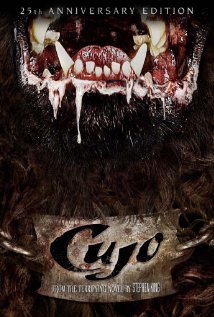
Book to Movie: Cujo (1983)


Book to Movie: Cujo (1983)
Screenplay by Don Carlos Dunaway and Lauren Currier
Based on a novel by Stephen King
Directed by Lewis Teague

Watch trailer here:

Stephen King’s Cujo had been on the shelf just a few months when the book was adapted for a short story. Most movies based on King’s books had done well on the big screen and nobody had yet made a truly bad movie based on a King work. It was a natural progression in the early and mid eighties for King novels to go right to the big screen.

Lewis Teague, just having finished directing the Stephen King anthology, Cat’s Eye, was drafted to do King’s dog movie.

Cujo the movie is essentially the same story as Cujo the novel. The screenwriters tinker at the margins of the story to make it better for the visual medium.

In the movie, we are immediately immersed in Donna Trenton’s (scream queen Dee Wallace) affair with Steve Kemp (played by Wallace’s real life husband, Christopher Stone). In the movie’s opening minutes, we see Donna stand up from Kemp’s bed and dress herself. Her visage is grim because of the guilt of the affair. It is here, in Kemp’s studio apartment Donna ends the affair in the movie version.

Kemp and Vic know each other because Vic delivers refinished furniture to the Trenton home. Early on, Vic has no idea there is an affair going on. Later, he spots Donna and Steve arguing outside of his apartment and gets the clue. His suspicions are confirmed when he comes home and finds Kemp in his kitchen, his wife crying, and broken eggs and glass on the floor.

Later, Vic drives off in his vintage Jaguar, leaving his wife in silence, heartbroken. He is off to try to save his business. She is left alone to wallow in guilt and remorse.

Just as in the book, the on evening excursion into town, the Pinto starts up again with its antics. Donna gets the car home and resolves to take it to Camber’s the next day.

Meanwhile, Gary and Joe Camber are getting theirs courtesy of Cujo – no longer the good dog.

The Pinto dies in the driveway. What transpires over the next 30 minutes is some of the most tense – and at times, tedious – movie making ever. Cujo is there to greet Donna and Tad. He is transformed from the fluffy, loveable St. Bernard to an evil looking beast with blood matted fur and a foam slathered face. Cujo tries to attack Donna as she approaches the garage looking for Camber.

Donna and Tad are trapped in the car and Cujo stands guard, waiting for his prey to die a slow death in the Detroit manufactured oven in which they are basting, or a much quicker, but painful death with their entrails dangling from his rabid jaws.

The makeup and effects people were in rare form when they shot the car scene because, even on the coldest winter night, one could not help but feel that stifling, muggy heat of a closed car on a summer day. For me, the viewing was more painful than pleasurable.

Eventually Vic is alarmed when his wife does not answer repeated phone calls. In the novel, his partner, Roger, is sympathetic and worried. In the movie, he’s narcissistic, pleading with Vic to stay and work on the campaign. Vic calls the authorities and heads for home.

Meanwhile, Donna resolves to try for the house. She can’t see Cujo. She doesn’t know where he is, but goes for it anyway. Cujo, lurking out of sight under the front bumper, pounces and bites deeply into her thigh. She barely makes it back to the car. She now is infected with rabies.

She and Tad swelter on. Tad now lives in a heat induced delirium.

Sheriff Bannerman is dispatched to the Camber home and Cujo greets him. They struggle and Bannerman drops his gun. While they struggle, Donna goes for the baseball bat lying off to the side of the car. Cujo and Donna Trenton square off. Tad Trenton’s life hangs in the balance.

Cujo attacks and Donna belts him across the head. He retreats and attacks again and Donna shatters his ribs and breaks the bat. Cujo is battered but not broken. He makes one final lunge. Donna thrusts the splintered handle of the bat upward, impaling Cujo on the wood. His teeth snap at her, just inches from her face. Then he fades. . .

She grabs Bannerman’s gun and breaks out the window of the house to let herself inside. She carries Tad in and starts showering him with cool water and trying to breathe life into him. Just as Tad responds, Cujo lunges through the window, making one last stab from Hell’s hot. Donna dispatches him with a bullet.

Just as this transpires, Vic shows up for a happy family reunion. There the movie ends.

I did care for this movie any more than I liked the book, but for different reasons. None of them have anything to do with the quality of the film. Dunaway and Currier did an excellent job of adapting King’s book to the screen and making the story work. Teague certainly created tension in his movie and the entire cast was solid.

I didn’t like the movie because it made me uncomfortable. I don’t mean it made me squeamish violated my core values. It made me physically uncomfortable. I felt as if I were dying of heat prostration just watching the last 30 minutes. The film left me feeling physically and emotionally exhausted. Perhaps that is a compliment to how well Teague directed the film. But I have no need to see this movie again.

The movie was well received upon its release in 1983, but it only rates 5.8 stars on IMDB. Perhaps it was more enjoyable viewing in the theater. Perhaps the casual viewer who didn't make a conscious effort to go to the theater and see it liked it less. For whatever reason, the movie's reputation has waned over time.

The obvious difference between book and movie is that Tad lives instead of dies. King fans may complain. Stephen King may complain (he did). But it had to be that way. Book readers are a different lot than movie goers. I didn’t care for Tad’s death in the book, but it works in literature. Unhappy endings work more often in books than in movies. Had Tad died, all those who went to see the movie and endured all that tension would have received no reward; no happy ending. After taking viewers through 30 minutes of mental anguish, there was no way Teague could have killed off Tad without movie goers being angry.

It was this movie rather than the book that injected the name, "Cujo" into our cultural lexicon. The name Cujo instantly stirs images of vicious dogs in the minds of people who’ve never read a King book and shun horror movies. Such was the impact of this movie.

There are those who enjoy movies where the tension is steady and long. I’m not one of them. I hesitate recommending this movie for that reason. If you are someone that does enjoy that kind of movie. Teague delivers a first rate motion picture.

Wednesday, June 8, 2011

Book to Movie: The Dead Zone (1983)


Book to Movie: The Dead Zone (1983)
Screenplay by Jeffery Boam
Directed by David Cronenberg

It was about 1983 that movies based on the works of Stephen King really became a hot commodity. The Dead Zone, Cujo, and Christine were all made into movies in 1983 with Children of the Corn and Firestarter following in 1984. During this time, screenwriters took liberties with King’s stories and usually made them work in the visual medium.

Jeffery Boam uses the ideas and concepts of King’s book. The movie captures the essence of King’s tale. However, he tells a different story. As I noted in my review of the book, this story was a tragedy. Boam tells King’s tale in a four act screenplay.

Sarah and Johnny – played exceptionally by Christopher Walken -- are planning to get married as the movie opens. They return home from the carnival where nothing happens. Sarah invites Johnny in to spend the night. The virtuous Johnny says he wants to put off sex until after marriage. They say goodnight and Johnny drives off into the night.

As he’s headed home in his yellow Volkswagen Beetle, a milk truck overturns in front of him and he collides with it. Sweet, wholesome milk does in sweet, wholesome Johnny Smith.

Johnny awakes in a private clinic run by his doctor, Sam Weizak. Almost five years have passed and he is stunned and heartbroken to hear that Sarah has moved on and gotten married.

Johnny’s first precognitive event is a great deal different in the movie and too melodramatic. Instead of just telling his therapist her house is on fire, as he does in the book, Johnny tells the therapist that her child’s bedroom is on fire with the child in it. The call for help is placed and Johnny saves the day!

His parents come to see him. We get hints of Johnny’s mother’s religious mania, but it is never developed. Sarah stops in also to tell Johnny of her life with her new husband and baby. She shares Johnny’s sorrow for their lost and doomed relationship.

Johnny returns home and tries to rebuild his life. His mom is now dead and he and his dad live alone in the country. One day, out of the blue as Johnny is splitting wood, Sarah shows up unexpectedly. They have lunch and when Sarah’s son falls asleep, they make love. They have dinner with Johnny’s dad, then Sarah leaves, making it clear that, after their love was consummated, she was moving on with the life she’d made for herself, without Johnny.

That is the chief emotional difference between the book and the movie. In the book, when Sarah and Johnny made love, Sarah made it clear it was a single act that was to suffice to make up for what was lost. It was ritualistic, and it was emotionally uplifting.

In the movie, the scene plays out as if Sarah is trying to absolve herself of something. She is quick to cut off Johnny’s pleas to see her again. She is done with him. She’s done her best to make it right. The scene in the movie is a downer.

Here ends Act One

Sheriff Bannerman of Castle Rock pays Johnny a visit. Driving him is the young deputy, Frank Dodd. Bannerman makes his plea for assistance and Johnny rejects his request and tells him to leave. But after hearing of another murder and pressure from his father, Johnny gives in and agrees to meet with Banner.

In the book, Johnny first handles the cigarette pack in the station where he can’t get anything. When he visits the crime scene is where he’s able to figure out Frank Dodd is the killer. In the movie, they are visiting the crime scene of the last murder when they are called to yet another murder that has just happened. Deputy Dodd drives them there and is then dispatched to handle crime control.

Johnny hovers over the spot in the town gazebo where the girl was killed and identifies Dodd as the killer. Dodd has taken the sheriff’s car and has headed for home. Bannerman and Johnny go to the house where they find Frank Dodd dead in the bathroom by his own hand.

The scene where Bannerman and Johnny close in on Dodd is the best part of the movie. Dodd’s mother is played exactly like Norman Bates’ mother and one can’t help but believe that King delved deeply into Robert Bloch’s Psycho inasmuch as he tapped Bram Stoker for ‘Salem’s Lot. The fifties, little boy cowboy motif of Frank Dodd’s bedroom and in the dilapidated house is a creepy setting suitable for a Stephen King movie. The brief interaction between Walken and Colleen Dewhurst who played Dodd’s mother is intense.

Here ends Act Two

As in the book, Johnny gets a job tutoring the son of a rich industrialist. But this story line plays out entirely differently than it does in the book.

As Johnny enters the Stuart home, he is introduced to Greg Stillson who is running for the U.S. Senate. Roger Stuart promises to consider a large donation to the Stillson campaign, but later tells Johnny that the guy is a buffoon – but a buffoon who will probably get elected.

Johnny agrees to tutor Stuart’s son, Chris. Chris is shy and struggles with school work. Johnny tutors him in reading and also works to build the kid’s self esteem. Roger is pleased with the progress. To reward Chris, Roger decides to form a hockey team, purchase the equipment, and coach it.

When Roger arrives at the home with the hockey gear, Johnny touches it and gets a premonition of the boys falling through the ice and sinking to the bottom of the pond (instead of being trapped in a burning building). Johnny frantically begs Roger Stuart to cancel the hockey practice. Johnny’s behavior scares Chris who also begs his dad to call it off. Disgusted and angry, Roger agrees. But Johnny is told his services are no longer needed.

Here ends the Third Act.

There is a knock at Johnny’s door and there to greet him is a Greg Stillson supporter going door to door for the campaign. As Johnny talks to him, his long lost Sarah walks up and introduces the campaign worker as her husband. The meeting is slightly awkward.

Greg decides to cross the street to the park and hear what Stillson has to say and see what makes him so charismatic and engaging. He greets Stillson as he approaches the stage. The two shake hands. Johnny gets hit with a terrifying image.

President Stillson is in his bunker. Before him is a general, reluctant to place his hand on a palm scanner and authorize a nuclear strike. Stillson is dressing him down for his cowardice when the Secretary of State bursts into the room, claiming that a diplomatic solution has been achieved. Stillson ignores them and launches the missiles, reveling in his triumph and his place in history.

When the two separate, both are stunned. Stillson staggers toward the stage, terrified by his new knowledge. A few days later, he asks Dr. Wiezak if he were given the opportunity, would he kill Hitler in his infancy. Without a moment of moral reflection Wiezak declares that he would.

This was where the movie is weakest. When asked in the book, Dr. Wiezak is concerned that Johnny has asked the question. He reflects before admitting that he would kill Hitler given the opportunity. In the movie, it appears almost as if Dr. Wiezak, whom Johnny has told of his Stillson vision, is compelling Johnny to act. Wiezak’s character is developed enough in the book and the movie for us to know he would not be so reckless in answering such a macabre hypothetical question asked of a man who is experiencing nervous and mental difficulties.

Greg decides to act. He acquires a sniper rifle and breaks into the town hall, hiding in the gallery. He is awakened by the entry of Stillson’s people when they enter to set up for the rally. He locks, loads, and waits. Stillson arrives and works his way to the stage.

Johnny jumps up and takes two shots, missing with both. As in the book, Stillson grabs a child and uses him for a shield. In the movie, it’s Sarah’s child who is at the rally with mom. Johnny recognizes her and her child just as a bullet from a Stillson body guard takes him in the chest. He falls from the balcony to the floor.

In the pandemonium, Stillson approaches the dying Johnny and asks, “Who are you?” Johnny grabs his hand. He sees Stillson, looking at the cover of Newsweek bearing the photo of him using the child as a shield. He takes a swig of whiskey and blows his brains out with a revolver. Johnny is satisfied he’s saved humanity.

Sarah comes over to him and weeps over his stricken body. As he dies, she tells him, “I love you.”

Although much different in the telling than the book, I thought Boam’s script was a tremendous rewrite of a book that would have been incredibly dull by direct transfer to screen.

This was before Christopher Walken had developed a reputation for playing crazy people, so his portrayal of vanilla Johnny Smith is believable and at times, superb.

King wrote many books better than The Dead Zone and many movies based on King’s work were better than The Dead Zone. However, many more were much worse. In the dozens of King’s works to be adapted to the visual medium, The Dead Zone certainly ranks as above average, but not anywhere near the best.